
Author: Emily Rassam

Texas Capital Gains Tax: Everything You Need to Know

texas capital gains
Key Takeaways:
  • Texas doesn’t tax capital gains, but the federal government does. If you live in Texas and sell an appreciated asset for a profit, you may owe federal capital gains tax depending on what you sell, how long you’ve owned it, and your taxable income.
  • The amount an asset has gone up in value isn’t necessarily the amount you’ll be taxed on. Your taxable gain is generally based on the difference between what you receive from the sale and your adjusted tax basis, which starts with what you paid for the asset and may change over time based on factors such as improvements, expenses, and depreciation.
  • What you’re selling matters. Stocks, real estate, business interests, cryptocurrency, inherited or gifted assets, and other investments can come with different tax rules and considerations.
  • Planning ahead may give you more options. Timing a sale, selling gradually, using capital losses, donating appreciated assets, and planning large transactions in advance are some strategies that may help you minimize the amount of federal tax you owe.

Texas is one of a handful of states that doesn’t tax capital gains at the state level. It also doesn’t have a personal income tax. 

That means if you’re a Texas resident and you sell stocks, real estate, a business, cryptocurrency, or other appreciated assets for more than you paid, the state won’t tax the profits.

Federal taxes are a different story.

Depending on what you’re selling, how long you’ve owned it, and your taxable income, you may still owe federal capital gains taxes. 

The good news? Understanding the rules before you sell can help you plan ahead and avoid unexpected tax consequences. 

Here’s what you need to know about capital gains taxes in Texas.

Is There a Capital Gains Tax in Texas?

The short answer is no. If you’re a Texas tax resident, you don’t have to pay a Texas capital gains tax when you sell an appreciated asset. 

Texas doesn’t tax profits from selling stocks, real estate, a business, cryptocurrency, private investments, or other assets.

But federal capital gains taxes may still apply when you sell an asset for more than it’s worth for tax purposes, known as your tax basis. 

Your tax basis is generally what you paid for the asset, adjusted for certain costs or other factors. (We’ll cover how tax basis works later in this guide.)

That’s why the phrase “Texas capital gains tax” can be confusing. 

While Texas doesn’t tax capital gains at the state level, the federal government may still tax all or part of your gain. 

In other words, the state tax may be zero, but your federal tax bill could still be significant.

One advantage of living in Texas is that you don’t have to worry about paying both federal capital gains tax and Texas state income tax on the same gain. 

In many other states, both may apply. 

Moving to Texas Doesn’t Always Mean Zero State Tax

If you’re moving to Texas from another state, don’t assume that establishing Texas residency automatically eliminates state income tax on every future capital gain. 

In some situations, your former state may still tax a gain based on when the sale occurs, where the asset is located, or how the income was earned.

For example, a former state may still tax:

  • A sale completed before you become a Texas resident. If you sell appreciated investments while you’re still a resident of your former state, that state may tax the gain even if you move to Texas shortly afterward.
  • Real estate located in your former state. If you move to Texas but continue to own a rental property, vacation home, land, or other real estate in your former state, that state will generally continue to tax the gain when you sell the property because the income is sourced to where the property is located.
  • Certain equity compensation earned while working in your former state. Stock options, ESPPs, RSUs, and other forms of equity compensation can have different state tax rules. A portion of the income may remain taxable by the state where the underlying services were performed, even after you move to Texas.
  • Installment-sale income from certain assets. If you sell an asset before moving and receive payments over several years, your former state may continue to tax income from the sale depending on the asset and the state’s sourcing rules.
  • Certain business or partnership interests. Gains from selling an interest in a business or partnership can have state-specific sourcing rules, particularly when the business owns real property or operates in the former state.

The rules vary significantly by state and by asset type. The timing of your move alone isn’t always enough to determine whether another state can tax a gain. If you’re planning a move to Texas around a large liquidity event, review the transaction and your residency status before the sale occurs.

What Creates a Federal Capital Gain?

A capital gain doesn’t happen simply because an asset you own has gone up in value. 

In many cases, you create a capital gain when you sell or otherwise dispose of an asset for more than your adjusted tax basis, which is generally what the IRS considers your cost for tax purposes.

For example, imagine you purchased shares of a fast-growing technology company for $10,000. Over several years, those shares grew in value to $25,000. 

Even though your investment has gained value, you generally don’t owe capital gains tax until you sell it and lock in the gain.

Your taxable gain generally depends on the difference between what you receive from the sale and your adjusted tax basis. 

For many assets, your tax basis starts with what you originally paid. Over time, however, that number can change.

Capital improvements, reinvested dividends, depreciation, inherited or gifted assets, and other adjustments can all affect your adjusted tax basis—and ultimately how your gain is calculated for tax purposes.

That’s why it’s so important to keep good records for any appreciated assets you own.

The following sections explain some of the common situations that can increase or decrease your tax basis and why those adjustments matter when it’s time to sell.

Realized and Unrealized Gains

As long as you continue to own an asset, any increase in its value is considered an unrealized gain because it hasn’t yet been triggered by a sale or other taxable transaction.

Let’s go back to our earlier example. Those shares of a fast-growing technology company you purchased for $10,000 are now worth $25,000. On paper, you’ve made a $15,000 profit.

But as long as you continue to own those shares, you don’t owe capital gains tax.

Once you sell those shares and lock in the $15,000 profit, that unrealized gain becomes what’s known as a realized gain

That’s when federal capital gains taxes may apply for Texas residents. 

Selling shares of stock, closing on the sale of real estate, selling a business interest, exchanging certain assets, or liquidating part of a taxable investment portfolio are all common taxable events that can create a realized gain.

Adjusted Basis and Net Sale Proceeds

In many cases, calculating a taxable gain on an appreciated asset isn’t as simple as subtracting the original purchase price from the sale price.

When calculating a capital gain, the IRS starts with what you paid for the asset and then adjusts that number over time to account for certain events. The result is your adjusted tax basis.

Depending on the asset, capital improvements, reinvested dividends, depreciation, inherited or gifted basis, and other prior tax adjustments can all affect your adjusted tax basis and, ultimately, the gain or loss you report when you sell the asset.

The amount you actually receive from the sale matters, too. 

Net sale proceeds are what you receive after certain selling expenses (i.e., commissions, closing costs, etc.) have been deducted. Your taxable gain is based on the difference between your net sale proceeds and your adjusted tax basis.

It’s important to distinguish between an asset’s appreciation and your taxable gain. 

An asset may increase substantially in value over time, but your adjusted tax basis helps determine how much of that appreciation is considered taxable gain when you sell.

For example, imagine you purchase a rental property for $300,000. Over the next 10 years, you spend $50,000 on replacing the roof and remodeling the kitchen. 

Those capital improvements don’t automatically increase the property’s market value by $50,000, but they may increase your adjusted tax basis by that amount. That means, for tax purposes, your adjusted tax basis could increase from $300,000 to $350,000.

If you later sell the property for $500,000, the property has appreciated by $200,000. But because your adjusted tax basis is $350,000, your taxable gain may be only $150,000.
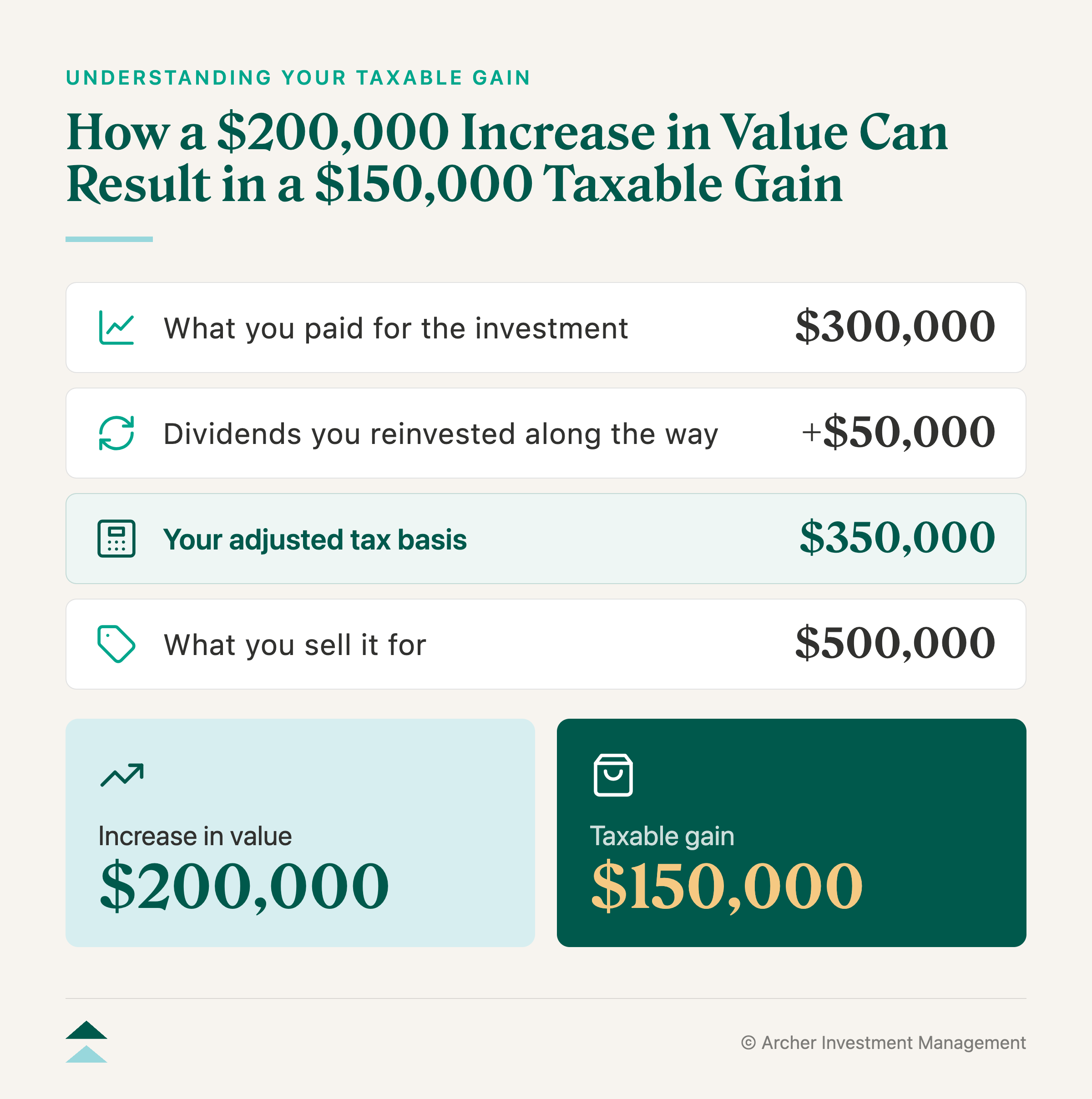
Taxable Gain in Texas

It’s also important to keep complete records to make sure you’re accurately reporting your taxable gain on an appreciated asset. 

That includes documents showing what you paid for the asset, such as settlement or brokerage statements, records of qualifying improvements or reinvestments, and documentation of selling expenses.

If you can’t document increases to your adjusted tax basis, you may not be able to include them when calculating your gain. That could make your taxable gain appear larger than it actually is, potentially causing you to pay more tax than necessary. 

Incomplete records can also make it more difficult to support the numbers reported on your tax return if questions come up later.

Short-Term and Long-Term Treatment

The length of time you’ve owned an asset before selling it can have a significant impact on how it’s taxed. 

Under federal tax rules, capital gains are classified as either short-term or long-term.

Assets held for one year or less before they’re sold typically are treated as short-term capital gains. Assets held for more than one year usually are treated as long-term capital gains. 

Because long-term capital gains tax rates are often lower than the rates that apply to short-term gains, the timing of a sale can make a meaningful difference in how much tax you’ll pay.
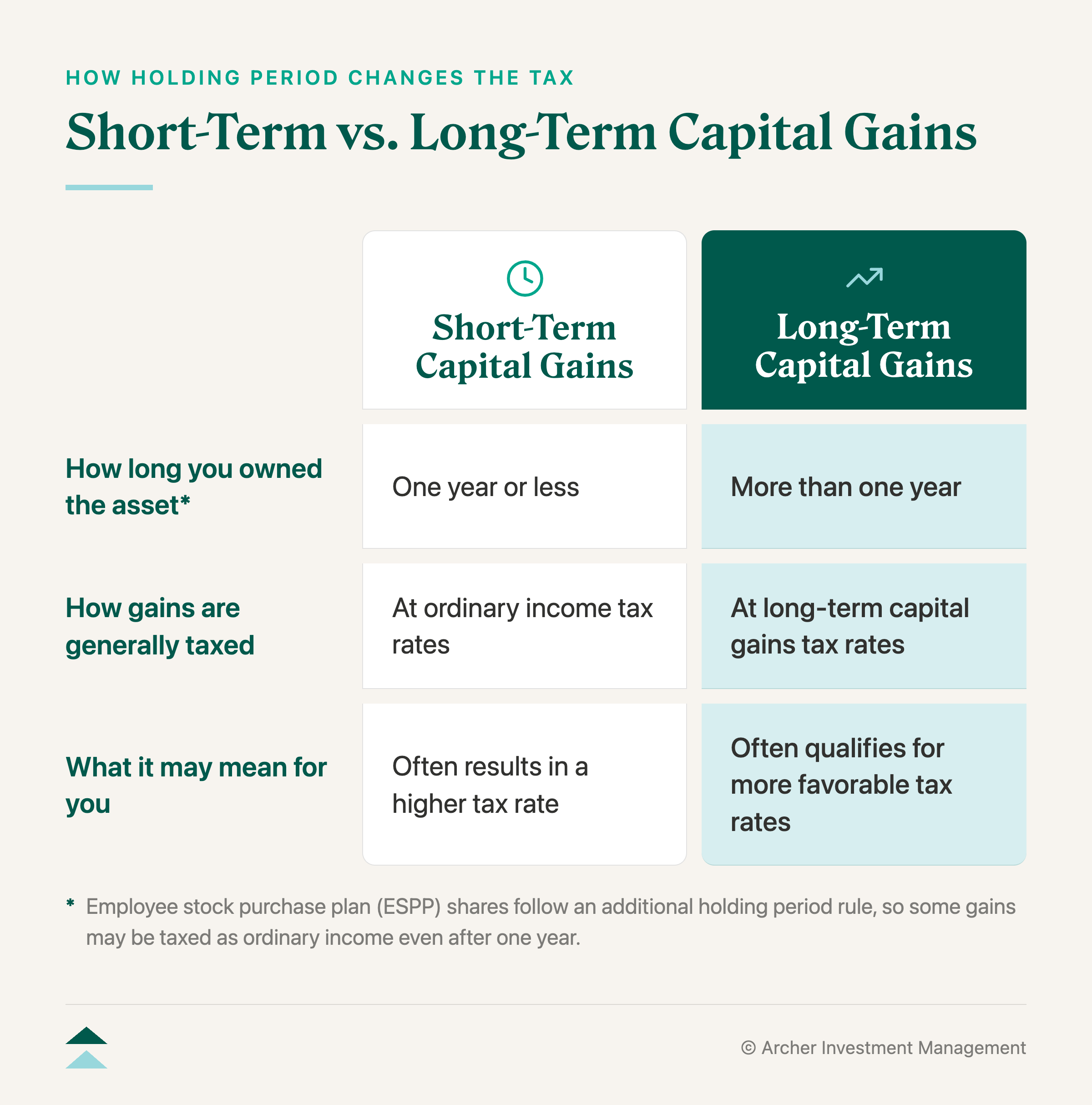
long-term capital gains

If you’re planning to sell an appreciated asset, it’s worth reviewing how long you’ve owned it before completing the transaction. Waiting a few days or weeks to qualify for long-term treatment could reduce your tax liability, depending on your situation. 

Of course, taxes are only one consideration. Your cash needs, investment goals, and overall financial plan may make selling sooner a better choice.

Capital Losses

If you sell a taxable investment for less than its value for tax purposes, you may have a capital loss instead of a capital gain.

Capital losses offset capital gains dollar for dollar, potentially reducing the amount of gain that’s subject to tax. Capital losses can also offset up to $3,000 of active income each year, and any leftover losses can carry forward into future tax years until they’re fully used up.

For example, say you sell an investment and realize a $15,000 capital gain, then sell another and realize a $9,000 capital loss. The $9,000 capital loss offsets a portion of the $15,000 gain, leaving a remaining gain of $6,000, which may be taxable.

Whether it makes sense to realize a capital loss depends on your overall financial picture, not just the tax impact. A financial professional or tax advisor can help you evaluate your options.

Common Assets That Create Capital Gains Questions for Texas Residents

If you sell an investment or other appreciated asset for a profit, you may owe federal capital gains tax.

The details, however, can vary depending on the asset. 

Selling stocks isn’t the same as selling a rental property, a business, or cryptocurrency. Different assets may have different recordkeeping requirements, exclusions, and reporting rules.

In the sections below, we’ll look at some of the common assets that raise federal capital gains tax questions for Texas residents.

Taxable Investment Accounts

Many people own stocks, mutual funds, exchange-traded funds (ETFs), and bonds through a taxable brokerage account.

If you sell one of these investments for a profit, you may owe federal capital gains tax. The amount depends on several factors, including how long you owned the investment and your overall tax situation.

Mutual funds work a little differently because they’re professionally managed portfolios that pool money from many investors. Instead of deciding when to buy and sell investments yourself, a fund manager makes those decisions on behalf of the fund’s investors. 

If the manager sells investments at a profit, you may receive what’s known as a capital gain distribution. That distribution may be taxable even though you didn’t personally sell your mutual fund shares.

Primary Homes and Real Estate

Selling your primary home (the home you live in) doesn’t always mean you’ll owe federal capital gains tax. You may qualify to exclude up to $250,000 of capital gain from federal tax, or up to $500,000 if you’re married and file a joint tax return.

In general, you qualify for the primary residence exclusion if you owned and lived in the home as your primary residence for at least two of the five years before the sale. 

If you don’t meet these requirements, or your gain exceeds the exclusion amount, part of your gain may still be taxable.

Real estate investors face different considerations. Selling rental properties, vacation homes, land, ranches, and other properties often requires additional calculations to determine your taxable gain.

Improvements you’ve made over the years, depreciation claimed on rental property, certain closing costs, and other adjustments may all affect how much of your profit is ultimately taxable. 

Because property sales often involve additional tax rules and calculations, consider talking with a financial professional or tax advisor before you sell.

Business Interests and Private Investments

Business interests can take several forms, including ownership, a partnership interest, private company stock, or startup equity. 

Depending on the asset being sold, the transaction may be treated as capital gains, ordinary income (taxed at the same rates as your wages), or a combination of both. 

Capital gains are generally taxed at lower federal tax rates than ordinary income, which can meaningfully impact how much you keep (or don’t) after taxes.

When selling a business, its legal structure and the structure of the sale can also affect its tax treatment. 

For example, the purchase price may be divided among different business assets. Amounts allocated to inventory, for example, may be taxed as ordinary income, while amounts allocated to the value of the business’s reputation and customer relationships (often called goodwill) or stock may qualify for capital gains treatment.

Whether payments are received all at once or over several years, whether part of the proceeds are held in escrow, and the timing of the sale closing may also affect the type of tax you owe and when you have to pay it.

Cryptocurrency, Collectibles, and Nontraditional Assets

Cryptocurrency, collectibles, precious metals, art, and other nontraditional assets may be subject to different federal tax rules than traditional investments. 

While selling these assets can create taxable gains, some transactions that don’t look like a traditional sale can also have tax consequences.

For example, because the IRS treats cryptocurrency and other digital assets such as Bitcoin and stablecoins as property rather than currency, using them to buy goods or exchanging one cryptocurrency for another may create a taxable event. 

Collectibles, such as artwork, antiques, rare coins, and precious metals, may also be taxed differently than stocks and other traditional investments, depending on the asset type and how long you’ve owned it.

Keeping detailed records showing when you acquired the asset, what you paid for it, and what you received when you sold or exchanged it can help you accurately calculate and report any taxable gain to the IRS.

Inherited and Gifted Assets

An inherited asset is property you receive upon someone’s death. A gifted asset is property someone gives you during their lifetime. 

Although selling either type of asset can create a capital gain, the IRS uses different rules to calculate that gain.

For inherited assets, the basis is generally reset to the property’s fair market value at the date of death.

For example, imagine your aunt bought a house 30 years ago for $150,000. You inherit the house when she dies. At that time, it’s worth $500,000. 

In many cases, your basis is “stepped up” to the fair market value; in this case, $500,000. If you sell the home later for $550,000, your taxable gain is typically based on the $50,000 it increased in value after you inherited it.

Gifted assets often retain the original owner’s basis, or the amount they paid when they bought it. 

Using the same example, let’s say your aunt gifted you the house while she was still alive. In that case, your basis would be the $150,000 she originally paid for it.

If you sold the home later for $550,000, your taxable gain would be based on the $400,000 increase in value over your aunt’s original basis.

capital gains on inheritance

Before selling inherited or gifted real estate, securities, business interests, or other appreciated property, confirm the basis that will be used to calculate your capital gain. 

For inherited assets, keep records such as a date-of-death appraisal or other documents showing the asset’s value when you inherited it. 

For gifted assets, keep any records from the original owner showing what they paid for the asset and any information that helps establish the asset’s basis. 

Having the right documentation can help you accurately calculate and report any taxable gain.

Closely Related Taxes and Costs That Are Not Texas Capital Gains Tax

Although Texas doesn’t tax capital gains, you may still encounter other taxes and costs when you sell an appreciated asset.

Knowing which taxes and costs may apply can give you a clearer understanding of how much you’ll actually keep from the sale.

Net Investment Income Tax

If you’re a higher-income taxpayer, you may also owe the federal Net Investment Income Tax (NIIT), an additional 3.8% tax on certain investment income, including capital gains.

The NIIT is separate from the federal capital gains tax and is not a Texas state tax.

Whether the NIIT applies depends on your income and other factors, so be sure to account for it when estimating the amount of tax you may owe on a sale.

Depreciation Recapture

If you sell rental property, business property, or another depreciated asset, you may owe more than the typical federal capital gains tax.

In some cases, part of your gain may be subject to depreciation recapture, a separate federal tax rule that generally applies when you’ve claimed depreciation deductions on the asset over time.

If you’ve claimed depreciation over the years, review your depreciation history before estimating your proceeds after taxes.

A financial professional or tax advisor can help you understand how these rules apply to your specific situation.

Ordinary Income Items in a Sale

When you sell a business, receive equity compensation, or exit an investment, you might assume every dollar you receive will be taxed as a capital gain. 

However, different parts of the transaction may be taxed differently.

For example, compensation income, inventory, accounts receivable, certain contract rights, and retirement account distributions may be treated as ordinary income rather than capital gains for tax purposes.

Knowing how each part of the transaction is taxed can give you a better idea of how much you’ll actually keep and help you avoid surprises at tax time.

Property Taxes, Closing Costs, and Transaction Expenses

When you sell an asset, you may also pay Texas property taxes, title fees, broker commissions, legal fees, and other transaction costs. 

These expenses are separate from the federal capital gains tax, even though they may arise as part of the same transaction.

Some of these costs may affect your capital gain, while others simply reduce the amount of money you receive from the sale. 

For example, broker commissions may reduce the capital gain you report on an investment sale for tax purposes. Others, such as property taxes, are separate expenses that can reduce how much you ultimately keep from the sale of a home.

Looking at taxes and transaction costs together can give you a more realistic estimate of what you’ll walk away with after the sale.

Ways Texas Residents Can Manage Federal Capital Gains Exposure

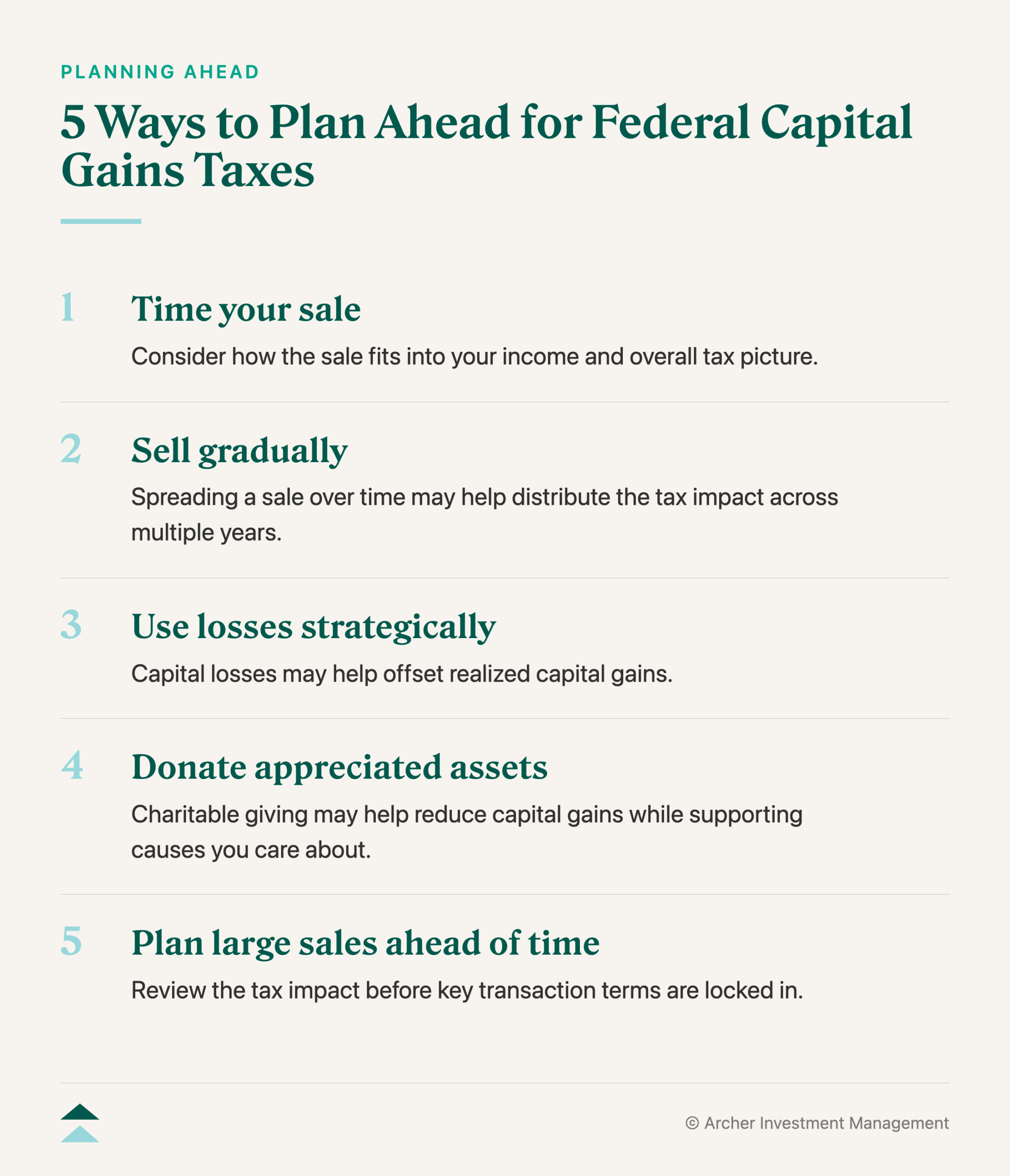
Once you understand how federal capital gains taxes work, the next step is deciding how to plan for them.

Because Texas doesn’t have a state capital gains tax, many capital gains tax planning strategies for Texas residents focus on federal tax rules.

Before selling an appreciated asset, consider how it could affect your income, taxes, investments, cash needs, charitable goals, and other financial priorities.
federal capital gains taxes

Timing a Sale Around the Full Tax Picture

The timing of a sale can influence the amount you may pay in federal taxes in a given year.

Depending on your circumstances, you may benefit from selling during a lower-income year, spreading sales across multiple years, or coordinating a sale around retirement, bonuses, business income, or significant deductions.

Instead of looking at the capital gain by itself, consider how the sale fits into your overall tax picture for the year.

Selling Gradually Instead of All at Once

Selling an appreciated asset over time instead of all at once may help spread the tax impact across multiple years while gradually creating access to cash.

It can also reduce concentration risk if a large portion of your wealth is tied up in a single investment or appreciated asset, such as company stock.

Using Capital Losses Intentionally

If some of your investments have declined in value, you may consider tax-loss harvesting. This strategy involves selling investments at a loss to help offset capital gains. 

If your investment losses exceed your gains, you may be able to use up to $3,000 per year to offset ordinary income from your regular earnings on your federal tax return, and any remaining losses can generally be carried forward to future tax years.

Keep in mind taxes are only one consideration when deciding whether to sell an investment at a loss.

Donating Appreciated Assets

If charitable giving is important to you, consider donating appreciated long-term securities or other eligible assets directly to causes you care about. 

That way, you may be able to avoid paying capital gains tax on the appreciation, as opposed to selling the assets and donating the cash to charity. 

You may also qualify for a charitable tax deduction if you itemize.

In addition to potential tax benefits, donating appreciated assets may help diversify your portfolio and reduce concentrated exposure to any single investment. 

Structuring Large Sales Before Terms Are Final

The structure of a business sale, real estate transaction, installment sale, or private investment exit can meaningfully affect how much you owe in federal taxes. 

Once the payment schedule, sale structure, and other key terms are locked in, some strategies for minimizing tax impacts may be off the table. 

Reviewing the proposed transaction and negotiating terms where appropriate can give you more flexibility and help you avoid tax surprises once the sale is finalized.

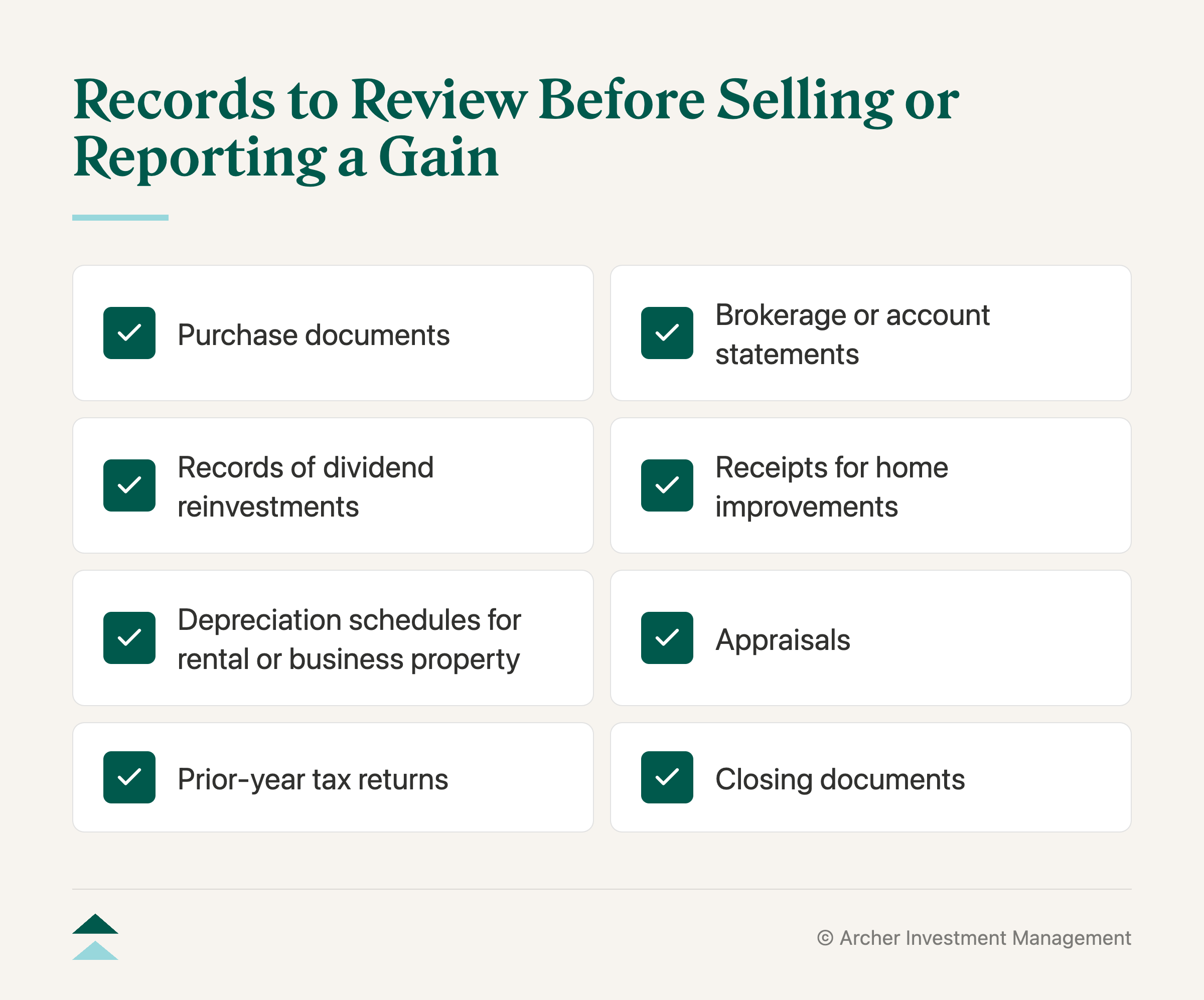
Records to Review Before Selling or Reporting a Gain

Before selling an appreciated asset or reporting a capital gain, review the records related to the purchase, ownership, and sale. 

Keeping accurate records helps you estimate how much you may owe in federal taxes before the transaction and report the sale correctly on your tax return afterward.

The records you’ll need depend on the type of asset you’re selling.
capital gains tx

Missing or incomplete records can make it difficult to calculate your adjusted tax basis accurately. That could lead to reporting a larger gain than necessary, underpaying taxes, filing delays, or confusion about what belongs on your federal tax return.

Reviewing your records can also help you estimate how much money you’ll have available after taxes, determine whether you may need to make estimated federal tax payments, and understand how the sale could affect your annual tax obligation.

Good recordkeeping isn’t just administrative. It can directly affect the capital gain you report and how much you may ultimately keep from the sale.

Capital Gains Taxes in Texas FAQs

Is there a capital gains tax in Texas?

No. Texas does not impose a state capital gains tax. 

However, Texas residents may still owe federal capital gains tax when they sell appreciated assets such as stocks, real estate, business interests, or other investments.

Do Texas residents still pay federal capital gains tax?

Yes. Even though Texas doesn’t tax capital gains, federal capital gains tax may still apply. 

The amount you may owe depends on factors such as your taxable income, how long you owned the asset, and the type of asset you sold.

What is the difference between short-term and long-term capital gains?

Short-term capital gains apply to assets held for one year or less and are usually taxed at the same rates as wages and other ordinary income. 

Long-term capital gains apply to assets held for more than one year and often qualify for lower federal tax rates.

Do I owe capital gains tax when I sell my Texas home?

Not always. Some homeowners may qualify to exclude up to $250,000 of capital gain from federal tax, or up to $500,000 if they’re married and file jointly, if they meet IRS ownership and use requirements. 

If the gain exceeds those limits or the property doesn’t qualify, federal capital gains tax may apply.

Are gains from stocks, mutual funds, and cryptocurrencies taxable for Texas residents?

They can be. Although Texas doesn’t have a state capital gains tax, selling appreciated stocks, mutual funds, cryptocurrency, or other investments may trigger federal capital gains tax, depending on your circumstances.

Can capital losses reduce the tax owed on capital gains?

Yes. Capital losses can offset capital gains for federal tax purposes.

If your losses exceed your gains, you may also be able to use a limited amount to offset ordinary income, such as wages, each year and carry any remaining losses forward to future tax years.

What records should I review before selling appreciated assets in Texas?

Review records that help establish your adjusted tax basis, which generally starts with what you paid for the asset and may change based on certain expenses, improvements, or other adjustments.

Depending on the type of asset, these records may include purchase documents, account statements, dividend reinvestment history, receipts for home improvements, depreciation schedules, appraisals, prior tax returns, and closing documents. 

Keeping complete records can help you estimate how much you may owe in federal taxes before a sale and report the transaction accurately afterward.

Get Help Planning Around Capital Gains Taxes in Texas

While Texas doesn’t have a state capital gains tax, federal capital gains tax may still apply when you sell an appreciated asset.

The timing, structure, and type of asset you’re selling can all affect how much of the proceeds you end up keeping.

Whether you’re selling investments, real estate, a business, inherited property, or another appreciated asset, understanding the potential tax impact before you sell can help you plan ahead and potentially keep more of the profits.

That’s where we come in.

Our team can help you estimate the potential federal tax implications of a sale, compare different sale scenarios, and evaluate strategies that may help reduce the tax impact.

We’re also here to talk through how the sale fits into your broader financial plan.

If you’re thinking about selling an appreciated asset and want to understand how the transaction could affect your tax situation, schedule a complimentary consultation.

Disclosure: Tax estimates and projections are based on information available at the time of analysis and are subject to change. Archer Investment Management does not provide legal or tax advice. Clients should consult their tax professional regarding their specific circumstances.

This article is for general educational purposes only and is not individualized tax, legal, or investment advice. Tax rules are complex and can change, and outcomes depend on your specific situation. You should consult your CPA and/or attorney regarding your circumstances. Archer Investment Management is an SEC-registered investment adviser; registration does not imply a certain level of skill or training. Investing involves risk, including the possible loss of principal. 

 

How Austin’s Tech Companies Structure Equity Compensation: What to Know About RSUs, ISOs, NSOs, and ESPPs

equity compensation in austin texas
Key Takeaways:
  • RSUs, ISOs, NSOs, and ESPPs all provide company equity, but they work—and are taxed—very differently. Understanding those differences can help you make more informed financial decisions about your equity compensation.
  • Timing matters. Vesting schedules, exercise decisions, and holding periods can all affect the value of your equity compensation and the taxes you may owe.
  • Your equity compensation should support your broader financial goals. A thoughtful strategy can help you manage risk, navigate taxes, and make the most of the opportunities your employer provides.

Home to fast-growing startups, established technology companies, and a thriving AI sector. Austin has become a leading technology hub, ranking as the fifth-largest tech talent market in North America in 2025. With Austin’s tech boom fueling competition for skilled professionals, equity compensation now plays an increasingly important role in how employers here attract, reward, and retain talent.

If you’ve accepted a job with an Austin tech company, there’s a good chance your pay package includes equity compensation—a chance to share in the company’s future success through stock awards or stock purchase opportunities.

If you’re evaluating a new job offer, it’s also worth knowing that equity compensation may be negotiable. While salaries often receive the most attention during offer discussions, some employers may have flexibility around equity awards, vesting terms, signing bonuses, or other compensation components.

For many employees, equity comp can become one of the most valuable parts of their overall financial picture. 

In some cases, it can create life-changing wealth. However, you typically don’t receive all of it at once. Instead, those shares become yours gradually through a process called vesting, which means you earn ownership over time as you continue working for the company or meet specific performance goals.

Most Austin tech companies rely on four common forms of equity compensation, although the type you’re offered depends on the company and your role:

  • Restricted Stock Units (RSUs)
  • Incentive Stock Options (ISOs)
  • Non-Qualified Stock Options (NSOs)
  • Employee Stock Purchase Plans (ESPPs)

Each equity comp program works differently. They have different tax rules, risks, and opportunities for building long-term wealth. The good news is that you don’t need to become an expert to understand your options. 

Learning how different equity compensation programs work can help you navigate your choices with greater confidence and make the most of the opportunities available to you.

In this comprehensive guide to stock options, we’ll walk through how RSUs, ISOs, NSOs, and ESPPs work, how they’re commonly used by Austin tech companies, and what you should know about vesting, taxes, and long-term financial planning so you can feel more confident making decisions about the equity you’ve earned.

Equity Compensation in Austin’s Tech Scene: The Basics

Why do so many Austin tech companies offer equity compensation instead of simply paying higher salaries? 

Equity compensation gives employees an opportunity to share in the company’s success while helping employers compete for top talent.

Equity compensation can be especially valuable in the technology industry, where companies often focus on future growth. 

Early-stage startups may not have the cash flow to offer the highest salaries, but they can make compensation packages more competitive by offering equity with the potential to appreciate over time. 

More established companies often continue to offer equity comp as a way to reward employees, encourage retention, and keep compensation competitive.

Austin’s technology sector includes companies at every stage of growth, from venture-backed startups to publicly traded corporations, so equity compensation packages can vary considerably from one employer to the next. 

Most companies rely on one or more common types of equity compensation, and the mix often changes as a company grows.

  • Early-stage startups often grant stock options, such as Incentive Stock Options (ISOs) or Nonqualified Stock Options (NSOs), giving employees the opportunity to purchase company stock at a predetermined price after meeting certain vesting requirements.
  • Growing and later-stage private companies often continue offering stock options while some also introduce Restricted Stock Units (RSUs) as they mature and prepare for a potential IPO or acquisition.
  • Public companies commonly provide Restricted Stock Units (RSUs) and Employee Stock Purchase Plans (ESPPs), enabling eligible employees to purchase company stock through payroll deductions, often at a discount. Some may also continue to offer stock options.

Understanding how each type of equity comp works can help you evaluate your compensation package and plan for the opportunities—and responsibilities—that come with owning company stock.

RSU vs. ISO vs. NSO vs. ESPP Programs for Austin Tech Companies

Although RSUs, ISOs, NSOs, and ESPPs are all common forms of equity compensation, they differ in how employees acquire shares, their tax treatment, and the level of flexibility they provide.

equity compensation

Restricted Stock Units (RSUs): How They Work

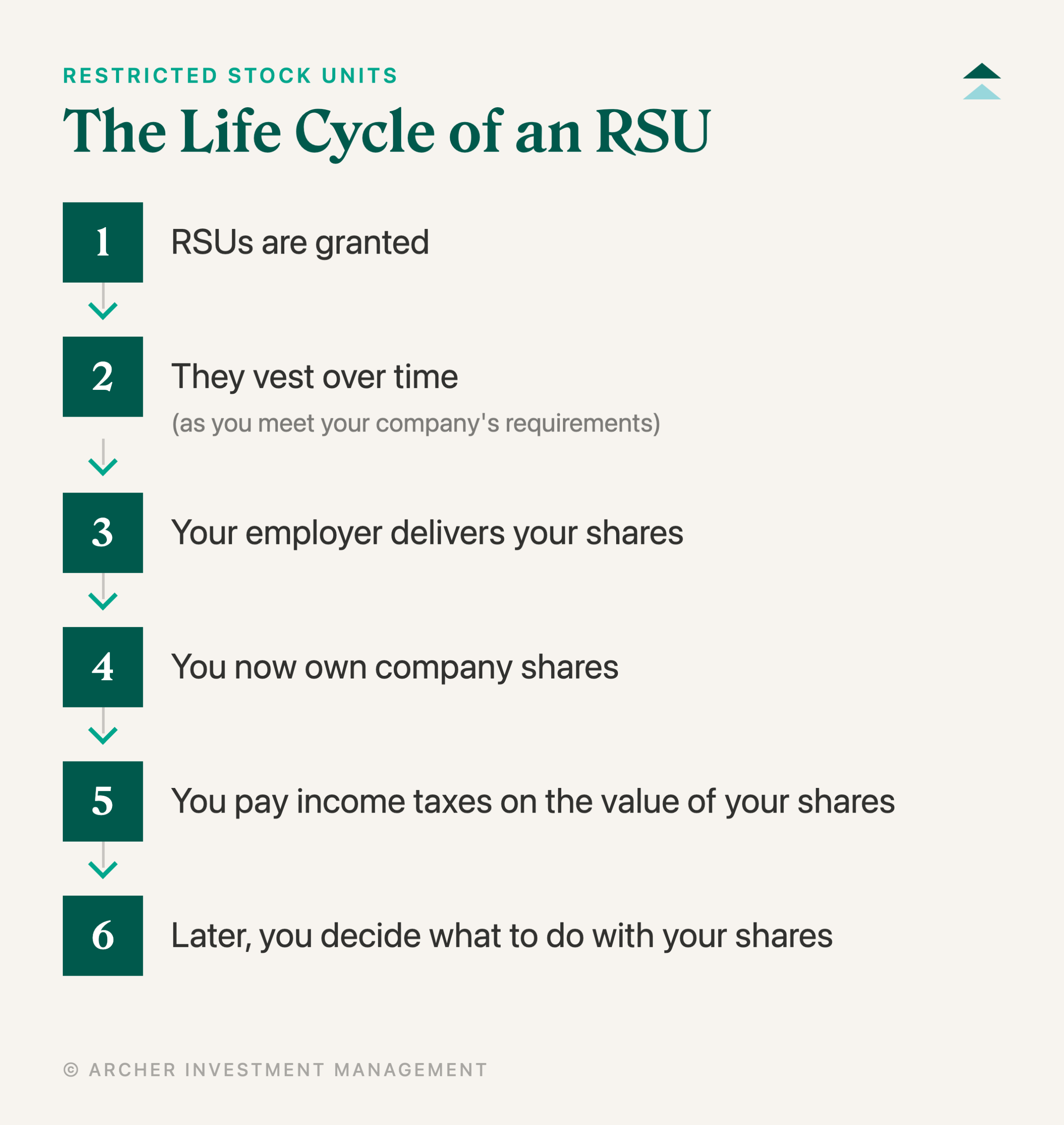
A Restricted Stock Unit (RSU) is an equity award that gives you company stock in the future. Your employer grants you RSUs as part of your scheduled bonus paid in stock, but you don’t get to own those shares right away. Instead, you earn the right to own those shares by meeting certain requirements, such as remaining with the company for a specific period or reaching performance goals.

For example, your offer letter might say you’ve been granted 1,000 RSUs as part of your compensation package. That doesn’t mean you immediately own 1,000 shares of company stock. Instead, your company uses a vesting schedule—a timeline that determines when your RSUs are delivered to you as shares of company stock.

As your RSUs vest, your employer usually deposits the shares into an investment or brokerage account in your name according to that schedule. Once that happens, they’re yours to keep. If you leave the company before all of your RSUs have vested, you’ll typically forfeit the RSUs that haven’t vested yet.

RSU life cycle

Companies use different vesting schedules depending on their equity compensation plans. Common examples include:

  • Time-based vesting: Your RSUs vest based on how long you’ve worked at the company.
  • Performance-based vesting: Your RSUs vest when you meet specific business or individual performance goals.
  • Double-trigger vesting: Some companies include special rules that allow unvested RSUs to vest sooner if the company is acquired and your job is also affected by the transaction. In other words, both events must occur before those RSUs become yours.

Taxes on RSUs are another important consideration. 

With RSUs, taxes often come into play twice. The first time could be when your RSUs vest and your employer delivers your shares. At that point, the IRS generally treats the value of those shares as taxable income. If you’re able to sell your shares in the future for more than they were worth when they were delivered to you, you may also owe taxes on those gains.

Pros of RSUs

  • Once your RSUs vest, the shares belong to you.
  • Your shares may increase in value over time if the company performs well.
  • RSUs provide a straightforward way to build ownership in the company over time.

Potential drawbacks of RSUs

  • Your employer—not you—determines when your RSUs vest and when you receive your shares.
  • You may owe income taxes when your RSUs vest, even if you aren’t able to sell the shares right away.
  • If a large portion of your investments is tied to your employer’s stock, changes in the company’s value could have a bigger impact on your overall finances.

Incentive Stock Options (ISOs): How They Work

Incentive Stock Options (ISOs) are a type of equity compensation that gives you the option to purchase company stock in the future. 

Your employer isn’t giving you shares of company stock yet. Instead, they’re giving you the opportunity to buy company stock later if you choose to do so.

Growth-stage startups often offer ISOs to attract and retain talented employees while giving them a financial stake in the company’s future. 

Before you can purchase company stock, you’ll typically need to meet your employer’s vesting requirements. Vesting means earning the right to purchase company stock by meeting your employer’s requirements, such as working for the company for a certain period of time or reaching specific performance goals.

Let’s walk through an example.

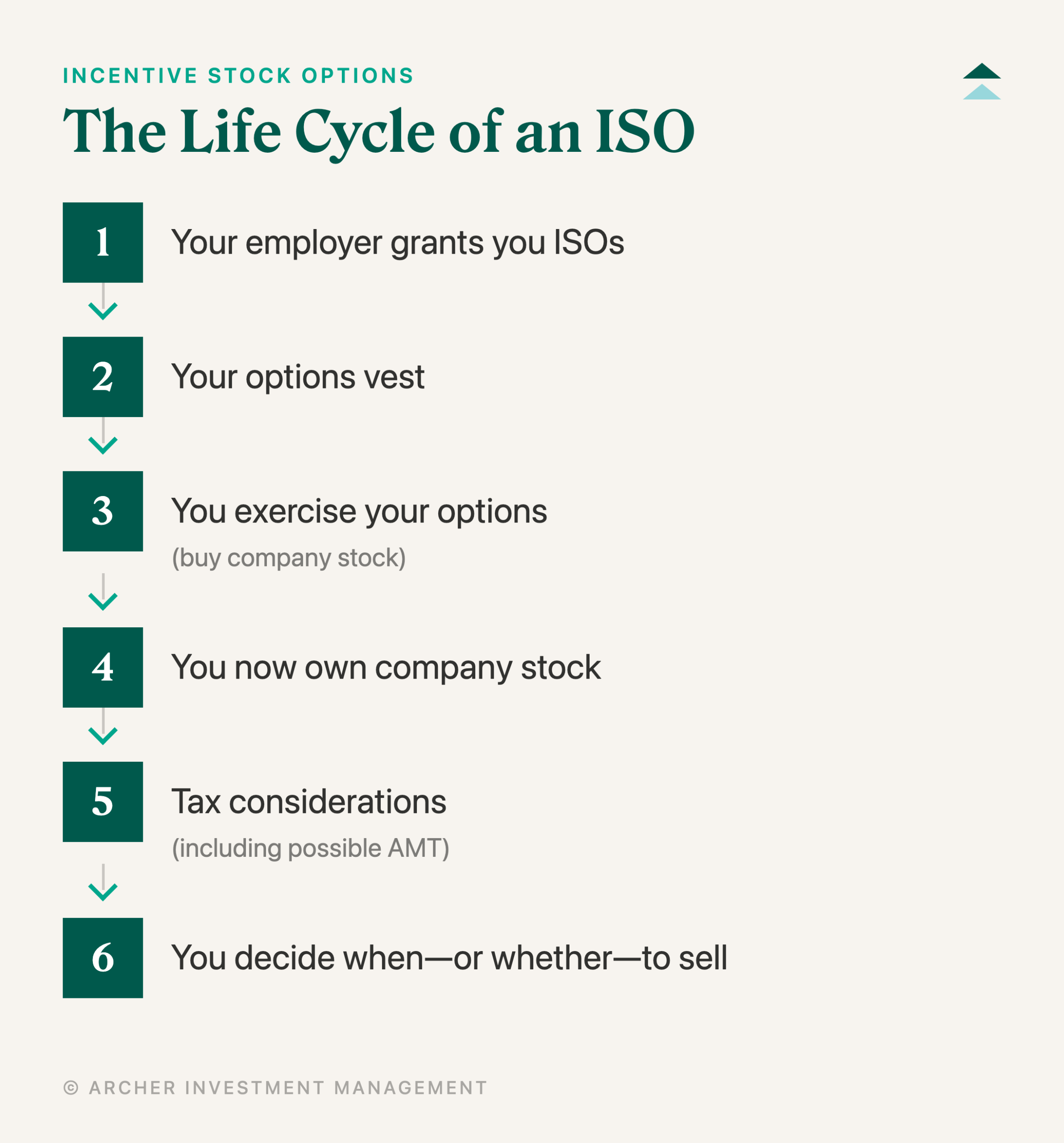
Imagine your employer grants you 1,000 ISOs as part of your compensation package. At this point, you don’t own company stock. Instead, you’ve been given the option to purchase up to 1,000 shares after your options vest.

Every ISO has a strike price—the amount you’ll pay for each share if you decide to exercise your options. The strike price is usually based on the stock’s fair market value (FMV)—the company’s estimated value per share—on the grant date, when your employer awards the options. Private companies often determine FMV through an independent 409A valuation.

Let’s say your strike price is $10 per share. A few years later, after your options have vested, the company’s stock is worth $35 per share. Because your strike price doesn’t change, you can still purchase the stock for $10 per share. Purchasing the stock is called exercising your options.

In this example, there’s a $25 difference between your strike price and what each share is worth when you exercise your options—or $25,000 across all 1,000 shares. That’s what gives ISOs their wealth-building potential.

If your company’s stock becomes more valuable over time, your strike price doesn’t change. That could allow you to purchase company stock at a discount compared with its current value when you exercise your options. Whether that ultimately helps you build wealth depends on how the company performs and what you decide to do with your shares.

Unlike restricted stock units (RSUs), which become company stock automatically once they vest, exercising an ISO requires you to purchase the shares yourself. That means you’ll need cash available if you decide to exercise your options.

Once your options vest, you don’t have to exercise them immediately. Most companies give employees an exercise window—the amount of time they have to decide whether to purchase company stock before their options expire. 

If you leave the company, that window is often much shorter—commonly 90 days—to preserve the favorable tax treatment available to ISOs. Some employers offer longer exercise windows, but after 90 days, unexercised ISOs typically lose their ISO tax status and are treated as non-qualified stock options (NSOs) instead.

ISO life cycle

Taxes and ISOs

And yes, you’ll also need to think about taxes on ISOs.

Remember, exercising your options (buying the stock) isn’t the same thing as selling your shares. Those are two separate decisions, and each has different tax implications.

One important concept to understand is the bargain element. In our example, you paid $10 per share for stock that was worth $35 per share when you exercised your options. That $25 difference is called the spread or bargain element.

Even though you haven’t sold the stock or received any cash, you’ve purchased something worth more than what you paid for it. For ISOs, the bargain element is considered a tax preference item—a type of income the IRS considers when determining whether the Alternative Minimum Tax (AMT) calculation applies.

The Alternative Minimum Tax (AMT) is a separate way the IRS calculates taxes in certain situations. Not everyone who exercises ISOs ends up owing AMT. Generally, the larger your bargain element—the difference between what you paid for the shares and what they were worth when you exercised them—the more likely exercising your ISOs is to trigger the Alternative Minimum Tax (AMT). 

Holding your shares after exercising your options can also affect how your ISOs are taxed when you eventually sell them. 

If you hold your shares for at least one year after exercising your options (purchasing the stock) and two years after the grant date (when your employer awarded your options), you may qualify for more favorable tax treatment. This is called a qualifying disposition.

Selling your shares before either of those holding periods ends is called a disqualifying disposition. 

That could mean you’ll lose some of the tax advantages ISOs can provide because part or all of your gain may be taxed as ordinary income instead of the lower long-term capital gains rate.

Because the AMT rules can be complex and depend on your overall tax situation, it’s a good idea to consult a tax professional or financial advisor with equity compensation experience before exercising a large number of ISOs.

Pros of ISOs

  • Opportunity to purchase company stock at a discount if its value increases beyond the strike price.
  • Potential tax advantages if you meet the IRS holding period requirements.
  • Your investment may increase in value if the company’s stock continues to grow after you purchase your shares.

Potential drawbacks of ISOs

  • You’ll typically need cash on hand to purchase your shares when you exercise your options.
  • Exercising your options may subject you to the Alternative Minimum Tax (AMT).
  • If the company’s stock declines after you purchase your shares, your investment could lose value.

Nonqualified Stock Options (NSOs): How They Work

Like Incentive Stock Options (ISOs), Nonqualified Stock Options (NSOs) give you the right—but not the obligation—to purchase a specific number of company shares at a predetermined price in the future. That predetermined price is called the exercise price (also known as the strike price). Before you can purchase those shares, your options typically must vest, meaning you’ll need to meet your employer’s vesting requirements, such as remaining with the company for a certain period of time.

One important difference is who can receive them. While ISOs are available only to employees, companies may also grant NSOs to directors, consultants, contractors, and other service providers. That flexibility is one reason many companies choose to offer NSOs.

Here’s how that might work in practice.

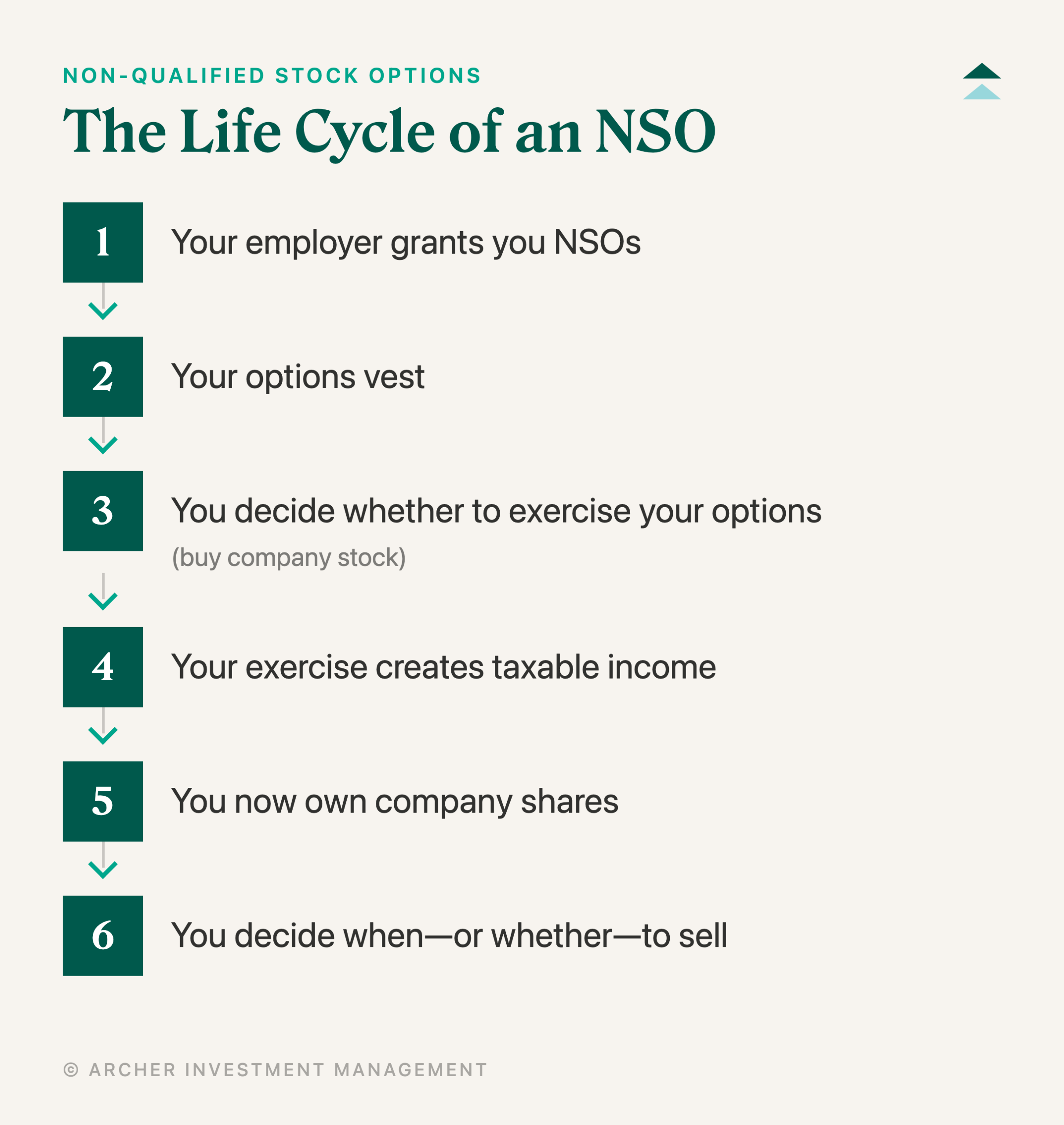
Suppose your company awards you 1,000 NSOs with an exercise price of $15 per share. A few years later, after your options have vested, the company’s stock is trading at $40 per share. That current value is called the fair market value (FMV)—essentially, what one share of the company’s stock is worth at that time.

If you decide to exercise your options, you’ll purchase those shares for $15 each, even though they’re currently worth $40. In this example, the $25 difference between your $15 exercise price and the $40 fair market value (often called the “spread”) generally becomes part of your taxable income for the year because the IRS views the spread as part of your compensation. In other words, the IRS typically taxes the spread at the same rate it taxes the income you earn from your job, known as your ordinary income tax rate. The larger the spread, the greater the potential impact on your taxes. In many cases, a portion of taxes are due at the time of exercise.

If you decide to keep your shares after exercising and they continue to increase in value, you may also owe capital gains tax when you eventually sell them. A capital gain simply means you sold the shares for more than they were worth when you exercised them. If you sell them for less, you may have a capital loss instead. Holding your shares for more than one year after exercising may allow any additional gain to qualify for the lower long-term capital gains tax rate, which may be lower than the tax rate that applies to your ordinary income.

NSO life cycle

Pros of NSOs

  • Available to a broader range of individuals than ISOs, including employees, contractors, consultants, and directors.
  • Opportunity to purchase company stock at a predetermined price, even if its value increases over time.
  • Unlike ISOs, no Alternative Minimum Tax (AMT) considerations when you exercise your options.

Potential drawbacks of NSOs

  • Exercising your options generally creates taxable income, even if you don’t sell your shares right away.
  • You’ll typically need cash available to purchase your shares when you exercise your options.
  • If the company’s stock declines after you purchase your shares, your investment could lose value.

Employee Stock Purchase Plans (ESPPs): How They Work

An Employee Stock Purchase Plan (ESPP) allows employees to purchase company stock at a discounted price through automatic payroll deductions. By making it easier to buy company stock, ESPPs give employees an opportunity to build ownership in the company over time.

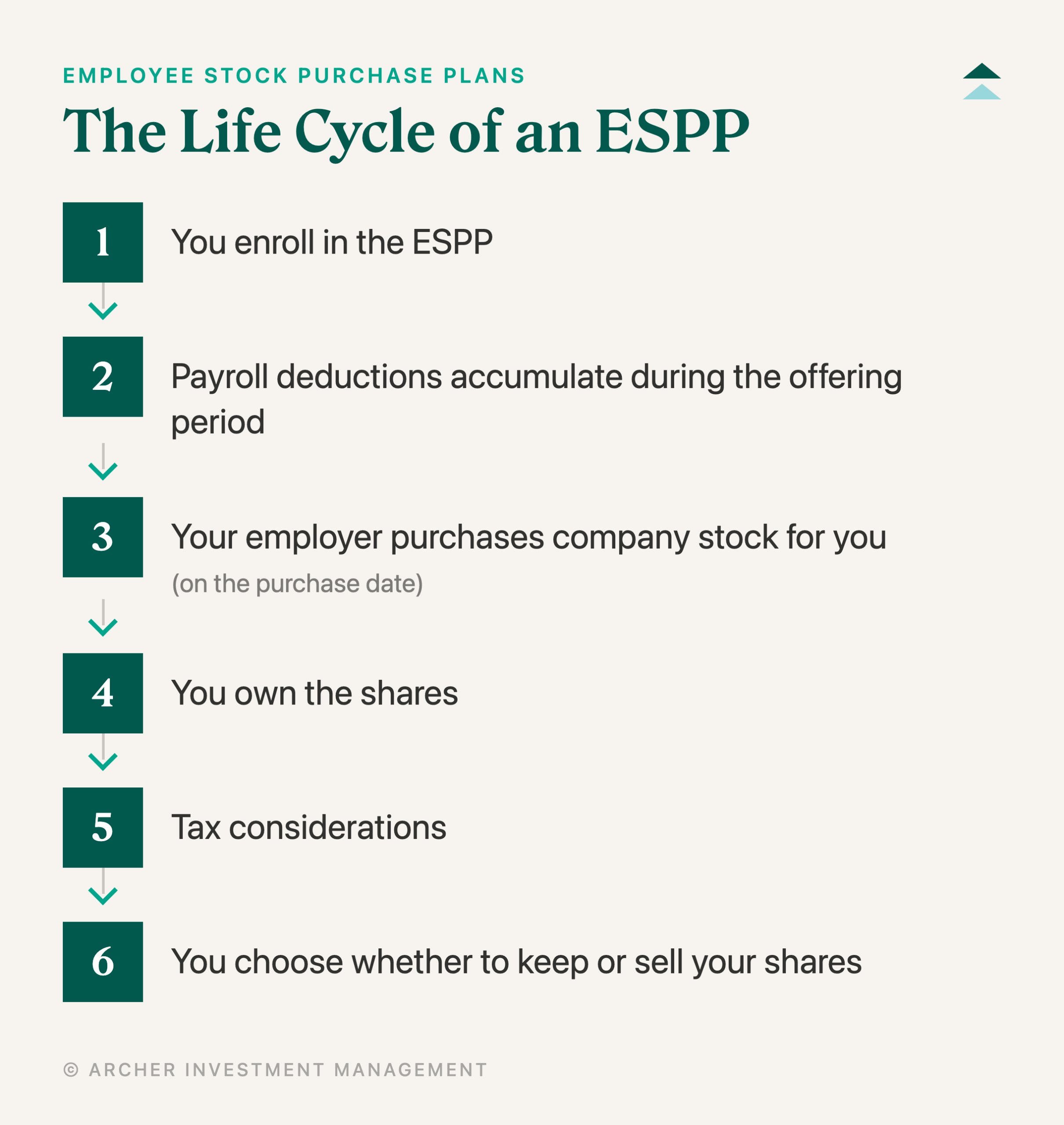
When you enroll in an ESPP, you choose how much you’d like to contribute from each paycheck. Your contributions are deducted from your paycheck after taxes. Those contributions continue to accumulate throughout the offering period—the time between when you enroll and when your employer purchases company stock on your behalf. 

At the end of the offering period, called the purchase date, your employer uses those contributions to invest in company stock for you.

The IRS limits employees to purchasing up to $25,000 of company stock through an ESPP each year, although many employees contribute much less.

Imagine you’ve contributed $5,000 to your employer’s ESPP during a six-month offering period. 

Many ESPPs allow employees to acquire company stock at a discount of up to 15% below the stock’s current market price. 

That means you’re buying it for less than what outside investors may be paying at the same time.

Some ESPPs also include a lookback provision. If they do, your discount may be based on whichever stock price is lower: the price at the beginning of the offering period or the price on the purchase date. If your company’s stock increases in value during that time, a lookback provision can increase your discount.

For example, suppose the stock was worth $100 at the start of the offering period and $140 on the purchase date. With a lookback provision, your purchase price would be based on the lower $100 price. After applying the 15% discount, you’d pay $85 per share—even though the stock is worth $140. That’s one reason many employees choose to participate in an ESPP. 

As with any investment, it’s important to think about how company stock fits into your overall financial plan. 

While ESPPs can be an effective way to build wealth, owning too much of any single stock can increase your investment risk.

The Life Cycle of an ESPP

Taxes and ESPPs

Your ESPP contributions are deducted from your paycheck after taxes. You typically won’t owe additional taxes when your employer purchases the shares for you.

Taxes usually come into play when you decide to sell your company stock. To qualify for more favorable tax treatment, you’ll generally need to:

  • Hold your shares for at least one year after the purchase date (when your employer purchases company stock for you).
  • Hold your shares for at least two years after the offering date (when the offering period began).

When you meet both requirements, it’s called a qualifying disposition. Doing so may allow more of your gains to qualify for the lower long-term capital gains tax rate.

Selling your shares before either holding period ends is called a disqualifying disposition. In that case, more of your gain may be taxed as ordinary income.

As with other types of equity compensation, ESPP tax rules can get complicated. A tax professional or financial advisor can help you understand the tax implications for your specific situation.

Pros of ESPPs

  • Opportunity to purchase company stock at a discount.
  • Automatic, after-tax payroll deductions make participation simple and flexible.
  • Potential tax advantages if you meet the IRS holding period requirements.

Potential drawbacks of ESPPs

  • Buying too much of your employer’s stock could tie a significant portion of your savings to the same company that provides your paycheck. If that company struggles, your financial situation could be affected in more than one way.
  • Your investment could lose value if the company’s stock declines after you purchase your shares.
  • Selling your shares before meeting the IRS holding period requirements may reduce some of the tax advantages. 

How Company Stage Influences Equity Compensation

The type of equity compensation you receive often depends on where a company is in its lifecycle. A young startup has different compensation goals—and financial resources—than an established public company. As a result, the mix of equity compensation being offered often changes as companies grow.

For example, imagine two software engineers who’ve accepted new jobs in Austin.

Taylor joins a fast-growing, privately owned startup. Because the company is focused on attracting talent while preserving cash, Taylor’s compensation package could include Incentive Stock Options (ISOs) or Non-Qualified Stock Options (NSOs). If the company continues to grow, those options could become significantly more valuable. Because its future is still uncertain, however, those potential rewards also come with greater risk than equity offered by a more established company.

Jordan, on the other hand, joins an established public technology company. Jordan receives Restricted Stock Units (RSUs) as part of an annual compensation package. He also chooses to participate in the company’s Employee Stock Purchase Plan (ESPP). Because the company’s stock already trades publicly, those programs provide employees with different ways to build ownership and reap the benefits of their contributions over time.

Company stage isn’t the only factor that influences equity compensation. Depending on your role and relationship with the company, you may receive different combinations of RSUs, ISOs, NSOs, and ESPPs. 

For example, executives and senior leaders may receive larger equity awards, while certain equity programs—such as NSOs—may also be available to directors, consultants, or other service providers. Employee stock purchase plans, by contrast, are often available to broader groups of eligible employees. 

As companies become more established, some of the uncertainty surrounding their future may decrease, but the type and amount of equity offered still often depend on factors such as your role, seniority, relationship to the company, and its compensation strategy.

Vesting Schedules and Liquidity Events

Most equity compensation doesn’t become yours all at once. Instead, it typically follows a vesting schedule that determines when you earn the right to receive or purchase company stock. 

Understanding when your equity vests—and when you can sell it—is an important part of managing your equity compensation.

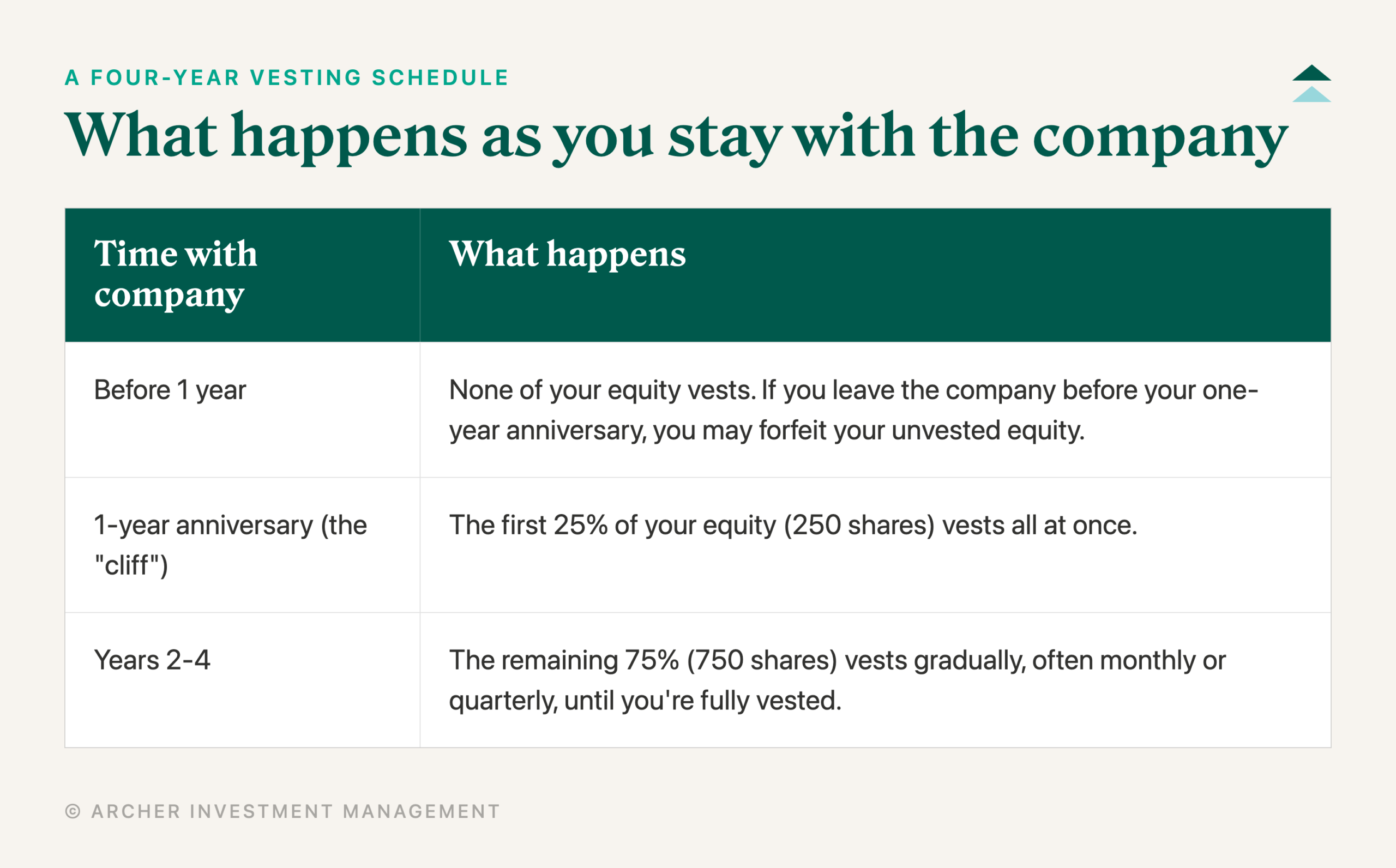
Many technology companies in Austin use a four-year vesting schedule with a one-year cliff

None of your equity typically vests during your first year with the company. Once you reach your one-year anniversary (the “cliff”), the first portion of your equity—often 25%—vests all at once. The remaining equity then vests gradually, often monthly or quarterly, over the next three years.

Here’s how that might play out if your compensation package included equity representing 1,000 shares:

vesting schedule

Some equity awards also include accelerated vesting if the company is acquired or experiences another major corporate event. 

Depending on the terms of your equity compensation plan, some or all of your unvested equity may vest sooner than originally scheduled. Because these provisions vary by employer, it’s important to review your equity plan documents so you understand how your company’s program works.

Owning equity doesn’t always mean you can sell it whenever you want. 

One of the biggest surprises for employees at private companies is that even if their shares increase in value, there may not be anyone available to buy them. In many cases, employees have to wait until the company goes public, is acquired, or offers another approved opportunity to sell their shares.

This is known as a liquidity event—a point when employees can convert company stock into cash.

Some private companies also create opportunities for employees to sell shares of company stock before an IPO. 

These may include company-sponsored buyback programs or approved secondary market transactions, which allow eligible employees to sell vested shares under certain conditions. 

Not every company offers these programs, so make sure you look into the options available through your employer when the time comes to sell your company stock.

Tax Implications of Equity Compensation

One of the biggest advantages of living and working in Texas is that the state doesn’t impose a personal income tax. That means you likely won’t pay Texas state income tax on your equity compensation.

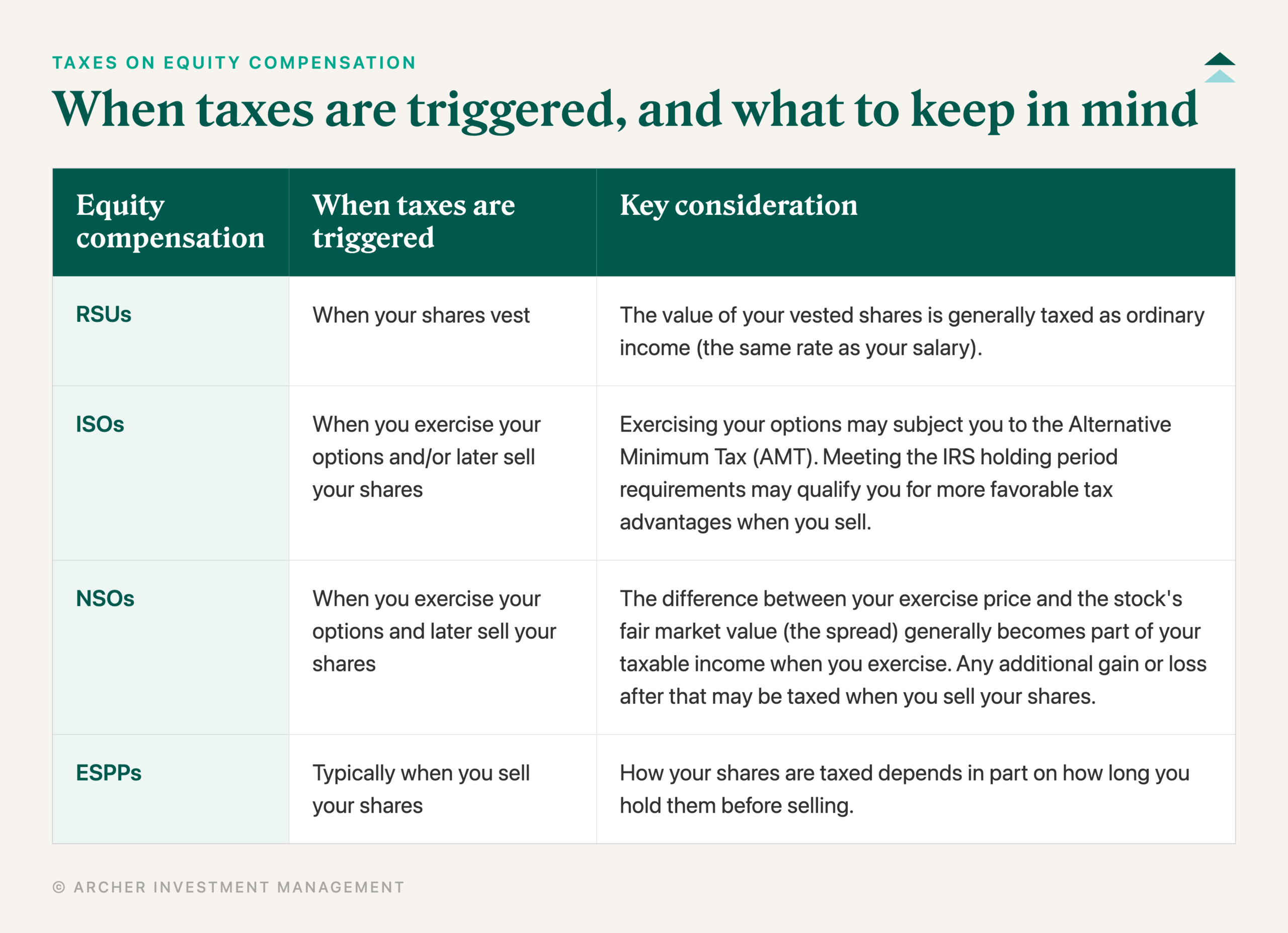
Federal tax rules, however, still apply—and those rules vary depending on whether you receive RSUs, ISOs, NSOs, or participate in an ESPP. 

taxes on equity compensation

One unique feature of Incentive Stock Options (ISOs) is the Alternative Minimum Tax (AMT)

Exercising ISOs doesn’t automatically mean you’ll owe AMT. However, exercising options with a large bargain element—the difference between your strike price and the stock’s fair market value when you exercise—may increase the likelihood that AMT applies.

Because AMT calculations depend on your overall financial situation, it’s difficult to predict whether you’ll owe additional taxes without looking at your complete tax picture. 

If you’re considering exercising a significant number of ISOs, working with a tax professional and financial advisor who understands equity compensation before making your decision can help you understand the potential impact.

Unlike ISOs, NSOs typically don’t trigger the AMT. Instead, the difference between your exercise price and the stock’s fair market value (the spread) generally becomes part of your taxable income when you exercise your options.

Here are a few strategies that may help you manage the tax implications of equity compensation:

  • Understand when each type of equity compensation may trigger taxes.
  • Plan the timing of ISO and NSO exercises, as well as company stock sales, carefully.
  • Consider the tax consequences before exercising options or selling company shares. .
  • Work with a financial advisor and tax professional before making significant equity-related decisions.

Smart Strategies for Managing Equity Compensation

Making the most of equity compensation requires thoughtful planning. The decisions you make about exercising, selling, or holding your shares can affect your taxes, investment strategy, and long-term financial goals.

Diversify your investments

If your company’s stock performs well, it’s easy for a large portion of your wealth to become tied to a single company. Gradually diversifying your investments may help reduce risk while preserving the wealth you’ve built.

Watch out for: Letting too much of your financial future depend on the performance of a single company.

Decide when to exercise ISOs thoughtfully

Exercising Incentive Stock Options (ISOs) isn’t always something you should do as soon as they vest. Before exercising your ISOs, consider your available cash, confidence in the company’s future, and the potential tax implications. If you’re planning to leave the company, pay close attention to any exercise deadlines. Many of these same planning considerations also apply to NSOs, although they’re taxed differently.

Watch out for: Waiting too long to exercise your stock options, or missing opportunities to exercise or sell when it makes the most sense for your situation.

Develop a strategy for your RSUs

When your Restricted Stock Units (RSUs) vest, you’ll need to decide whether to keep your shares or sell some or all of them. Some employees sell enough shares to help cover taxes and diversify their investments, while others hold them if doing so supports their long-term strategy. The right approach for you depends on your goals and overall portfolio.

Watch out for: Letting your default decision be to “do nothing” instead of deciding whether selling or holding supports your long-term goals.

Be strategic about ESPP contributions

Choose a contribution amount that fits comfortably within your budget, and consider how much of your savings is already invested in your employer’s stock. Once you’ve purchased shares, decide whether selling or holding them best supports your priorities and tax situation.

Watch out for: Contributing more than you can comfortably afford, selling too quickly without considering potential tax advantages, or allowing too much of your wealth to remain invested in your employer’s stock.

Make equity compensation part of your financial plan

Rather than thinking of equity compensation as an “extra,” make it part of your overall financial plan. Whether you’re saving for retirement, buying a home, or funding another long-term goal, your equity decisions should support your broader financial priorities.

Keep in mind: The best equity compensation strategy isn’t necessarily the one that minimizes taxes or maximizes returns—it’s the one that fits your overall financial plan.

Austin Tech Company Equity Compensation FAQs

What’s the difference between RSUs, ISOs, and ESPPs?

RSUs, ISOs, NSOs, and ESPPs are all forms of equity compensation, but they each work differently. RSUs turn into company stock once your shares vest. ISOs and NSOs give you the option to purchase company stock at a fixed price (called the strike price) after vesting, but they’re taxed in different ways. ESPPs allow employees to purchase company stock through after-tax payroll deductions, often at a discount. The type of equity compensation you receive usually depends on the programs your employer offers, your role and/or relationship to the company, and the company’s lifecycle.

Can I participate in more than one equity compensation program?

Yes. If your employer offers multiple equity compensation programs and you’re eligible to participate, you may receive more than one type of equity compensation. For example, an employee at a public technology company might be granted RSUs as part of their compensation package while also participating in the company’s ESPP. You may also receive different forms of equity compensation over the course of your careers as you change employers or as your role or the company’s compensation programs evolve.

What happens to unvested equity if I leave my job?

In many cases, unvested equity is forfeited when you leave the company. Vested equity may remain yours, but the rules vary depending on the type of equity compensation and your employer’s plan. For example, vested ISOs often have a limited exercise window after you leave the company. Depending on your employer’s plan, similar deadlines may also apply to NSOs. Review your equity plan documents carefully before leaving your employer so you understand the deadlines and requirements that apply to your situation.

How do IPOs and acquisitions affect my equity?

An IPO or acquisition can significantly change how your equity works. For employees at private companies that go public, these events may create an opportunity to sell shares that were previously difficult to convert into cash. Depending on your equity plan, an acquisition may also trigger accelerated vesting for some or all of your unvested equity. The exact outcome depends on what your employer’s plan documents say and the terms of the transaction.

Are there unique tax benefits for Texas employees?

Texas does not have a state income tax, which means you typically won’t owe state income tax on equity compensation if you live and work in Texas. However, federal tax rules still apply. Depending on the type of equity compensation you receive, you may owe ordinary income tax (the same tax rates that generally apply to wages), capital gains tax when you sell shares that have increased in value, or, in the case of some ISOs, the Alternative Minimum Tax (AMT). On the other hand, Nonqualified Stock Options (NSOs) are usually taxed when you exercise your options. A tax professional or financial advisor can help you understand how these rules apply to your situation.

Should I sell my company stock right away or hold it?

There’s no one-size-fits-all answer. The best decision depends on your financial and tax situation, and how much of your overall wealth is already invested in your employer’s equity comp program. Some employees choose to sell shares to diversify their investments, while others hold onto their shares because they believe in the company’s long-term potential. Rather than asking whether you should always sell or always hold, consider how that decision supports the future you’re trying to build and your liquidity needs. A financial advisor can help you evaluate trade-offs and develop a strategy that fits your overall financial plan.

Turning Your Equity Into Freedom, Flexibility, and Financial Resources You Can Use

Receiving equity compensation can be exciting, but making the most of it takes thoughtful planning. Between vesting schedules, taxes, and investment decisions, it’s easy to focus on the details without stepping back to see how it all fits together.

The good news is that equity comp doesn’t have to be confusing. 

Understanding the details of your equity compensation package and what your options look like is a great place to start. 

Whether you’re deciding when to exercise options, sell shares, or hold them as part of a long-term investment strategy, thoughtful planning can make a meaningful difference in what you’re able to turn your equity into for yourself and your family. 

Get Personalized Guidance for Your Equity Compensation

If you’re receiving equity compensation from an Austin technology company, you don’t have to navigate those decisions alone. 

Archer Investment Management helps tech professionals understand their equity, map out their options, and coordinate with their CPA to understand the tax impacts.

Whether you’re evaluating a new job offer, deciding when to exercise stock options, or building a long-term strategy for managing RSUs, ISOs, NSOs, and ESPPs, we’re here to help.

Schedule a call with us to understand all your options, easily weigh trade-offs, and build a financial plan around what matters most to you.

This article is for general educational purposes only and is not individualized tax, legal, or investment advice. Tax rules are complex and can change, and outcomes depend on your specific situation. You should consult your CPA and/or attorney regarding your circumstances. Archer Investment Management is an SEC-registered investment adviser; registration does not imply a certain level of skill or training. Investing involves risk, including the possible loss of principal.