

How Austin’s Tech Companies Structure Equity Compensation: What to Know About RSUs, ISOs, NSOs, and ESPPs
Key Takeaways:
- RSUs, ISOs, NSOs, and ESPPs all provide company equity, but they work—and are taxed—very differently. Understanding those differences can help you make more informed financial decisions about your equity compensation.
- Timing matters. Vesting schedules, exercise decisions, and holding periods can all affect the value of your equity compensation and the taxes you may owe.
- Your equity compensation should support your broader financial goals. A thoughtful strategy can help you manage risk, navigate taxes, and make the most of the opportunities your employer provides.
Home to fast-growing startups, established technology companies, and a thriving AI sector. Austin has become a leading technology hub, ranking as the fifth-largest tech talent market in North America in 2025. With Austin’s tech boom fueling competition for skilled professionals, equity compensation now plays an increasingly important role in how employers here attract, reward, and retain talent.
If you’ve accepted a job with an Austin tech company, there’s a good chance your pay package includes equity compensation—a chance to share in the company’s future success through stock awards or stock purchase opportunities.
If you’re evaluating a new job offer, it’s also worth knowing that equity compensation may be negotiable. While salaries often receive the most attention during offer discussions, some employers may have flexibility around equity awards, vesting terms, signing bonuses, or other compensation components.
For many employees, equity comp can become one of the most valuable parts of their overall financial picture.
In some cases, it can create life-changing wealth. However, you typically don’t receive all of it at once. Instead, those shares become yours gradually through a process called vesting, which means you earn ownership over time as you continue working for the company or meet specific performance goals.
Most Austin tech companies rely on four common forms of equity compensation, although the type you’re offered depends on the company and your role:
- Restricted Stock Units (RSUs)
- Incentive Stock Options (ISOs)
- Non-Qualified Stock Options (NSOs)
- Employee Stock Purchase Plans (ESPPs)
Each equity comp program works differently. They have different tax rules, risks, and opportunities for building long-term wealth. The good news is that you don’t need to become an expert to understand your options.
Learning how different equity compensation programs work can help you navigate your choices with greater confidence and make the most of the opportunities available to you.
In this comprehensive guide to stock options, we’ll walk through how RSUs, ISOs, NSOs, and ESPPs work, how they’re commonly used by Austin tech companies, and what you should know about vesting, taxes, and long-term financial planning so you can feel more confident making decisions about the equity you’ve earned.
Equity Compensation in Austin’s Tech Scene: The Basics
Why do so many Austin tech companies offer equity compensation instead of simply paying higher salaries?
Equity compensation gives employees an opportunity to share in the company’s success while helping employers compete for top talent.
Equity compensation can be especially valuable in the technology industry, where companies often focus on future growth.
Early-stage startups may not have the cash flow to offer the highest salaries, but they can make compensation packages more competitive by offering equity with the potential to appreciate over time.
More established companies often continue to offer equity comp as a way to reward employees, encourage retention, and keep compensation competitive.
Austin’s technology sector includes companies at every stage of growth, from venture-backed startups to publicly traded corporations, so equity compensation packages can vary considerably from one employer to the next.
Most companies rely on one or more common types of equity compensation, and the mix often changes as a company grows.
- Early-stage startups often grant stock options, such as Incentive Stock Options (ISOs) or Nonqualified Stock Options (NSOs), giving employees the opportunity to purchase company stock at a predetermined price after meeting certain vesting requirements.
- Growing and later-stage private companies often continue offering stock options while some also introduce Restricted Stock Units (RSUs) as they mature and prepare for a potential IPO or acquisition.
- Public companies commonly provide Restricted Stock Units (RSUs) and Employee Stock Purchase Plans (ESPPs), enabling eligible employees to purchase company stock through payroll deductions, often at a discount. Some may also continue to offer stock options.
Understanding how each type of equity comp works can help you evaluate your compensation package and plan for the opportunities—and responsibilities—that come with owning company stock.
RSU vs. ISO vs. NSO vs. ESPP Programs for Austin Tech Companies
Although RSUs, ISOs, NSOs, and ESPPs are all common forms of equity compensation, they differ in how employees acquire shares, their tax treatment, and the level of flexibility they provide.

Restricted Stock Units (RSUs): How They Work
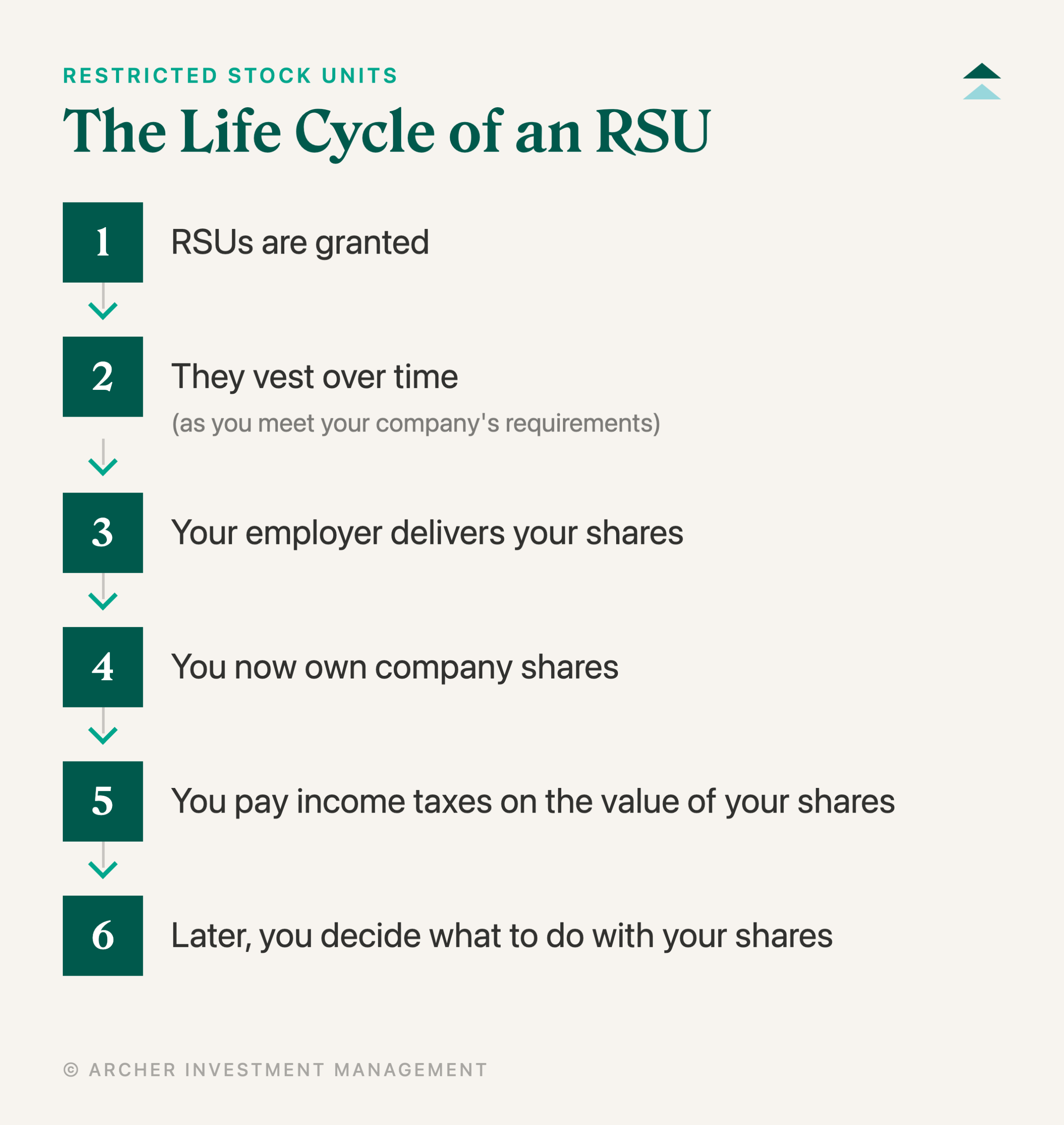
A Restricted Stock Unit (RSU) is an equity award that gives you company stock in the future. Your employer grants you RSUs as part of your scheduled bonus paid in stock, but you don’t get to own those shares right away. Instead, you earn the right to own those shares by meeting certain requirements, such as remaining with the company for a specific period or reaching performance goals.
For example, your offer letter might say you’ve been granted 1,000 RSUs as part of your compensation package. That doesn’t mean you immediately own 1,000 shares of company stock. Instead, your company uses a vesting schedule—a timeline that determines when your RSUs are delivered to you as shares of company stock.
As your RSUs vest, your employer usually deposits the shares into an investment or brokerage account in your name according to that schedule. Once that happens, they’re yours to keep. If you leave the company before all of your RSUs have vested, you’ll typically forfeit the RSUs that haven’t vested yet.
Companies use different vesting schedules depending on their equity compensation plans. Common examples include:
- Time-based vesting: Your RSUs vest based on how long you’ve worked at the company.
- Performance-based vesting: Your RSUs vest when you meet specific business or individual performance goals.
- Double-trigger vesting: Some companies include special rules that allow unvested RSUs to vest sooner if the company is acquired and your job is also affected by the transaction. In other words, both events must occur before those RSUs become yours.
Taxes on RSUs are another important consideration.
With RSUs, taxes often come into play twice. The first time could be when your RSUs vest and your employer delivers your shares. At that point, the IRS generally treats the value of those shares as taxable income. If you’re able to sell your shares in the future for more than they were worth when they were delivered to you, you may also owe taxes on those gains.
Pros of RSUs
- Once your RSUs vest, the shares belong to you.
- Your shares may increase in value over time if the company performs well.
- RSUs provide a straightforward way to build ownership in the company over time.
Potential drawbacks of RSUs
- Your employer—not you—determines when your RSUs vest and when you receive your shares.
- You may owe income taxes when your RSUs vest, even if you aren’t able to sell the shares right away.
- If a large portion of your investments is tied to your employer’s stock, changes in the company’s value could have a bigger impact on your overall finances.
Incentive Stock Options (ISOs): How They Work
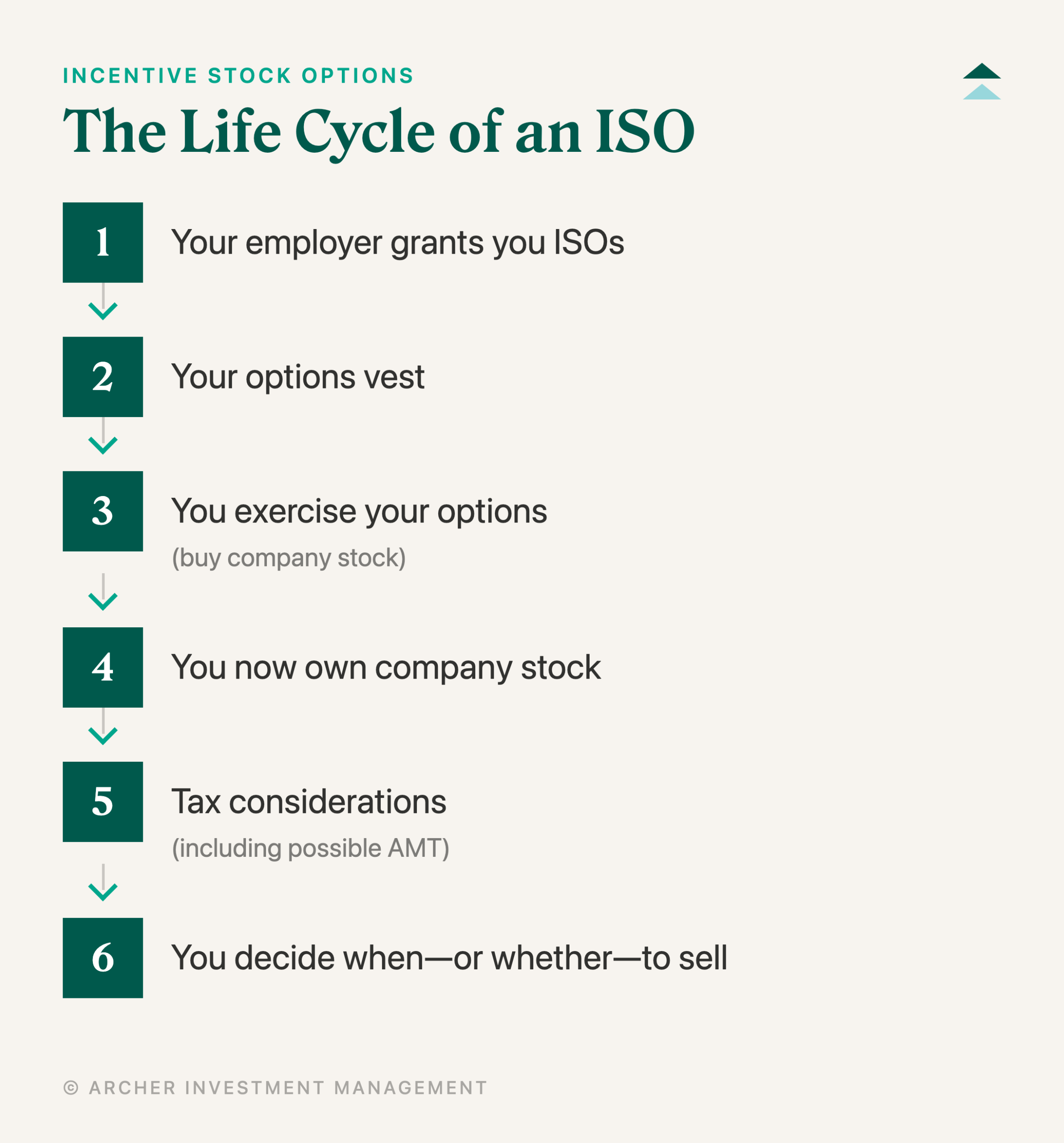
Incentive Stock Options (ISOs) are a type of equity compensation that gives you the option to purchase company stock in the future.
Your employer isn’t giving you shares of company stock yet. Instead, they’re giving you the opportunity to buy company stock later if you choose to do so.
Growth-stage startups often offer ISOs to attract and retain talented employees while giving them a financial stake in the company’s future.
Before you can purchase company stock, you’ll typically need to meet your employer’s vesting requirements. Vesting means earning the right to purchase company stock by meeting your employer’s requirements, such as working for the company for a certain period of time or reaching specific performance goals.
Let’s walk through an example.
Imagine your employer grants you 1,000 ISOs as part of your compensation package. At this point, you don’t own company stock. Instead, you’ve been given the option to purchase up to 1,000 shares after your options vest.
Every ISO has a strike price—the amount you’ll pay for each share if you decide to exercise your options. The strike price is usually based on the stock’s fair market value (FMV)—the company’s estimated value per share—on the grant date, when your employer awards the options. Private companies often determine FMV through an independent 409A valuation.
Let’s say your strike price is $10 per share. A few years later, after your options have vested, the company’s stock is worth $35 per share. Because your strike price doesn’t change, you can still purchase the stock for $10 per share. Purchasing the stock is called exercising your options.
In this example, there’s a $25 difference between your strike price and what each share is worth when you exercise your options—or $25,000 across all 1,000 shares. That’s what gives ISOs their wealth-building potential.
If your company’s stock becomes more valuable over time, your strike price doesn’t change. That could allow you to purchase company stock at a discount compared with its current value when you exercise your options. Whether that ultimately helps you build wealth depends on how the company performs and what you decide to do with your shares.
Unlike restricted stock units (RSUs), which become company stock automatically once they vest, exercising an ISO requires you to purchase the shares yourself. That means you’ll need cash available if you decide to exercise your options.
Once your options vest, you don’t have to exercise them immediately. Most companies give employees an exercise window—the amount of time they have to decide whether to purchase company stock before their options expire.
If you leave the company, that window is often much shorter—commonly 90 days—to preserve the favorable tax treatment available to ISOs. Some employers offer longer exercise windows, but after 90 days, unexercised ISOs typically lose their ISO tax status and are treated as non-qualified stock options (NSOs) instead.
Taxes and ISOs
And yes, you’ll also need to think about taxes on ISOs.
Remember, exercising your options (buying the stock) isn’t the same thing as selling your shares. Those are two separate decisions, and each has different tax implications.
One important concept to understand is the bargain element. In our example, you paid $10 per share for stock that was worth $35 per share when you exercised your options. That $25 difference is called the spread or bargain element.
Even though you haven’t sold the stock or received any cash, you’ve purchased something worth more than what you paid for it. For ISOs, the bargain element is considered a tax preference item—a type of income the IRS considers when determining whether the Alternative Minimum Tax (AMT) calculation applies.
The Alternative Minimum Tax (AMT) is a separate way the IRS calculates taxes in certain situations. Not everyone who exercises ISOs ends up owing AMT. Generally, the larger your bargain element—the difference between what you paid for the shares and what they were worth when you exercised them—the more likely exercising your ISOs is to trigger the Alternative Minimum Tax (AMT).
Holding your shares after exercising your options can also affect how your ISOs are taxed when you eventually sell them.
If you hold your shares for at least one year after exercising your options (purchasing the stock) and two years after the grant date (when your employer awarded your options), you may qualify for more favorable tax treatment. This is called a qualifying disposition.
Selling your shares before either of those holding periods ends is called a disqualifying disposition.
That could mean you’ll lose some of the tax advantages ISOs can provide because part or all of your gain may be taxed as ordinary income instead of the lower long-term capital gains rate.
Because the AMT rules can be complex and depend on your overall tax situation, it’s a good idea to consult a tax professional or financial advisor with equity compensation experience before exercising a large number of ISOs.
Pros of ISOs
- Opportunity to purchase company stock at a discount if its value increases beyond the strike price.
- Potential tax advantages if you meet the IRS holding period requirements.
- Your investment may increase in value if the company’s stock continues to grow after you purchase your shares.
Potential drawbacks of ISOs
- You’ll typically need cash on hand to purchase your shares when you exercise your options.
- Exercising your options may subject you to the Alternative Minimum Tax (AMT).
- If the company’s stock declines after you purchase your shares, your investment could lose value.
Nonqualified Stock Options (NSOs): How They Work
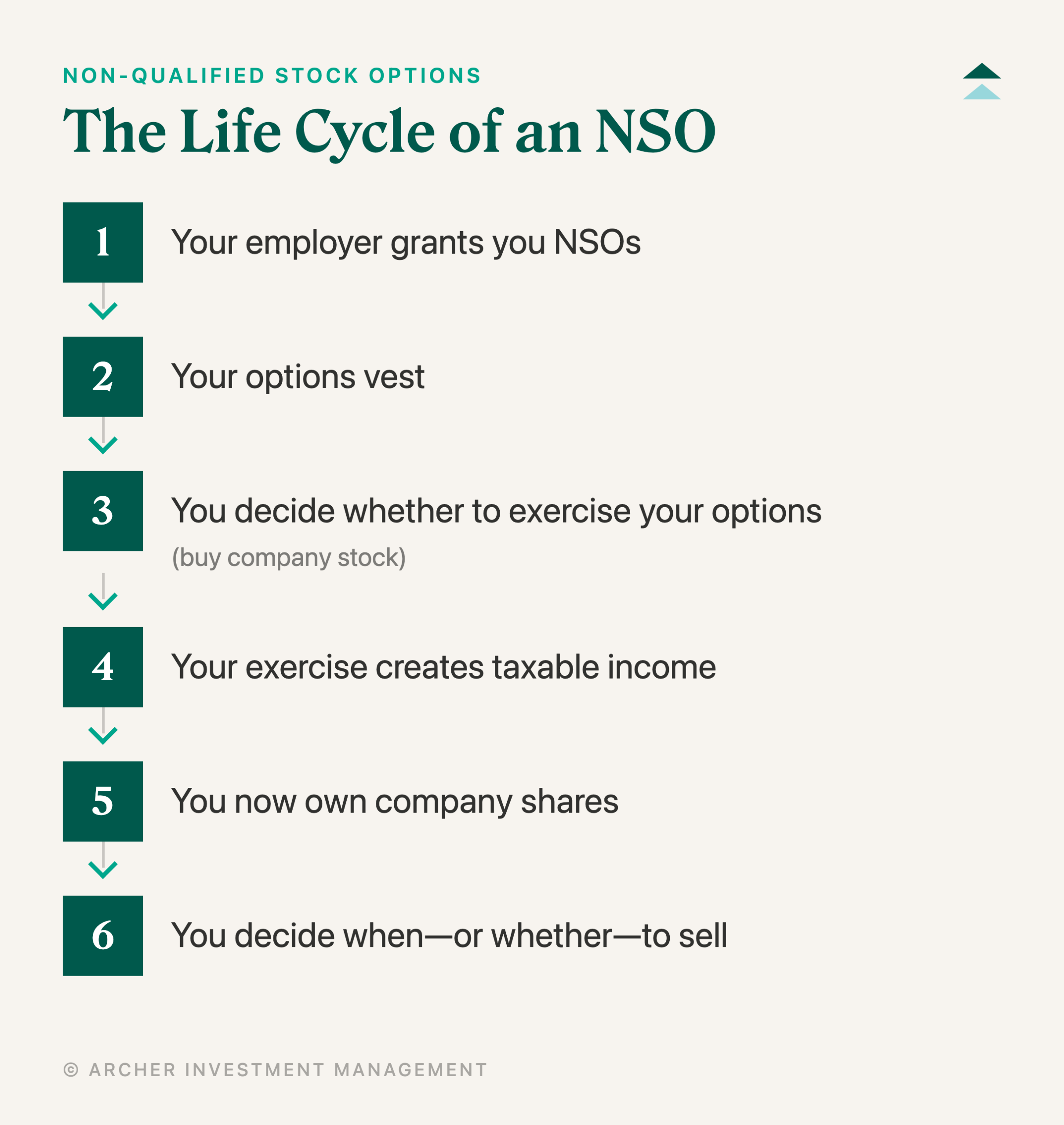
Like Incentive Stock Options (ISOs), Nonqualified Stock Options (NSOs) give you the right—but not the obligation—to purchase a specific number of company shares at a predetermined price in the future. That predetermined price is called the exercise price (also known as the strike price). Before you can purchase those shares, your options typically must vest, meaning you’ll need to meet your employer’s vesting requirements, such as remaining with the company for a certain period of time.
One important difference is who can receive them. While ISOs are available only to employees, companies may also grant NSOs to directors, consultants, contractors, and other service providers. That flexibility is one reason many companies choose to offer NSOs.
Here’s how that might work in practice.
Suppose your company awards you 1,000 NSOs with an exercise price of $15 per share. A few years later, after your options have vested, the company’s stock is trading at $40 per share. That current value is called the fair market value (FMV)—essentially, what one share of the company’s stock is worth at that time.
If you decide to exercise your options, you’ll purchase those shares for $15 each, even though they’re currently worth $40. In this example, the $25 difference between your $15 exercise price and the $40 fair market value (often called the “spread”) generally becomes part of your taxable income for the year because the IRS views the spread as part of your compensation. In other words, the IRS typically taxes the spread at the same rate it taxes the income you earn from your job, known as your ordinary income tax rate. The larger the spread, the greater the potential impact on your taxes. In many cases, a portion of taxes are due at the time of exercise.
If you decide to keep your shares after exercising and they continue to increase in value, you may also owe capital gains tax when you eventually sell them. A capital gain simply means you sold the shares for more than they were worth when you exercised them. If you sell them for less, you may have a capital loss instead. Holding your shares for more than one year after exercising may allow any additional gain to qualify for the lower long-term capital gains tax rate, which may be lower than the tax rate that applies to your ordinary income.
Pros of NSOs
- Available to a broader range of individuals than ISOs, including employees, contractors, consultants, and directors.
- Opportunity to purchase company stock at a predetermined price, even if its value increases over time.
- Unlike ISOs, no Alternative Minimum Tax (AMT) considerations when you exercise your options.
Potential drawbacks of NSOs
- Exercising your options generally creates taxable income, even if you don’t sell your shares right away.
- You’ll typically need cash available to purchase your shares when you exercise your options.
- If the company’s stock declines after you purchase your shares, your investment could lose value.
Employee Stock Purchase Plans (ESPPs): How They Work
An Employee Stock Purchase Plan (ESPP) allows employees to purchase company stock at a discounted price through automatic payroll deductions. By making it easier to buy company stock, ESPPs give employees an opportunity to build ownership in the company over time.
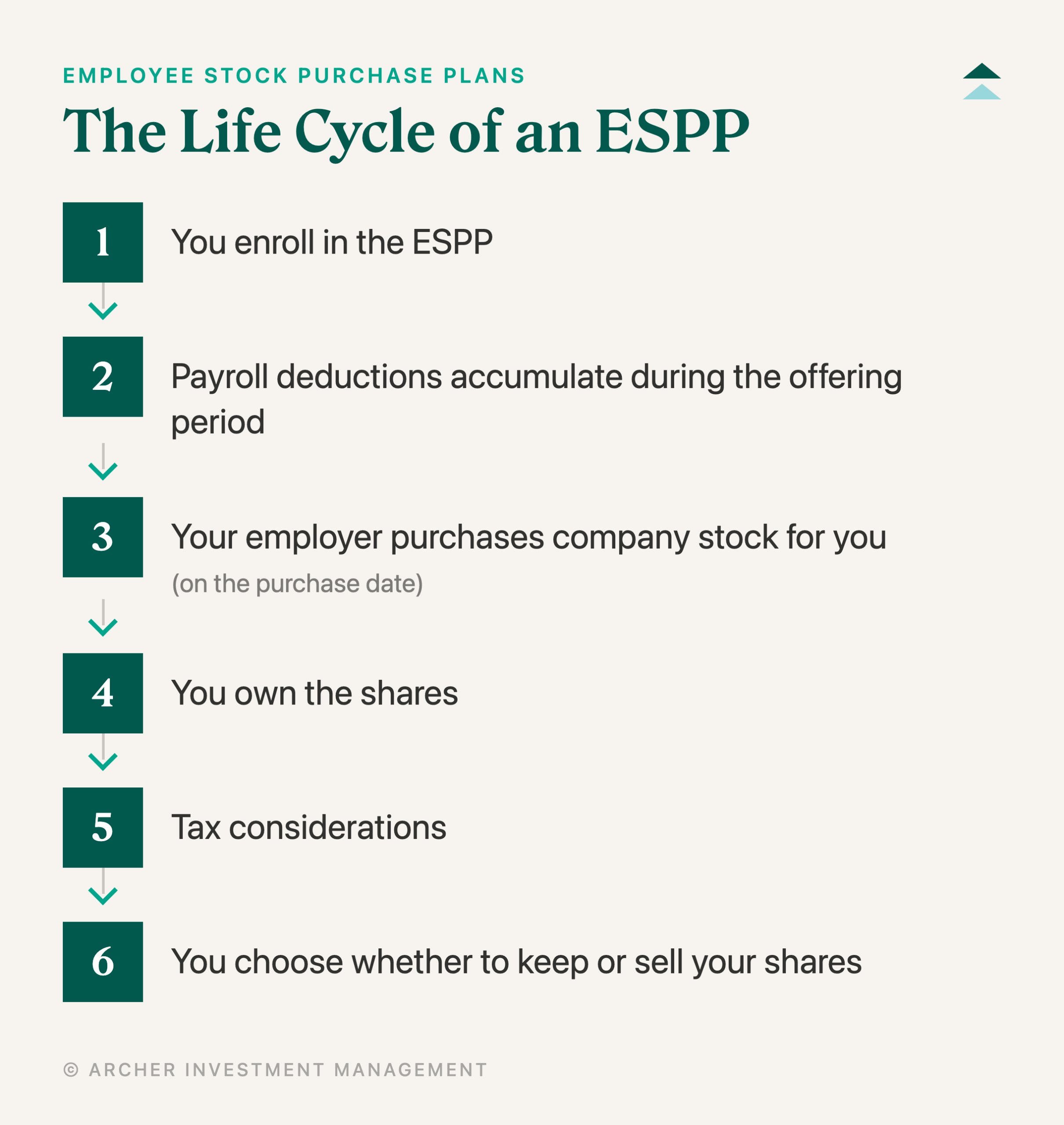
When you enroll in an ESPP, you choose how much you’d like to contribute from each paycheck. Your contributions are deducted from your paycheck after taxes. Those contributions continue to accumulate throughout the offering period—the time between when you enroll and when your employer purchases company stock on your behalf.
At the end of the offering period, called the purchase date, your employer uses those contributions to invest in company stock for you.
The IRS limits employees to purchasing up to $25,000 of company stock through an ESPP each year, although many employees contribute much less.
Imagine you’ve contributed $5,000 to your employer’s ESPP during a six-month offering period.
Many ESPPs allow employees to acquire company stock at a discount of up to 15% below the stock’s current market price.
That means you’re buying it for less than what outside investors may be paying at the same time.
Some ESPPs also include a lookback provision. If they do, your discount may be based on whichever stock price is lower: the price at the beginning of the offering period or the price on the purchase date. If your company’s stock increases in value during that time, a lookback provision can increase your discount.
For example, suppose the stock was worth $100 at the start of the offering period and $140 on the purchase date. With a lookback provision, your purchase price would be based on the lower $100 price. After applying the 15% discount, you’d pay $85 per share—even though the stock is worth $140. That’s one reason many employees choose to participate in an ESPP.
As with any investment, it’s important to think about how company stock fits into your overall financial plan.
While ESPPs can be an effective way to build wealth, owning too much of any single stock can increase your investment risk.
Taxes and ESPPs
Your ESPP contributions are deducted from your paycheck after taxes. You typically won’t owe additional taxes when your employer purchases the shares for you.
Taxes usually come into play when you decide to sell your company stock. To qualify for more favorable tax treatment, you’ll generally need to:
- Hold your shares for at least one year after the purchase date (when your employer purchases company stock for you).
- Hold your shares for at least two years after the offering date (when the offering period began).
When you meet both requirements, it’s called a qualifying disposition. Doing so may allow more of your gains to qualify for the lower long-term capital gains tax rate.
Selling your shares before either holding period ends is called a disqualifying disposition. In that case, more of your gain may be taxed as ordinary income.
As with other types of equity compensation, ESPP tax rules can get complicated. A tax professional or financial advisor can help you understand the tax implications for your specific situation.
Pros of ESPPs
- Opportunity to purchase company stock at a discount.
- Automatic, after-tax payroll deductions make participation simple and flexible.
- Potential tax advantages if you meet the IRS holding period requirements.
Potential drawbacks of ESPPs
- Buying too much of your employer’s stock could tie a significant portion of your savings to the same company that provides your paycheck. If that company struggles, your financial situation could be affected in more than one way.
- Your investment could lose value if the company’s stock declines after you purchase your shares.
- Selling your shares before meeting the IRS holding period requirements may reduce some of the tax advantages.
How Company Stage Influences Equity Compensation
The type of equity compensation you receive often depends on where a company is in its lifecycle. A young startup has different compensation goals—and financial resources—than an established public company. As a result, the mix of equity compensation being offered often changes as companies grow.
For example, imagine two software engineers who’ve accepted new jobs in Austin.
Taylor joins a fast-growing, privately owned startup. Because the company is focused on attracting talent while preserving cash, Taylor’s compensation package could include Incentive Stock Options (ISOs) or Non-Qualified Stock Options (NSOs). If the company continues to grow, those options could become significantly more valuable. Because its future is still uncertain, however, those potential rewards also come with greater risk than equity offered by a more established company.
Jordan, on the other hand, joins an established public technology company. Jordan receives Restricted Stock Units (RSUs) as part of an annual compensation package. He also chooses to participate in the company’s Employee Stock Purchase Plan (ESPP). Because the company’s stock already trades publicly, those programs provide employees with different ways to build ownership and reap the benefits of their contributions over time.
Company stage isn’t the only factor that influences equity compensation. Depending on your role and relationship with the company, you may receive different combinations of RSUs, ISOs, NSOs, and ESPPs.
For example, executives and senior leaders may receive larger equity awards, while certain equity programs—such as NSOs—may also be available to directors, consultants, or other service providers. Employee stock purchase plans, by contrast, are often available to broader groups of eligible employees.
As companies become more established, some of the uncertainty surrounding their future may decrease, but the type and amount of equity offered still often depend on factors such as your role, seniority, relationship to the company, and its compensation strategy.
Vesting Schedules and Liquidity Events
Most equity compensation doesn’t become yours all at once. Instead, it typically follows a vesting schedule that determines when you earn the right to receive or purchase company stock.
Understanding when your equity vests—and when you can sell it—is an important part of managing your equity compensation.
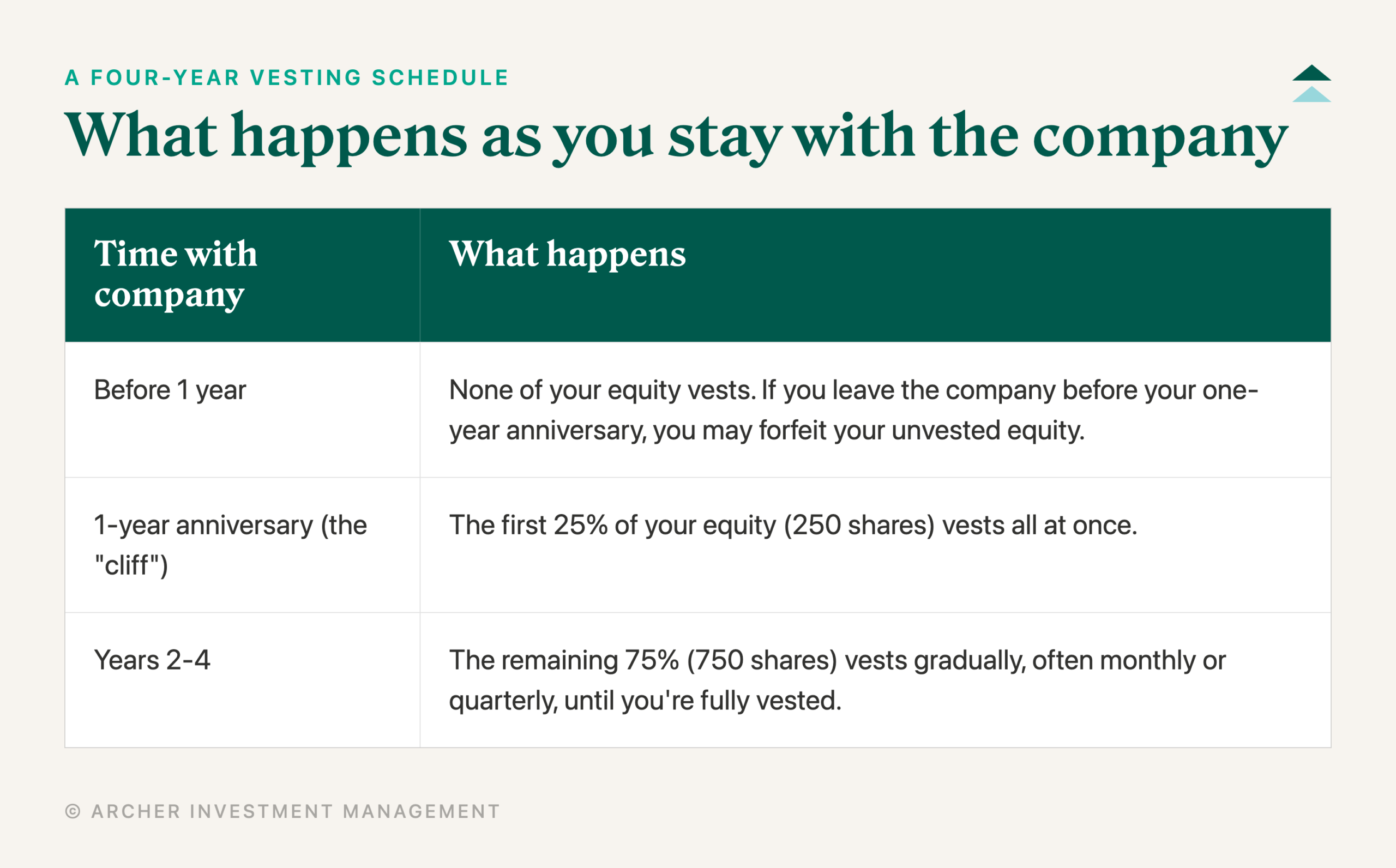
Many technology companies in Austin use a four-year vesting schedule with a one-year cliff.
None of your equity typically vests during your first year with the company. Once you reach your one-year anniversary (the “cliff”), the first portion of your equity—often 25%—vests all at once. The remaining equity then vests gradually, often monthly or quarterly, over the next three years.
Here’s how that might play out if your compensation package included equity representing 1,000 shares:
Some equity awards also include accelerated vesting if the company is acquired or experiences another major corporate event.
Depending on the terms of your equity compensation plan, some or all of your unvested equity may vest sooner than originally scheduled. Because these provisions vary by employer, it’s important to review your equity plan documents so you understand how your company’s program works.
Owning equity doesn’t always mean you can sell it whenever you want.
One of the biggest surprises for employees at private companies is that even if their shares increase in value, there may not be anyone available to buy them. In many cases, employees have to wait until the company goes public, is acquired, or offers another approved opportunity to sell their shares.
This is known as a liquidity event—a point when employees can convert company stock into cash.
Some private companies also create opportunities for employees to sell shares of company stock before an IPO.
These may include company-sponsored buyback programs or approved secondary market transactions, which allow eligible employees to sell vested shares under certain conditions.
Not every company offers these programs, so make sure you look into the options available through your employer when the time comes to sell your company stock.
Tax Implications of Equity Compensation
One of the biggest advantages of living and working in Texas is that the state doesn’t impose a personal income tax. That means you likely won’t pay Texas state income tax on your equity compensation.
Federal tax rules, however, still apply—and those rules vary depending on whether you receive RSUs, ISOs, NSOs, or participate in an ESPP.
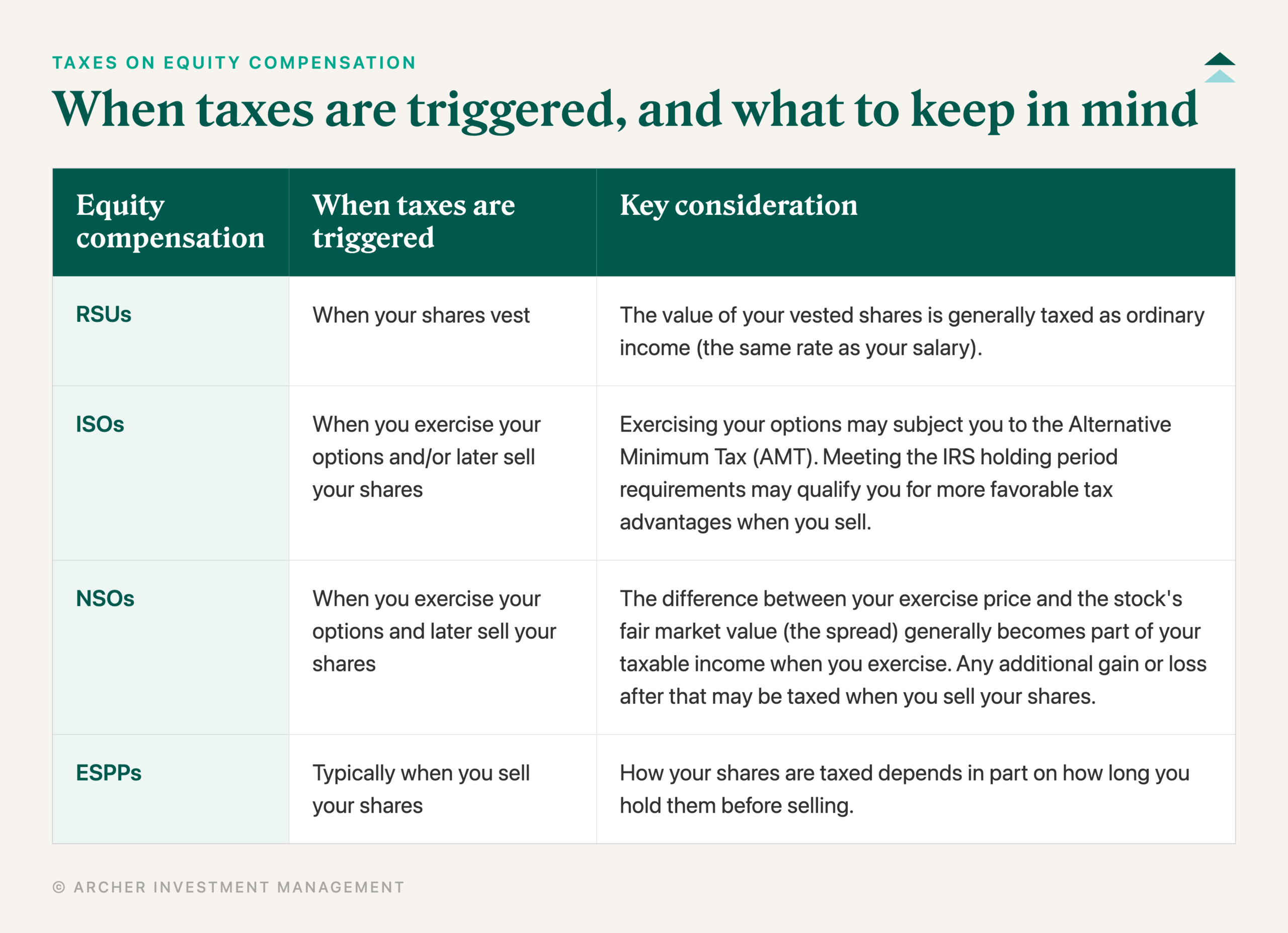
One unique feature of Incentive Stock Options (ISOs) is the Alternative Minimum Tax (AMT).
Exercising ISOs doesn’t automatically mean you’ll owe AMT. However, exercising options with a large bargain element—the difference between your strike price and the stock’s fair market value when you exercise—may increase the likelihood that AMT applies.
Because AMT calculations depend on your overall financial situation, it’s difficult to predict whether you’ll owe additional taxes without looking at your complete tax picture.
If you’re considering exercising a significant number of ISOs, working with a tax professional and financial advisor who understands equity compensation before making your decision can help you understand the potential impact.
Unlike ISOs, NSOs typically don’t trigger the AMT. Instead, the difference between your exercise price and the stock’s fair market value (the spread) generally becomes part of your taxable income when you exercise your options.
Here are a few strategies that may help you manage the tax implications of equity compensation:
- Understand when each type of equity compensation may trigger taxes.
- Plan the timing of ISO and NSO exercises, as well as company stock sales, carefully.
- Consider the tax consequences before exercising options or selling company shares. .
- Work with a financial advisor and tax professional before making significant equity-related decisions.
Smart Strategies for Managing Equity Compensation
Making the most of equity compensation requires thoughtful planning. The decisions you make about exercising, selling, or holding your shares can affect your taxes, investment strategy, and long-term financial goals.
Diversify your investments
If your company’s stock performs well, it’s easy for a large portion of your wealth to become tied to a single company. Gradually diversifying your investments may help reduce risk while preserving the wealth you’ve built.
Watch out for: Letting too much of your financial future depend on the performance of a single company.
Decide when to exercise ISOs thoughtfully
Exercising Incentive Stock Options (ISOs) isn’t always something you should do as soon as they vest. Before exercising your ISOs, consider your available cash, confidence in the company’s future, and the potential tax implications. If you’re planning to leave the company, pay close attention to any exercise deadlines. Many of these same planning considerations also apply to NSOs, although they’re taxed differently.
Watch out for: Waiting too long to exercise your stock options, or missing opportunities to exercise or sell when it makes the most sense for your situation.
Develop a strategy for your RSUs
When your Restricted Stock Units (RSUs) vest, you’ll need to decide whether to keep your shares or sell some or all of them. Some employees sell enough shares to help cover taxes and diversify their investments, while others hold them if doing so supports their long-term strategy. The right approach for you depends on your goals and overall portfolio.
Watch out for: Letting your default decision be to “do nothing” instead of deciding whether selling or holding supports your long-term goals.
Be strategic about ESPP contributions
Choose a contribution amount that fits comfortably within your budget, and consider how much of your savings is already invested in your employer’s stock. Once you’ve purchased shares, decide whether selling or holding them best supports your priorities and tax situation.
Watch out for: Contributing more than you can comfortably afford, selling too quickly without considering potential tax advantages, or allowing too much of your wealth to remain invested in your employer’s stock.
Make equity compensation part of your financial plan
Rather than thinking of equity compensation as an “extra,” make it part of your overall financial plan. Whether you’re saving for retirement, buying a home, or funding another long-term goal, your equity decisions should support your broader financial priorities.
Keep in mind: The best equity compensation strategy isn’t necessarily the one that minimizes taxes or maximizes returns—it’s the one that fits your overall financial plan.
Austin Tech Company Equity Compensation FAQs
What’s the difference between RSUs, ISOs, and ESPPs?
RSUs, ISOs, NSOs, and ESPPs are all forms of equity compensation, but they each work differently. RSUs turn into company stock once your shares vest. ISOs and NSOs give you the option to purchase company stock at a fixed price (called the strike price) after vesting, but they’re taxed in different ways. ESPPs allow employees to purchase company stock through after-tax payroll deductions, often at a discount. The type of equity compensation you receive usually depends on the programs your employer offers, your role and/or relationship to the company, and the company’s lifecycle.
Can I participate in more than one equity compensation program?
Yes. If your employer offers multiple equity compensation programs and you’re eligible to participate, you may receive more than one type of equity compensation. For example, an employee at a public technology company might be granted RSUs as part of their compensation package while also participating in the company’s ESPP. You may also receive different forms of equity compensation over the course of your careers as you change employers or as your role or the company’s compensation programs evolve.
What happens to unvested equity if I leave my job?
In many cases, unvested equity is forfeited when you leave the company. Vested equity may remain yours, but the rules vary depending on the type of equity compensation and your employer’s plan. For example, vested ISOs often have a limited exercise window after you leave the company. Depending on your employer’s plan, similar deadlines may also apply to NSOs. Review your equity plan documents carefully before leaving your employer so you understand the deadlines and requirements that apply to your situation.
How do IPOs and acquisitions affect my equity?
An IPO or acquisition can significantly change how your equity works. For employees at private companies that go public, these events may create an opportunity to sell shares that were previously difficult to convert into cash. Depending on your equity plan, an acquisition may also trigger accelerated vesting for some or all of your unvested equity. The exact outcome depends on what your employer’s plan documents say and the terms of the transaction.
Are there unique tax benefits for Texas employees?
Texas does not have a state income tax, which means you typically won’t owe state income tax on equity compensation if you live and work in Texas. However, federal tax rules still apply. Depending on the type of equity compensation you receive, you may owe ordinary income tax (the same tax rates that generally apply to wages), capital gains tax when you sell shares that have increased in value, or, in the case of some ISOs, the Alternative Minimum Tax (AMT). On the other hand, Nonqualified Stock Options (NSOs) are usually taxed when you exercise your options. A tax professional or financial advisor can help you understand how these rules apply to your situation.
Should I sell my company stock right away or hold it?
There’s no one-size-fits-all answer. The best decision depends on your financial and tax situation, and how much of your overall wealth is already invested in your employer’s equity comp program. Some employees choose to sell shares to diversify their investments, while others hold onto their shares because they believe in the company’s long-term potential. Rather than asking whether you should always sell or always hold, consider how that decision supports the future you’re trying to build and your liquidity needs. A financial advisor can help you evaluate trade-offs and develop a strategy that fits your overall financial plan.
Turning Your Equity Into Freedom, Flexibility, and Financial Resources You Can Use
Receiving equity compensation can be exciting, but making the most of it takes thoughtful planning. Between vesting schedules, taxes, and investment decisions, it’s easy to focus on the details without stepping back to see how it all fits together.
The good news is that equity comp doesn’t have to be confusing.
Understanding the details of your equity compensation package and what your options look like is a great place to start.
Whether you’re deciding when to exercise options, sell shares, or hold them as part of a long-term investment strategy, thoughtful planning can make a meaningful difference in what you’re able to turn your equity into for yourself and your family.
Get Personalized Guidance for Your Equity Compensation
If you’re receiving equity compensation from an Austin technology company, you don’t have to navigate those decisions alone.
Archer Investment Management helps tech professionals understand their equity, map out their options, and coordinate with their CPA to understand the tax impacts.
Whether you’re evaluating a new job offer, deciding when to exercise stock options, or building a long-term strategy for managing RSUs, ISOs, NSOs, and ESPPs, we’re here to help.
Schedule a call with us to understand all your options, easily weigh trade-offs, and build a financial plan around what matters most to you.
This article is for general educational purposes only and is not individualized tax, legal, or investment advice. Tax rules are complex and can change, and outcomes depend on your specific situation. You should consult your CPA and/or attorney regarding your circumstances. Archer Investment Management is an SEC-registered investment adviser; registration does not imply a certain level of skill or training. Investing involves risk, including the possible loss of principal.