

- Texas doesn’t tax capital gains, but the federal government does. If you live in Texas and sell an appreciated asset for a profit, you may owe federal capital gains tax depending on what you sell, how long you’ve owned it, and your taxable income.
- The amount an asset has gone up in value isn’t necessarily the amount you’ll be taxed on. Your taxable gain is generally based on the difference between what you receive from the sale and your adjusted tax basis, which starts with what you paid for the asset and may change over time based on factors such as improvements, expenses, and depreciation.
- What you’re selling matters. Stocks, real estate, business interests, cryptocurrency, inherited or gifted assets, and other investments can come with different tax rules and considerations.
- Planning ahead may give you more options. Timing a sale, selling gradually, using capital losses, donating appreciated assets, and planning large transactions in advance are some strategies that may help you minimize the amount of federal tax you owe.
Texas is one of a handful of states that doesn’t tax capital gains at the state level. It also doesn’t have a personal income tax.
That means if you’re a Texas resident and you sell stocks, real estate, a business, cryptocurrency, or other appreciated assets for more than you paid, the state won’t tax the profits.
Federal taxes are a different story.
Depending on what you’re selling, how long you’ve owned it, and your taxable income, you may still owe federal capital gains taxes.
The good news? Understanding the rules before you sell can help you plan ahead and avoid unexpected tax consequences.
Here’s what you need to know about capital gains taxes in Texas.
Is There a Capital Gains Tax in Texas?
The short answer is no. If you’re a Texas tax resident, you don’t have to pay a Texas capital gains tax when you sell an appreciated asset.
Texas doesn’t tax profits from selling stocks, real estate, a business, cryptocurrency, private investments, or other assets.
But federal capital gains taxes may still apply when you sell an asset for more than it’s worth for tax purposes, known as your tax basis.
Your tax basis is generally what you paid for the asset, adjusted for certain costs or other factors. (We’ll cover how tax basis works later in this guide.)
That’s why the phrase “Texas capital gains tax” can be confusing.
While Texas doesn’t tax capital gains at the state level, the federal government may still tax all or part of your gain.
In other words, the state tax may be zero, but your federal tax bill could still be significant.
One advantage of living in Texas is that you don’t have to worry about paying both federal capital gains tax and Texas state income tax on the same gain.
In many other states, both may apply.
Moving to Texas Doesn’t Always Mean Zero State Tax
If you’re moving to Texas from another state, don’t assume that establishing Texas residency automatically eliminates state income tax on every future capital gain.
In some situations, your former state may still tax a gain based on when the sale occurs, where the asset is located, or how the income was earned.
For example, a former state may still tax:
- A sale completed before you become a Texas resident. If you sell appreciated investments while you’re still a resident of your former state, that state may tax the gain even if you move to Texas shortly afterward.
- Real estate located in your former state. If you move to Texas but continue to own a rental property, vacation home, land, or other real estate in your former state, that state will generally continue to tax the gain when you sell the property because the income is sourced to where the property is located.
- Certain equity compensation earned while working in your former state. Stock options, ESPPs, RSUs, and other forms of equity compensation can have different state tax rules. A portion of the income may remain taxable by the state where the underlying services were performed, even after you move to Texas.
- Installment-sale income from certain assets. If you sell an asset before moving and receive payments over several years, your former state may continue to tax income from the sale depending on the asset and the state’s sourcing rules.
- Certain business or partnership interests. Gains from selling an interest in a business or partnership can have state-specific sourcing rules, particularly when the business owns real property or operates in the former state.
The rules vary significantly by state and by asset type. The timing of your move alone isn’t always enough to determine whether another state can tax a gain. If you’re planning a move to Texas around a large liquidity event, review the transaction and your residency status before the sale occurs.
What Creates a Federal Capital Gain?
A capital gain doesn’t happen simply because an asset you own has gone up in value.
In many cases, you create a capital gain when you sell or otherwise dispose of an asset for more than your adjusted tax basis, which is generally what the IRS considers your cost for tax purposes.
For example, imagine you purchased shares of a fast-growing technology company for $10,000. Over several years, those shares grew in value to $25,000.
Even though your investment has gained value, you generally don’t owe capital gains tax until you sell it and lock in the gain.
Your taxable gain generally depends on the difference between what you receive from the sale and your adjusted tax basis.
For many assets, your tax basis starts with what you originally paid. Over time, however, that number can change.
Capital improvements, reinvested dividends, depreciation, inherited or gifted assets, and other adjustments can all affect your adjusted tax basis—and ultimately how your gain is calculated for tax purposes.
That’s why it’s so important to keep good records for any appreciated assets you own.
The following sections explain some of the common situations that can increase or decrease your tax basis and why those adjustments matter when it’s time to sell.
Realized and Unrealized Gains
As long as you continue to own an asset, any increase in its value is considered an unrealized gain because it hasn’t yet been triggered by a sale or other taxable transaction.
Let’s go back to our earlier example. Those shares of a fast-growing technology company you purchased for $10,000 are now worth $25,000. On paper, you’ve made a $15,000 profit.
But as long as you continue to own those shares, you don’t owe capital gains tax.
Once you sell those shares and lock in the $15,000 profit, that unrealized gain becomes what’s known as a realized gain.
That’s when federal capital gains taxes may apply for Texas residents.
Selling shares of stock, closing on the sale of real estate, selling a business interest, exchanging certain assets, or liquidating part of a taxable investment portfolio are all common taxable events that can create a realized gain.
Adjusted Basis and Net Sale Proceeds
In many cases, calculating a taxable gain on an appreciated asset isn’t as simple as subtracting the original purchase price from the sale price.
When calculating a capital gain, the IRS starts with what you paid for the asset and then adjusts that number over time to account for certain events. The result is your adjusted tax basis.
Depending on the asset, capital improvements, reinvested dividends, depreciation, inherited or gifted basis, and other prior tax adjustments can all affect your adjusted tax basis and, ultimately, the gain or loss you report when you sell the asset.
The amount you actually receive from the sale matters, too.
Net sale proceeds are what you receive after certain selling expenses (i.e., commissions, closing costs, etc.) have been deducted. Your taxable gain is based on the difference between your net sale proceeds and your adjusted tax basis.
It’s important to distinguish between an asset’s appreciation and your taxable gain.
An asset may increase substantially in value over time, but your adjusted tax basis helps determine how much of that appreciation is considered taxable gain when you sell.
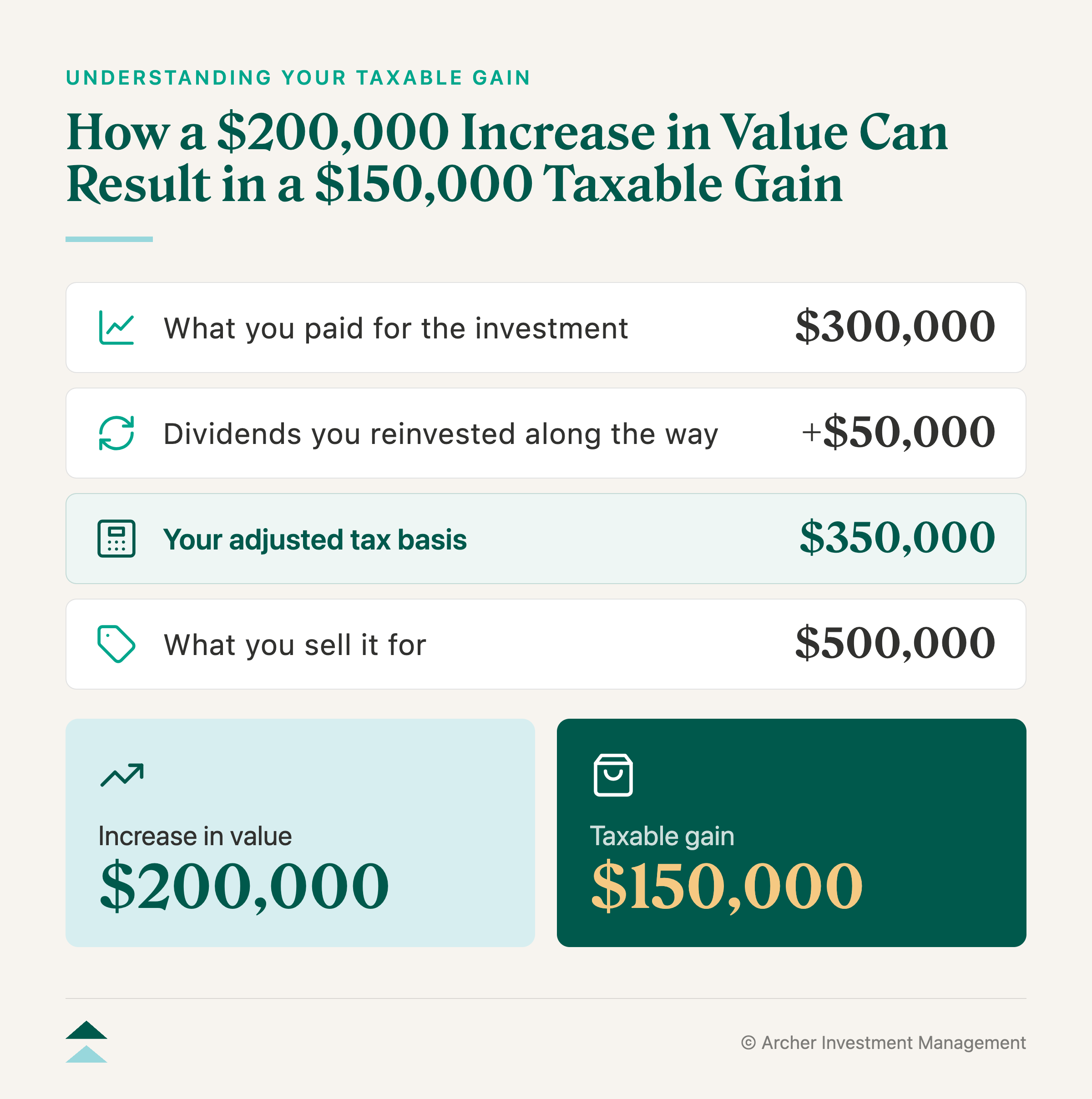
For example, imagine you purchase a rental property for $300,000. Over the next 10 years, you spend $50,000 on replacing the roof and remodeling the kitchen.
Those capital improvements don’t automatically increase the property’s market value by $50,000, but they may increase your adjusted tax basis by that amount. That means, for tax purposes, your adjusted tax basis could increase from $300,000 to $350,000.
If you later sell the property for $500,000, the property has appreciated by $200,000. But because your adjusted tax basis is $350,000, your taxable gain may be only $150,000.
It’s also important to keep complete records to make sure you’re accurately reporting your taxable gain on an appreciated asset.
That includes documents showing what you paid for the asset, such as settlement or brokerage statements, records of qualifying improvements or reinvestments, and documentation of selling expenses.
If you can’t document increases to your adjusted tax basis, you may not be able to include them when calculating your gain. That could make your taxable gain appear larger than it actually is, potentially causing you to pay more tax than necessary.
Incomplete records can also make it more difficult to support the numbers reported on your tax return if questions come up later.
Short-Term and Long-Term Treatment
The length of time you’ve owned an asset before selling it can have a significant impact on how it’s taxed.
Under federal tax rules, capital gains are classified as either short-term or long-term.
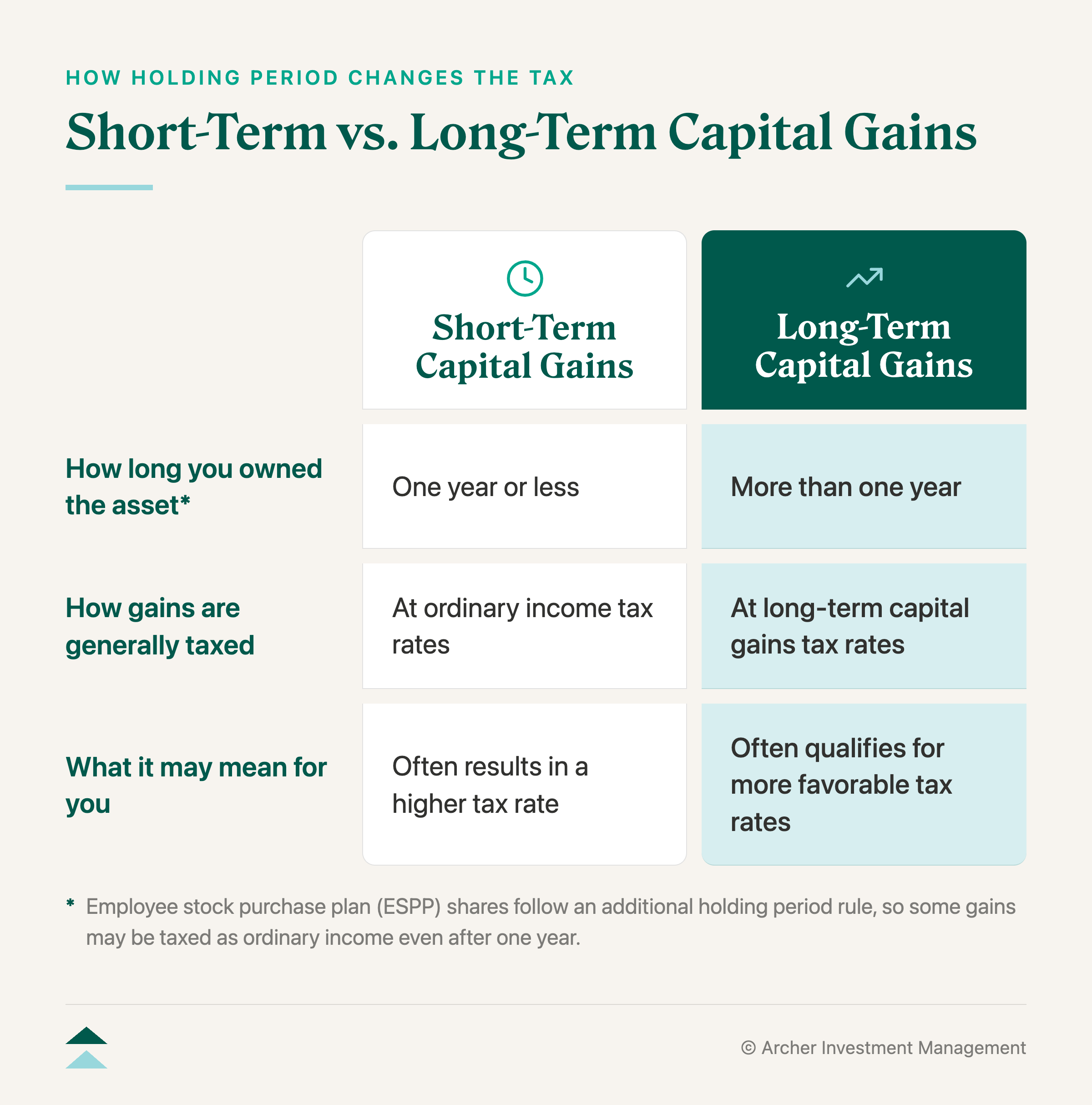
Assets held for one year or less before they’re sold typically are treated as short-term capital gains. Assets held for more than one year usually are treated as long-term capital gains.
Because long-term capital gains tax rates are often lower than the rates that apply to short-term gains, the timing of a sale can make a meaningful difference in how much tax you’ll pay.
If you’re planning to sell an appreciated asset, it’s worth reviewing how long you’ve owned it before completing the transaction. Waiting a few days or weeks to qualify for long-term treatment could reduce your tax liability, depending on your situation.
Of course, taxes are only one consideration. Your cash needs, investment goals, and overall financial plan may make selling sooner a better choice.
Capital Losses
If you sell a taxable investment for less than its value for tax purposes, you may have a capital loss instead of a capital gain.
Capital losses offset capital gains dollar for dollar, potentially reducing the amount of gain that’s subject to tax. Capital losses can also offset up to $3,000 of active income each year, and any leftover losses can carry forward into future tax years until they’re fully used up.
For example, say you sell an investment and realize a $15,000 capital gain, then sell another and realize a $9,000 capital loss. The $9,000 capital loss offsets a portion of the $15,000 gain, leaving a remaining gain of $6,000, which may be taxable.
Whether it makes sense to realize a capital loss depends on your overall financial picture, not just the tax impact. A financial professional or tax advisor can help you evaluate your options.
Common Assets That Create Capital Gains Questions for Texas Residents
If you sell an investment or other appreciated asset for a profit, you may owe federal capital gains tax.
The details, however, can vary depending on the asset.
Selling stocks isn’t the same as selling a rental property, a business, or cryptocurrency. Different assets may have different recordkeeping requirements, exclusions, and reporting rules.
In the sections below, we’ll look at some of the common assets that raise federal capital gains tax questions for Texas residents.
Taxable Investment Accounts
Many people own stocks, mutual funds, exchange-traded funds (ETFs), and bonds through a taxable brokerage account.
If you sell one of these investments for a profit, you may owe federal capital gains tax. The amount depends on several factors, including how long you owned the investment and your overall tax situation.
Mutual funds work a little differently because they’re professionally managed portfolios that pool money from many investors. Instead of deciding when to buy and sell investments yourself, a fund manager makes those decisions on behalf of the fund’s investors.
If the manager sells investments at a profit, you may receive what’s known as a capital gain distribution. That distribution may be taxable even though you didn’t personally sell your mutual fund shares.
Primary Homes and Real Estate
Selling your primary home (the home you live in) doesn’t always mean you’ll owe federal capital gains tax. You may qualify to exclude up to $250,000 of capital gain from federal tax, or up to $500,000 if you’re married and file a joint tax return.
In general, you qualify for the primary residence exclusion if you owned and lived in the home as your primary residence for at least two of the five years before the sale.
If you don’t meet these requirements, or your gain exceeds the exclusion amount, part of your gain may still be taxable.
Real estate investors face different considerations. Selling rental properties, vacation homes, land, ranches, and other properties often requires additional calculations to determine your taxable gain.
Improvements you’ve made over the years, depreciation claimed on rental property, certain closing costs, and other adjustments may all affect how much of your profit is ultimately taxable.
Because property sales often involve additional tax rules and calculations, consider talking with a financial professional or tax advisor before you sell.
Business Interests and Private Investments
Business interests can take several forms, including ownership, a partnership interest, private company stock, or startup equity.
Depending on the asset being sold, the transaction may be treated as capital gains, ordinary income (taxed at the same rates as your wages), or a combination of both.
Capital gains are generally taxed at lower federal tax rates than ordinary income, which can meaningfully impact how much you keep (or don’t) after taxes.
When selling a business, its legal structure and the structure of the sale can also affect its tax treatment.
For example, the purchase price may be divided among different business assets. Amounts allocated to inventory, for example, may be taxed as ordinary income, while amounts allocated to the value of the business’s reputation and customer relationships (often called goodwill) or stock may qualify for capital gains treatment.
Whether payments are received all at once or over several years, whether part of the proceeds are held in escrow, and the timing of the sale closing may also affect the type of tax you owe and when you have to pay it.
Cryptocurrency, Collectibles, and Nontraditional Assets
Cryptocurrency, collectibles, precious metals, art, and other nontraditional assets may be subject to different federal tax rules than traditional investments.
While selling these assets can create taxable gains, some transactions that don’t look like a traditional sale can also have tax consequences.
For example, because the IRS treats cryptocurrency and other digital assets such as Bitcoin and stablecoins as property rather than currency, using them to buy goods or exchanging one cryptocurrency for another may create a taxable event.
Collectibles, such as artwork, antiques, rare coins, and precious metals, may also be taxed differently than stocks and other traditional investments, depending on the asset type and how long you’ve owned it.
Keeping detailed records showing when you acquired the asset, what you paid for it, and what you received when you sold or exchanged it can help you accurately calculate and report any taxable gain to the IRS.
Inherited and Gifted Assets
An inherited asset is property you receive upon someone’s death. A gifted asset is property someone gives you during their lifetime.
Although selling either type of asset can create a capital gain, the IRS uses different rules to calculate that gain.
For inherited assets, the basis is generally reset to the property’s fair market value at the date of death.
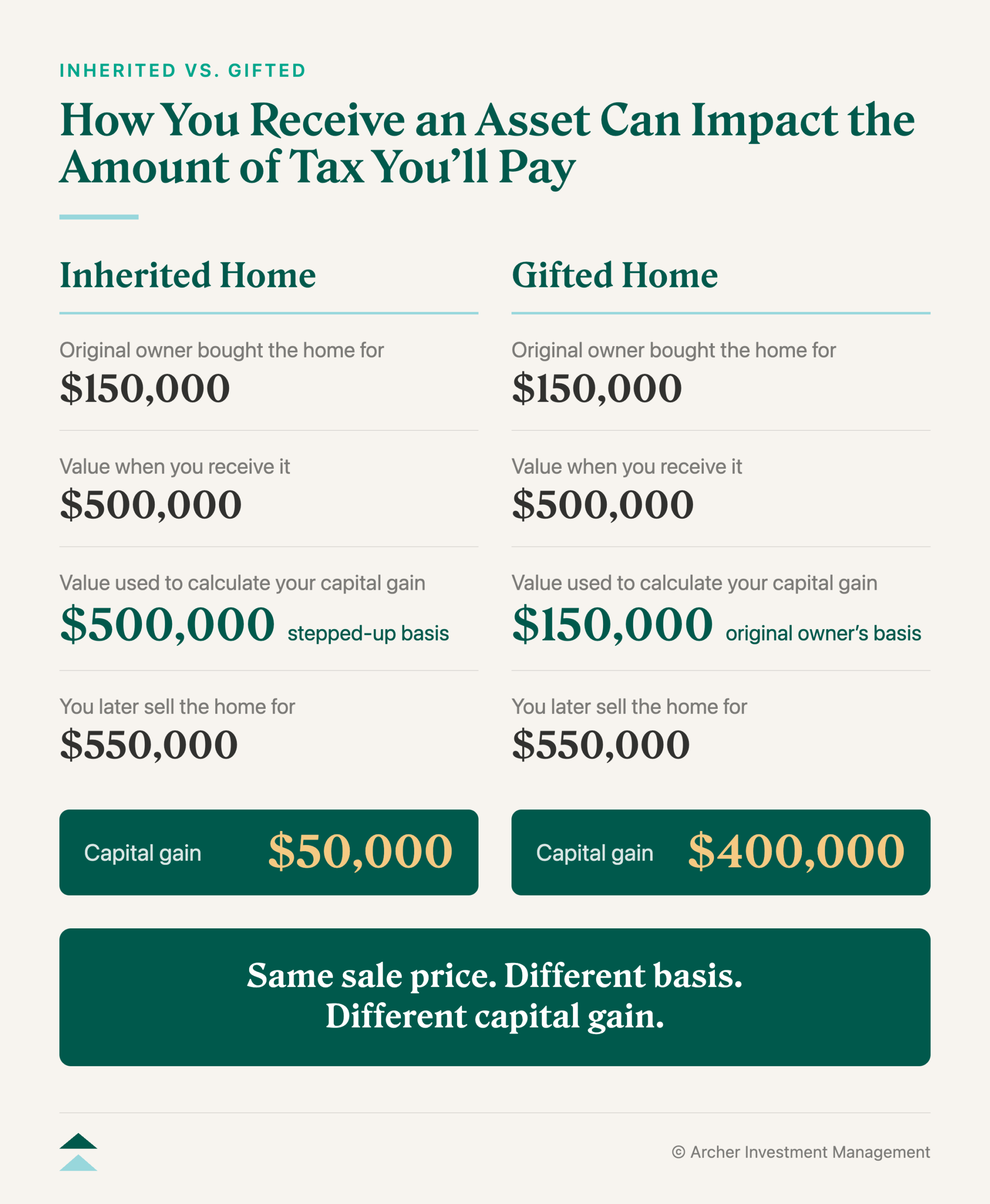
For example, imagine your aunt bought a house 30 years ago for $150,000. You inherit the house when she dies. At that time, it’s worth $500,000.
In many cases, your basis is “stepped up” to the fair market value; in this case, $500,000. If you sell the home later for $550,000, your taxable gain is typically based on the $50,000 it increased in value after you inherited it.
Gifted assets often retain the original owner’s basis, or the amount they paid when they bought it.
Using the same example, let’s say your aunt gifted you the house while she was still alive. In that case, your basis would be the $150,000 she originally paid for it.
If you sold the home later for $550,000, your taxable gain would be based on the $400,000 increase in value over your aunt’s original basis.
Before selling inherited or gifted real estate, securities, business interests, or other appreciated property, confirm the basis that will be used to calculate your capital gain.
For inherited assets, keep records such as a date-of-death appraisal or other documents showing the asset’s value when you inherited it.
For gifted assets, keep any records from the original owner showing what they paid for the asset and any information that helps establish the asset’s basis.
Having the right documentation can help you accurately calculate and report any taxable gain.
Closely Related Taxes and Costs That Are Not Texas Capital Gains Tax
Although Texas doesn’t tax capital gains, you may still encounter other taxes and costs when you sell an appreciated asset.
Knowing which taxes and costs may apply can give you a clearer understanding of how much you’ll actually keep from the sale.
Net Investment Income Tax
If you’re a higher-income taxpayer, you may also owe the federal Net Investment Income Tax (NIIT), an additional 3.8% tax on certain investment income, including capital gains.
The NIIT is separate from the federal capital gains tax and is not a Texas state tax.
Whether the NIIT applies depends on your income and other factors, so be sure to account for it when estimating the amount of tax you may owe on a sale.
Depreciation Recapture
If you sell rental property, business property, or another depreciated asset, you may owe more than the typical federal capital gains tax.
In some cases, part of your gain may be subject to depreciation recapture, a separate federal tax rule that generally applies when you’ve claimed depreciation deductions on the asset over time.
If you’ve claimed depreciation over the years, review your depreciation history before estimating your proceeds after taxes.
A financial professional or tax advisor can help you understand how these rules apply to your specific situation.
Ordinary Income Items in a Sale
When you sell a business, receive equity compensation, or exit an investment, you might assume every dollar you receive will be taxed as a capital gain.
However, different parts of the transaction may be taxed differently.
For example, compensation income, inventory, accounts receivable, certain contract rights, and retirement account distributions may be treated as ordinary income rather than capital gains for tax purposes.
Knowing how each part of the transaction is taxed can give you a better idea of how much you’ll actually keep and help you avoid surprises at tax time.
Property Taxes, Closing Costs, and Transaction Expenses
When you sell an asset, you may also pay Texas property taxes, title fees, broker commissions, legal fees, and other transaction costs.
These expenses are separate from the federal capital gains tax, even though they may arise as part of the same transaction.
Some of these costs may affect your capital gain, while others simply reduce the amount of money you receive from the sale.
For example, broker commissions may reduce the capital gain you report on an investment sale for tax purposes. Others, such as property taxes, are separate expenses that can reduce how much you ultimately keep from the sale of a home.
Looking at taxes and transaction costs together can give you a more realistic estimate of what you’ll walk away with after the sale.
Ways Texas Residents Can Manage Federal Capital Gains Exposure
Once you understand how federal capital gains taxes work, the next step is deciding how to plan for them.
Because Texas doesn’t have a state capital gains tax, many capital gains tax planning strategies for Texas residents focus on federal tax rules.
Before selling an appreciated asset, consider how it could affect your income, taxes, investments, cash needs, charitable goals, and other financial priorities.
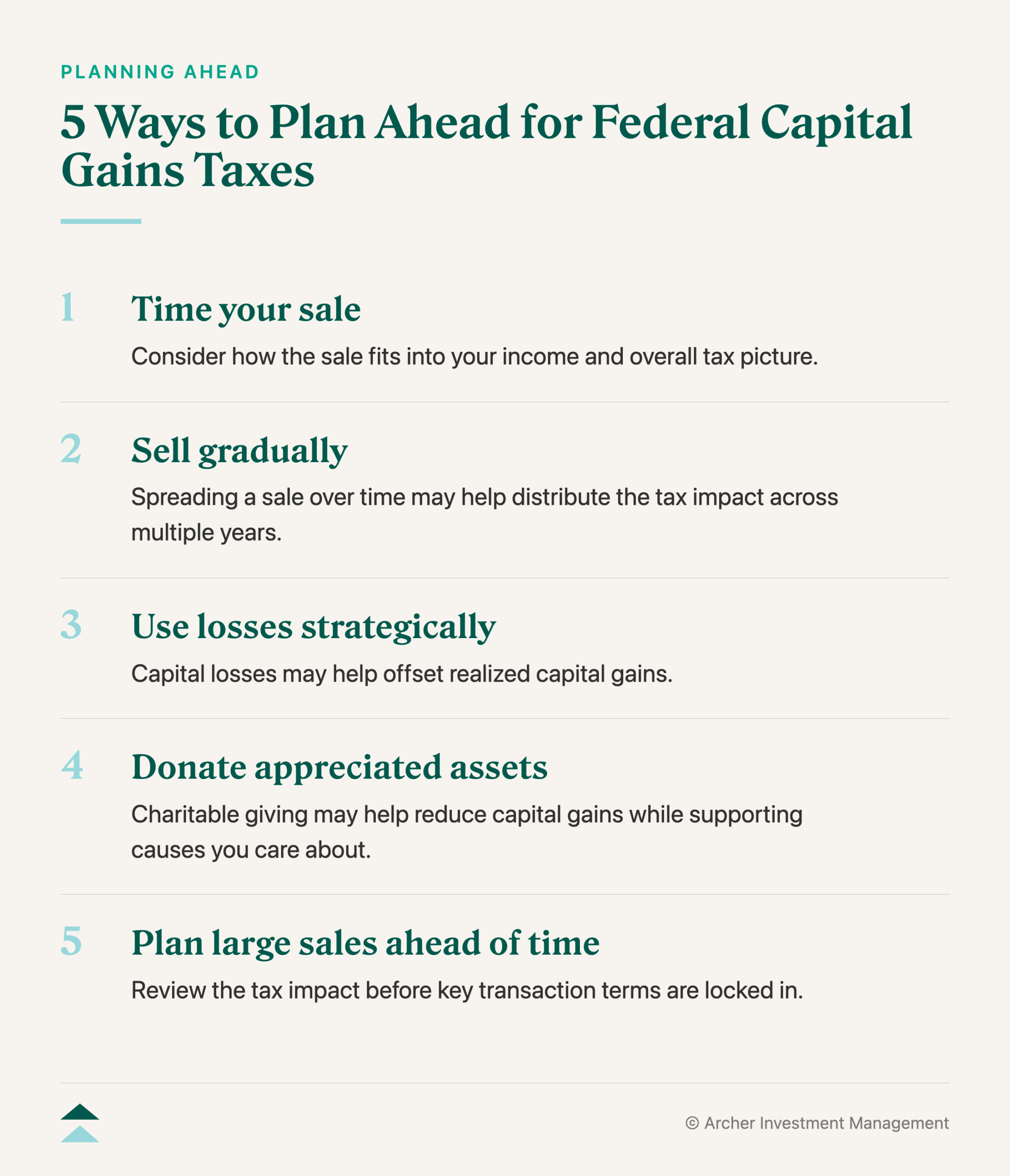
Timing a Sale Around the Full Tax Picture
The timing of a sale can influence the amount you may pay in federal taxes in a given year.
Depending on your circumstances, you may benefit from selling during a lower-income year, spreading sales across multiple years, or coordinating a sale around retirement, bonuses, business income, or significant deductions.
Instead of looking at the capital gain by itself, consider how the sale fits into your overall tax picture for the year.
Selling Gradually Instead of All at Once
Selling an appreciated asset over time instead of all at once may help spread the tax impact across multiple years while gradually creating access to cash.
It can also reduce concentration risk if a large portion of your wealth is tied up in a single investment or appreciated asset, such as company stock.
Using Capital Losses Intentionally
If some of your investments have declined in value, you may consider tax-loss harvesting. This strategy involves selling investments at a loss to help offset capital gains.
If your investment losses exceed your gains, you may be able to use up to $3,000 per year to offset ordinary income from your regular earnings on your federal tax return, and any remaining losses can generally be carried forward to future tax years.
Keep in mind taxes are only one consideration when deciding whether to sell an investment at a loss.
Donating Appreciated Assets
If charitable giving is important to you, consider donating appreciated long-term securities or other eligible assets directly to causes you care about.
That way, you may be able to avoid paying capital gains tax on the appreciation, as opposed to selling the assets and donating the cash to charity.
You may also qualify for a charitable tax deduction if you itemize.
In addition to potential tax benefits, donating appreciated assets may help diversify your portfolio and reduce concentrated exposure to any single investment.
Structuring Large Sales Before Terms Are Final
The structure of a business sale, real estate transaction, installment sale, or private investment exit can meaningfully affect how much you owe in federal taxes.
Once the payment schedule, sale structure, and other key terms are locked in, some strategies for minimizing tax impacts may be off the table.
Reviewing the proposed transaction and negotiating terms where appropriate can give you more flexibility and help you avoid tax surprises once the sale is finalized.
Records to Review Before Selling or Reporting a Gain
Before selling an appreciated asset or reporting a capital gain, review the records related to the purchase, ownership, and sale.
Keeping accurate records helps you estimate how much you may owe in federal taxes before the transaction and report the sale correctly on your tax return afterward.
The records you’ll need depend on the type of asset you’re selling.
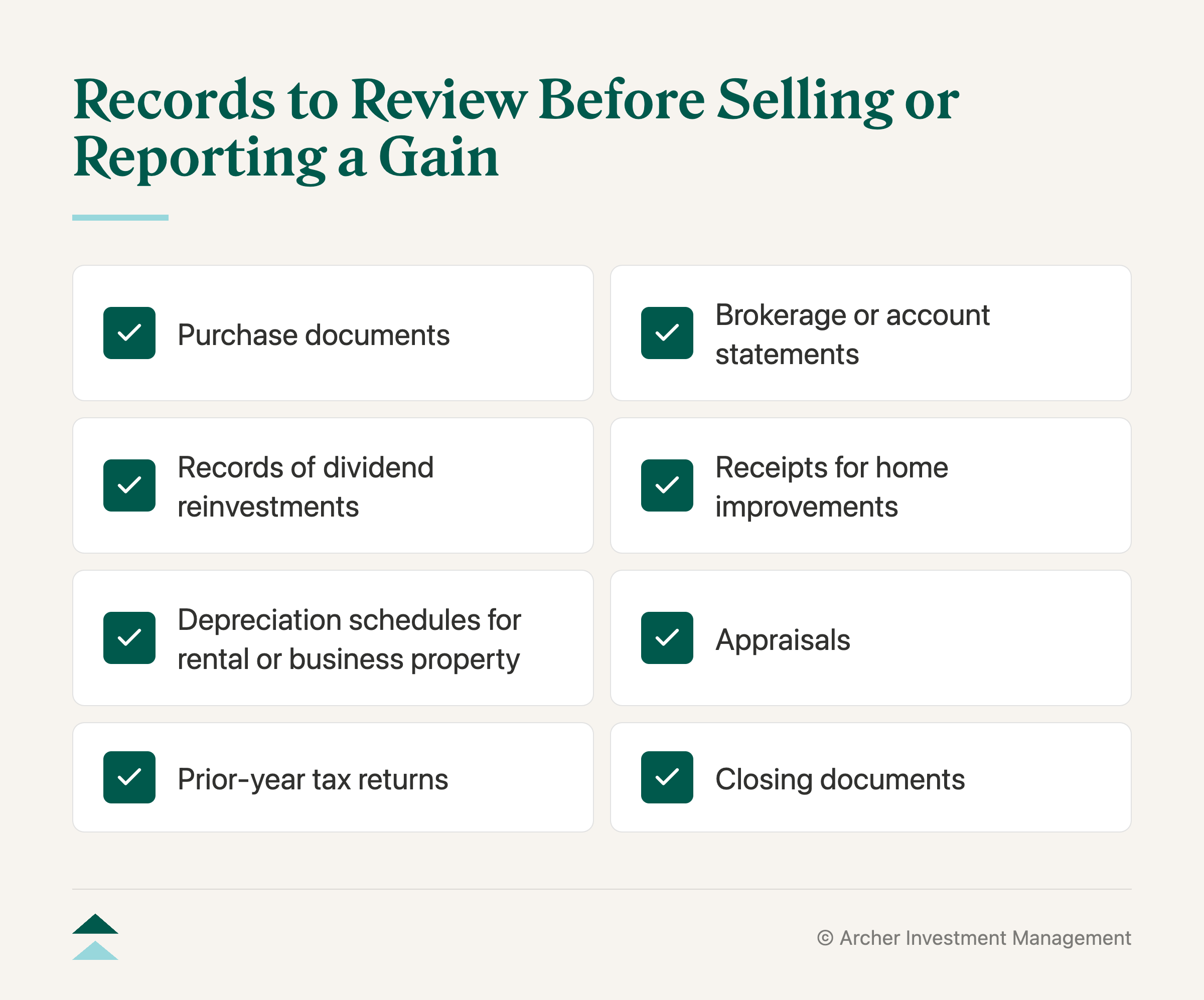
Missing or incomplete records can make it difficult to calculate your adjusted tax basis accurately. That could lead to reporting a larger gain than necessary, underpaying taxes, filing delays, or confusion about what belongs on your federal tax return.
Reviewing your records can also help you estimate how much money you’ll have available after taxes, determine whether you may need to make estimated federal tax payments, and understand how the sale could affect your annual tax obligation.
Good recordkeeping isn’t just administrative. It can directly affect the capital gain you report and how much you may ultimately keep from the sale.
Capital Gains Taxes in Texas FAQs
Is there a capital gains tax in Texas?
No. Texas does not impose a state capital gains tax.
However, Texas residents may still owe federal capital gains tax when they sell appreciated assets such as stocks, real estate, business interests, or other investments.
Do Texas residents still pay federal capital gains tax?
Yes. Even though Texas doesn’t tax capital gains, federal capital gains tax may still apply.
The amount you may owe depends on factors such as your taxable income, how long you owned the asset, and the type of asset you sold.
What is the difference between short-term and long-term capital gains?
Short-term capital gains apply to assets held for one year or less and are usually taxed at the same rates as wages and other ordinary income.
Long-term capital gains apply to assets held for more than one year and often qualify for lower federal tax rates.
Do I owe capital gains tax when I sell my Texas home?
Not always. Some homeowners may qualify to exclude up to $250,000 of capital gain from federal tax, or up to $500,000 if they’re married and file jointly, if they meet IRS ownership and use requirements.
If the gain exceeds those limits or the property doesn’t qualify, federal capital gains tax may apply.
Are gains from stocks, mutual funds, and cryptocurrencies taxable for Texas residents?
They can be. Although Texas doesn’t have a state capital gains tax, selling appreciated stocks, mutual funds, cryptocurrency, or other investments may trigger federal capital gains tax, depending on your circumstances.
Can capital losses reduce the tax owed on capital gains?
Yes. Capital losses can offset capital gains for federal tax purposes.
If your losses exceed your gains, you may also be able to use a limited amount to offset ordinary income, such as wages, each year and carry any remaining losses forward to future tax years.
What records should I review before selling appreciated assets in Texas?
Review records that help establish your adjusted tax basis, which generally starts with what you paid for the asset and may change based on certain expenses, improvements, or other adjustments.
Depending on the type of asset, these records may include purchase documents, account statements, dividend reinvestment history, receipts for home improvements, depreciation schedules, appraisals, prior tax returns, and closing documents.
Keeping complete records can help you estimate how much you may owe in federal taxes before a sale and report the transaction accurately afterward.
Get Help Planning Around Capital Gains Taxes in Texas
While Texas doesn’t have a state capital gains tax, federal capital gains tax may still apply when you sell an appreciated asset.
The timing, structure, and type of asset you’re selling can all affect how much of the proceeds you end up keeping.
Whether you’re selling investments, real estate, a business, inherited property, or another appreciated asset, understanding the potential tax impact before you sell can help you plan ahead and potentially keep more of the profits.
That’s where we come in.
Our team can help you estimate the potential federal tax implications of a sale, compare different sale scenarios, and evaluate strategies that may help reduce the tax impact.
We’re also here to talk through how the sale fits into your broader financial plan.
If you’re thinking about selling an appreciated asset and want to understand how the transaction could affect your tax situation, schedule a complimentary consultation.
Disclosure: Tax estimates and projections are based on information available at the time of analysis and are subject to change. Archer Investment Management does not provide legal or tax advice. Clients should consult their tax professional regarding their specific circumstances.
This article is for general educational purposes only and is not individualized tax, legal, or investment advice. Tax rules are complex and can change, and outcomes depend on your specific situation. You should consult your CPA and/or attorney regarding your circumstances. Archer Investment Management is an SEC-registered investment adviser; registration does not imply a certain level of skill or training. Investing involves risk, including the possible loss of principal.


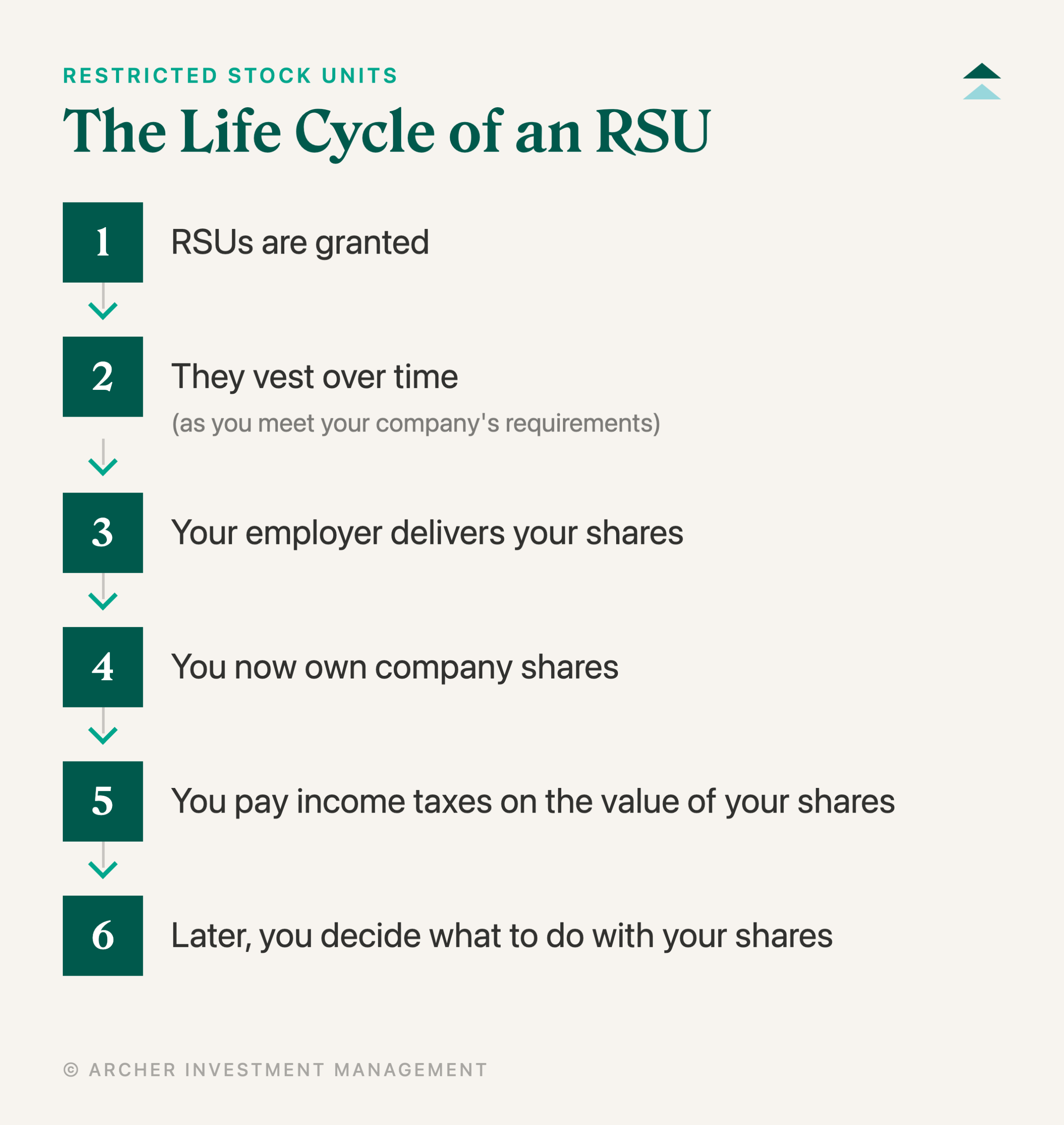
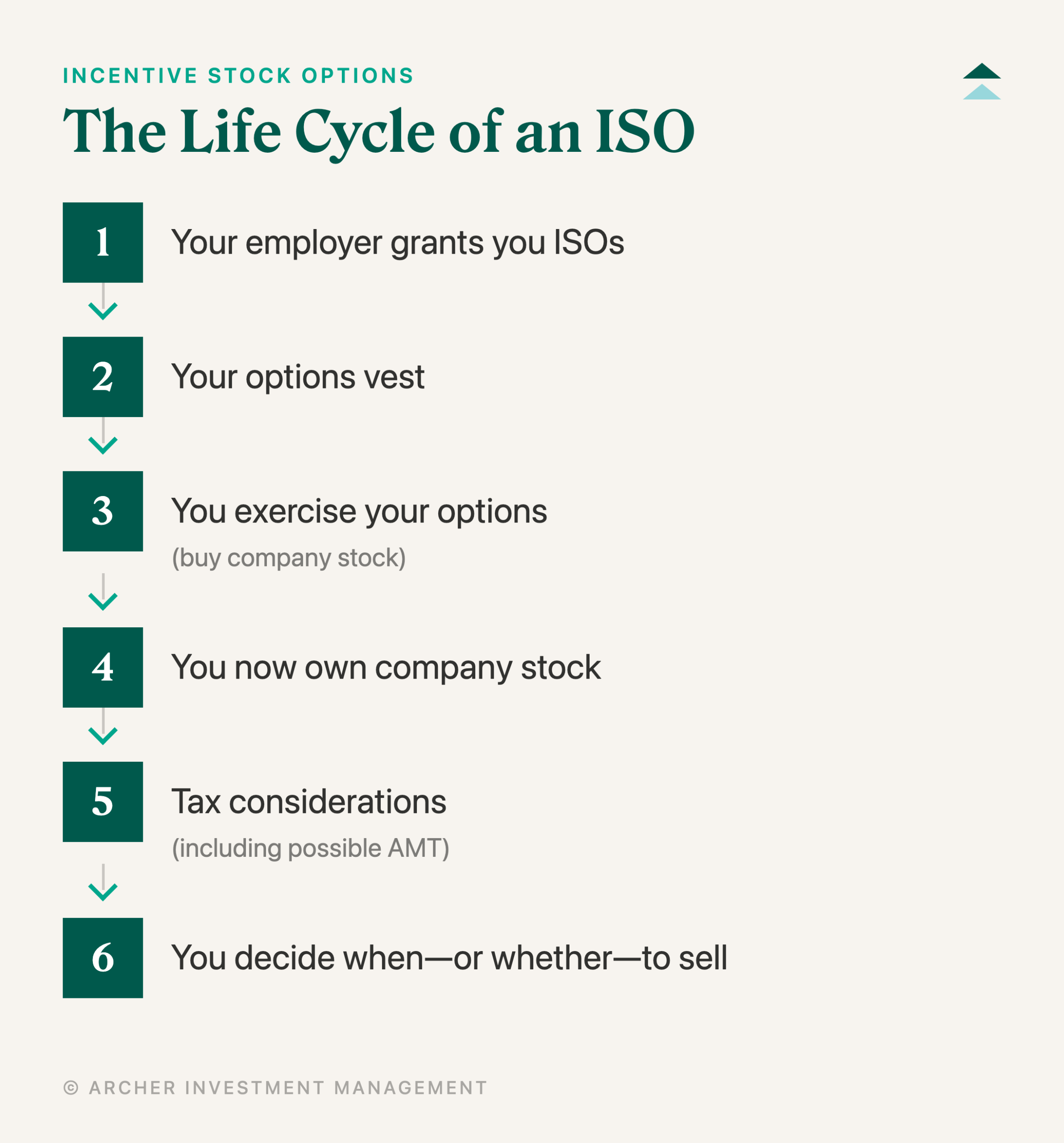






 What the Tax Picture Could Look Like
 The State-Tax Swing: Why Residency Matters in SpaceX IPO Planning
 IPO Wealth Is a Life-Planning Moment