

3 Ways SpaceX Employees Diversify Before the IPO (2026 Update)
Key Takeaways:
- Pre-IPO SpaceX employees have several ways to reduce concentration risk, but each strategy solves different trade-offs.
- Section 351 exchanges, options overlays, and exchange funds all involve trade-offs around taxes, control, liquidity, complexity, and upside potential.
- The right approach usually depends less on finding the “best” strategy and more on choosing the trade-offs that fit your goals, timeline, and risk tolerance.
Once SpaceX equity becomes a meaningful part of your net worth, diversification stops being a theoretical concept and starts feeling urgent.
In our work with pre‑IPO SpaceX employees, three strategies tend to come up most often when concentration risk becomes uncomfortable:
- Section 351 exchanges
- Options overlay strategies
- Exchange funds
All three aim to reduce single‑stock risk—but they work in very different ways, with very different trade‑offs. Understanding those differences is critical before committing to any one approach. Let’s break them down.
Big Picture: Three Paths to Managing Concentration Risk
At a high level, these strategies answer different questions:None is universally “better.” Each fits different priorities around taxes, control, liquidity, and complexity, especially important considerations before an IPO.
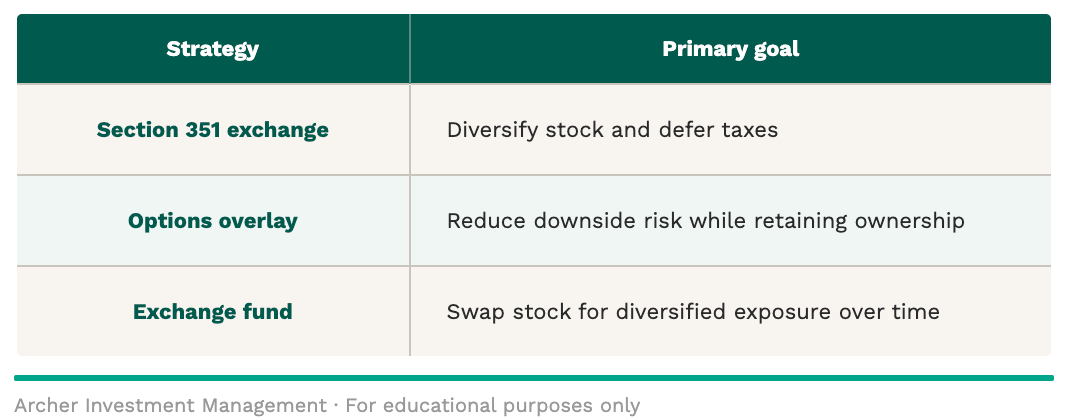 None is universally “better.” Each fits different priorities around taxes, control, liquidity, and complexity, especially important considerations before an IPO.
Talk to your financial advisor to understand how this applies to your personal situation.
Section 351 Exchanges: Structural Diversification with Tax Deferral
A Section 351 exchange allows you to contribute SpaceX shares into a newly created entity in exchange for ownership in a diversified investment vehicle—without triggering immediate capital gains taxes.
Best for pre‑IPO SpaceX employees who:
- Have extremely low cost basis
- Are comfortable with long lockups
- Want immediate diversification
- Prioritize tax deferral over flexibility
Key advantages
- No capital gains tax at the time of exchange
- Immediate reduction in single‑stock exposure
- Professionally managed diversification
Trade‑offs
- Loss of control over assets and tax timing
- Multi‑year illiquidity
- Meaningful fees and complexity
- Deferred taxes still come due later
A Section 351 plan is often the most aggressive diversification tool, but also the least flexible.
Options Overlays: Risk Management Without Selling Stock
Options overlay strategies (such as collars or covered calls) use derivatives to define downside risk and/or generate income, while allowing you to continue owning your SpaceX shares.
For pre‑IPO employees, these are sometimes used when liquidity events are expected, but timing remains uncertain.
Best for pre‑IPO SpaceX employees who:
- Want to retain ownership and control
- Are comfortable with complexity
- Expect future liquidity (IPO or tender)
- Prefer incremental risk reduction
Key advantages
- No sale of shares
- Retains upside (to a point)
- Can reduce volatility or generate income
Trade‑offs
- No true diversification
- Requires ongoing management
- Costs can erode returns
- May cap upside during major positive events
Options overlays manage risk, not concentration. Your net worth is still tied to SpaceX.
👉 Learn more about our financial planning work with high-earning tech executives, or read our broader guide to SpaceX IPO financial planning.
Exchange Funds: A Middle Ground—With Constraints
Exchange funds pool stock from multiple investors and allow participants to exchange their concentrated shares for interests in a broadly diversified fund.
Unlike Section 351 exchanges, many exchange funds are long‑standing vehicles with predefined structures.
Best for pre‑IPO SpaceX employees who:
- Want diversification without selling
- Can tolerate long lockups
- Are comfortable with limited transparency
- Don’t need near‑term liquidity
Key advantages
- Diversification without immediate taxes
- Exposure to a portfolio of other stocks
- Familiar structure for many high‑net‑worth investors
Trade‑offs
- Very limited liquidity (often 7+ years)
- Less control over holdings
- Fees and structural constraints
- Concentration can still re‑emerge at exit
Exchange funds can feel intuitive, but they are not liquid solutions, and exits often arrive later and differently than investors expect.
How Pre‑IPO SpaceX Employees Typically Combine These Strategies
In practice, most SpaceX employees don’t choose just one. Instead, diversification tends to happen in stages, as liquidity options evolve:
- Early career: tolerate concentration, build cash reserves
- Pre‑IPO maturation: evaluate options overlays or partial transfers
- Liquidity events: layer in direct sales and tax planning
- Post‑IPO: reassess full portfolio diversification
Section 351 plans may play a role, but often alongside more flexible tools that preserve future optionality.
There’s No “Best” Strategy; Only the Right Trade‑Off For You
The most common mistake we see is evaluating these strategies in isolation. The real question isn’t: “Which strategy is best?” It’s: “Which set of trade‑offs am I most comfortable living with?”
For pre‑IPO SpaceX employees, trade‑offs around liquidity, control, taxes, and risk tolerance matter more than theoretical returns.
Our team of CERTIFIED FINANCIAL PLANNER® professionals (serving clients nationwide, virtually) works with SpaceX employees to help them understand their equity, explore their options, and build personalized financial plans around what matters most to them.
If a large portion of your net worth is tied to SpaceX stock, a thoughtful plan can help you think more clearly about taxes, liquidity, concentration risk, and what this wealth is meant to do for your life.
Book a call to build a thoughtful plan for your SpaceX equity, so you can worry less about money and focus more on the life you are building.
This article is for general educational purposes only and is not individualized tax, legal, or investment advice. Tax rules are complex and can change, and outcomes depend on your specific situation. You should consult your CPA and/or attorney regarding your circumstances. Archer Investment Management is an SEC-registered investment adviser; registration does not imply a certain level of skill or training. Investing involves risk, including the possible loss of principal.