
When You Should or Should Not Max Out Your 401(k)
At Archer Investment Management, we help tech professionals and pre-retirees gain clarity and confidence about their financial futures — so they can worry less about money and focus more on enjoying the life they’ve worked hard to build.
Many of our clients are high earners navigating tech equity compensation, IPO windfalls, and high-stress roles, or individuals preparing for retirement who want a smooth and confident transition.
What makes us unique as financial advisors is our belief that money isn’t just math — it’s deeply connected to your decisions, your dreams, and sometimes even your worries.
That’s why we design financial plans that don’t just prepare you for the future, but also make your life feel better today.
By weaving together financial planning, tax strategies, and investment management with proactive guidance, we help clients replace stress and second-guessing with clarity, confidence, and more room for the things that matter most.
The result is a clear plan that reduces stress and creates flexibility in your financial life.
Whether you’re aiming to retire early, shift into more fulfilling work, or maximize the wealth you’ve worked so hard to build.
Here’s what clients say about working with Archer:
“I was quite literally afraid of getting help and of all that it involved. It’s been wonderful. No kidding: best decision ever!
I’m not finance-oriented by any measure, but luck came my way for once and I found myself having enough assets to need some help. Only I didn’t know what kind of help I needed and it’s easy to get overwhelmed quickly and I was on like year number whatever of being overwhelmed and I just kicked that can down the road every year.After a short search, I found Archer’s team and quickly just pushed other options off the table and signed on. They’ve actually been able to simplify things in a way that makes me feel like I can manage my life and not worry about it all for the first time in years. I basically had all eggs, but no basket. Now I have a comprehensive plan from some incredible staff and I actually love the process instead of dreading the matter.
Simply put, Archer has changed how I view my own finances and what used to be a cause of stress for me is now a giant sigh of relief. I said in the title it was the best decision ever and I mean it: this has 100% seriously no-fingers-crossed changed my life. If you’re like me and you’ve been debating if you even need this kind of help, then yes… yes, you do!”
Scott
Received via WealthTender on July 10, 2024
Disclosure: These testimonials were provided by current Archer Investment Management clients and may not be representative of the experiences of other clients. The clients were not compensated, nor are there material conflicts of interest that would affect the given testimonials. View more reviews on WealthTender or Google.
That said, we know we aren’t the right fit for everyone. That’s why we’ve compiled this list of other respected financial advisors in Austin for 2026 to help you find the right match for your unique situation.
Disclaimer: This list is not exhaustive. It reflects our opinion only and should not be considered a testimonial or endorsement of any advisor included.
Specialty:
Why They Stand Out: LeafHouse is one of Austin’s largest independent RIAs, managing over $2 billion in assets. They’re known for their retirement plan investment management expertise, fiduciary advice, and proprietary technology platform that streamlines complex portfolio oversight.
Specialty:
Why They Stand Out: Reap operates as a “virtual family office,” guiding clients through tax strategy, estate planning, retirement income, and investments. They’re particularly strong for entrepreneurs and affluent families who want to preserve and grow wealth across generations.
“Chris and his team enabled me to retire and continue to enjoy a very comfortable lifestyle. Their level of professionalism, fiscal knowledge and integrity is very hard to find in these competitive times. Reap Financial guided us through the many investment loopholes, ensuring we placed our savings in the right buckets.
For anyone looking for financial peace of mind in their later years, I would not hesitate to recommend Chris and his team at Reap Financial.”
Keith M.
Received via Google Review in May 2025
Specialty:
Why They Stand Out: Austin Wealth emphasizes collaboration and education. Clients gain access to a secure wealth management system to track progress, paired with regular check-ins and proactive communication.
Specialty:
Why They Stand Out: Led by Dr. Massi de Santis, Ph.D. and CFP®, DESMO integrates behavioral economics into comprehensive, fee-only planning. Their approach helps clients identify and overcome biases that can derail financial progress.
Specialty:
Why They Stand Out: Founded by Jane Mepham, CFP®, Elgon focuses on immigrant families and professionals navigating equity compensation. Jane’s IT background and personal immigrant experience give her unique insight into the challenges these clients face.
“Jane is not only a great financial advisor but also knowledgeable, kind, and hard working.
She’s ready to do the research to help advise on tricky financial decisions or provide the depth of knowledge she already has on cross-border financial advice.
We’re so happy we chose Jane as our advisor.”
Mat B.
Received via Wealthtender in March 2025
When you’re searching for the right financial advisor, it can be difficult to spot the differences.
Here’s what sets Archer apart:
Archer Investment Management has been recognized with several national awards, including:
To learn more about our professional certifications and awards, click here.
See all award disclosures here.
Austin is home to a wide range of excellent financial advisors, each with unique specialties and strengths. If you’re looking for guidance, you have strong options across the city.
But if you’re a tech professional navigating equity compensation or a pre-retiree preparing for your next chapter, Archer Investment Management may be a great fit for you.
We help clients reduce stress, create flexibility, and build an intentional financial plan that supports the life they want to live today and tomorrow.
Want to learn more? Schedule a free consultation with one of our CERTIFIED FINANCIAL PLANNERS® today.
Key Takeaways:
If you’ve received Incentive Stock Options (ISOs) from your employer, one of the biggest financial decisions you’ll make is deciding when to sell your shares after you’ve purchased them (a step known as exercising).
Exercising ISOs presents a critical decision: Should you aim for a qualifying disposition or selling earlier, triggering a disqualifying disposition? The choice isn’t just about taxes; it can play a role in your financial goals, such as buying a home or managing risks in your portfolio.
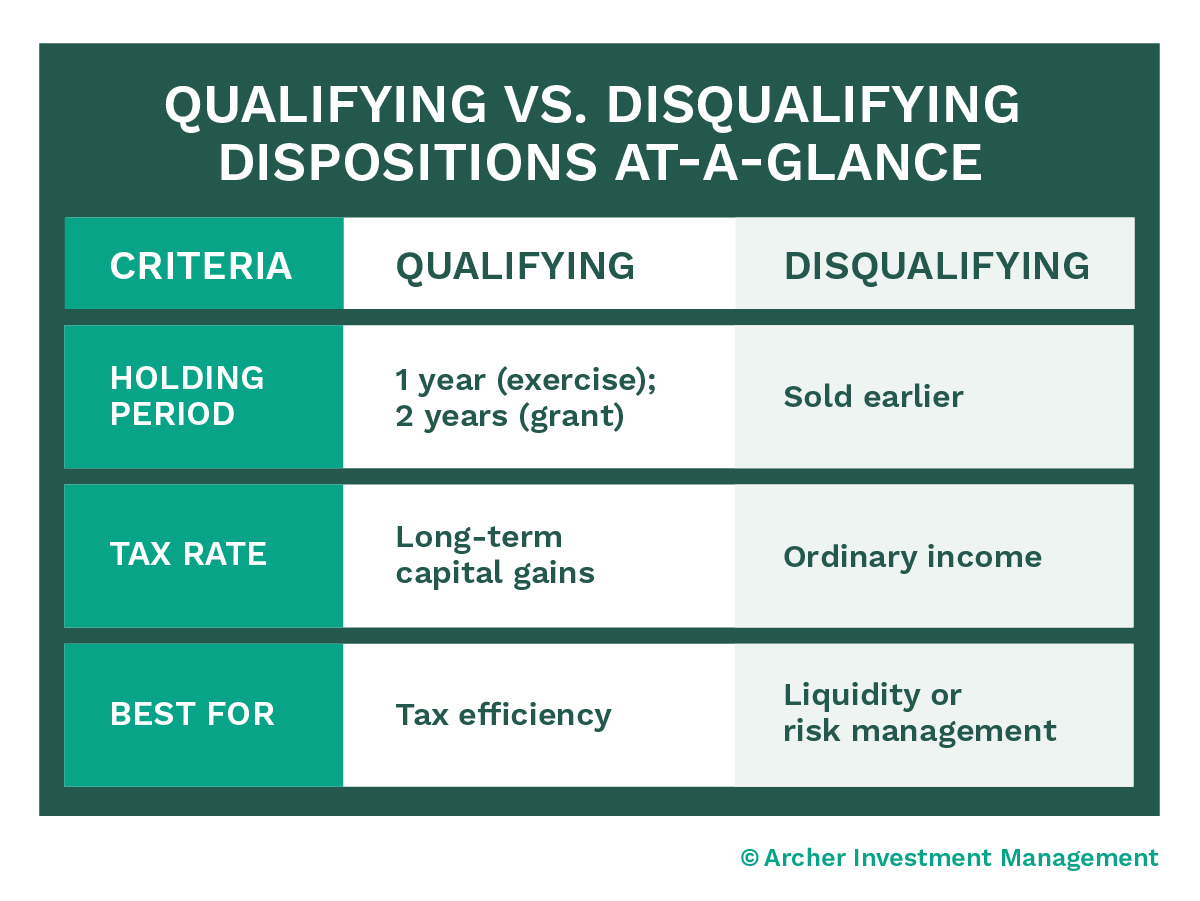
A qualifying disposition happens when you sell your ISO shares after meeting two specific holding period requirements:
1. At least one year after the exercise date (when you purchased the shares)
2. At least two years after the grant date (when you received the options)
When you meet both of these requirements, you’ll pay the lower long-term capital gains tax rate (0%, 15%, or 20%, depending on your income) instead of the much higher ordinary income tax rates.
Watch Out! Many people only focus on the one-year holding period after exercise. But don’t forget—you also need to hold them for at least two years after the grant date. Missing this second requirement could mean paying much higher taxes by triggering a disqualifying disposition.
A disqualifying disposition happens if you sell your ISO shares too early—before meeting the two holding periods.
When this happens, your profits are taxed at ordinary income tax rates, which can go as high as 37% for top earners. That’s a big difference from the lower rates when the sale is considered a qualifying disposition.
It’s exciting to hold stock in your company, but holding too much can be risky. If the stock price drops, your portfolio could take a big hit.
That’s why it’s important to think about your ISOs as part of a bigger picture and make sure your investments are well-balanced to protect your long-term financial health.
The difference between qualifying and disqualifying dispositions has a big impact on how much of your profit you get to keep after taxes.
Here’s the breakdown:
Let’s say you’re in the highest tax bracket. The difference between these rates could mean paying 17% more in taxes—potentially costing you tens of thousands of dollars, depending on how much stock you’re selling.
Struggling to untangle the best time to sell your stock? That’s exactly what we help our clients with every day. Schedule a call with us, and we can help you figure it out.
Even though disqualifying dispositions can come with higher taxes, there are times when they make good financial sense.
If you have immediate liquidity needs—whether for buying a house, paying for an emergency, covering education costs, or any other major expense—having money on hand might be more valuable than holding out for tax savings.
Selling early can also help reduce your financial risk.
For example, if you’re worried about your company’s performance, stock market swings, or your own job security, it could be smarter to sell some shares now and diversify your investments rather than waiting just to save on taxes.
Here’s a real-life example:
One of our clients, a Tesla employee, faced an unexpected layoff. They needed money quickly to relocate, buy a bigger home, purchase a second car, and prepare for a baby.
In this situation, selling the shares immediately—even with the higher tax hit—was the right move.
The immediate funds allowed them to meet their needs without unnecessary stress.
Let’s talk about the Alternative Minimum Tax (AMT), which can complicate ISO decisions.
If you exercise your ISOs but don’t sell the shares right away, you might owe AMT even though you haven’t made any money from selling them.
Here’s how it works: The IRS looks at the “paper gain”—the difference between the price you paid to exercise your options and the market value of the stock. Even if you’re just holding the shares, this paper gain can create a tax bill. It’s one more thing to factor in when planning your ISO strategy.
A paper gain is like potential profit. It’s the difference between what you paid for your stock when you exercised your options and what the stock is worth today.
Even though you haven’t sold the stock or made any real money, the IRS looks at this potential profit and might tax you on it with the Alternative Minimum Tax (AMT). It’s like being taxed on money you don’t actually have in your pocket yet!
(We often refer to this potential profit as “an “unrealized” gain).
There’s no one-size-fits-all answer for when to sell your ISO shares—it all depends on your personal situation and financial planning needs.
Remember, tax laws aren’t set in stone
Tax laws change, which could affect how you plan your ISO sales. Changes to capital gains tax rates or AMT rules might also impact your strategy.
Staying informed about these potential shifts by working with a CERTIFIED FINANCIAL PLANNER® is important so you can adapt your plan and avoid surprises.
To make informed ISO decisions, take a close look at your grant dates and exercise dates, calculating the tax impact of a qualifying versus selling early to trigger a disqualifying disposition, and consider any immediate liquidity needs. Your risk tolerance also shapes your approach.
Once you have a clear sense of your financial picture, set a timeline for exercising and selling your shares based on the current market and your company’s performance.
Working with a CERTIFIED FINANCIAL PLANNER® experienced in equity compensation can help align your ISO strategy with broader financial goals, while a tax professional can provide tailored advice for your situation.
Qualifying dispositions can be a great way to save on taxes, but they’re not always the right choice. The best decision balances tax savings with your personal needs and financial goals.
Sometimes, it’s worth paying a little more in taxes if it helps you meet a big life goal, reduce risk, or feel more financially secure.
Reach out to our team at Archer Investment Management to schedule a consultation.
We specialize in helping tech professionals make smart, confident decisions about their equity compensation.
Schedule a call with our team.
Editor’s Note: This article was originally published on August 15th, 2022. It has been updated to offer an expanded scope of the subject area.
Read More On Equity Comp From Our Team: