
Tag: options overlay strategy

A Pre‑IPO Planning Checklist for SpaceX Employees with Equity Compensation

pre-IPO equity planning
Key Takeaways:
  • Pre-IPO SpaceX planning starts with knowing exactly what you own, how concentrated you are, and what liquidity may or may not be available.
  • The biggest risks usually involve taxes, timing, and having too much of your net worth tied to one company before an IPO or tender window opens.
  • A strong plan should be built in stages, coordinated with the right advisors, and documented before emotions or tight deadlines drive decisions.

If SpaceX equity makes up a large portion of your net worth, pre‑IPO planning isn’t about optimizing returns, it’s about managing risk, taxes, and optionality before liquidity arrives.

This checklist reflects the most common issues we see among SpaceX employees as equity values grow and decisions become harder to reverse.

You don’t need to act on everything at once, but you do want to understand the full picture before a narrow liquidity window opens.

1. Inventory Your SpaceX Equity (Know What You Actually Own)

Before any strategy discussion, get clarity on the basics:

  • Number of shares owned (vested vs unvested)
  • Option types (ISOs, NSOs)
  • Exercise dates and prices
  • Cost basis and holding periods
  • Transfer restrictions or consent requirements
  • Exposure through prior tender offers or side vehicles

Many planning mistakes happen simply because this information isn’t centralized.

Talk to your financial advisor to understand how this applies to your personal situation.

2. Understand Your Concentration Risk

Ask yourself honestly:

  • What percentage of my net worth is SpaceX equity?
  • Is my income also tied to the company?
  • Would a significant decline materially change my lifestyle or plans?

If your career, income, and investments all depend on the same company, concentration risk is likely higher than it feels day‑to‑day.

3. Model Multiple Liquidity Scenarios (Not Just the IPO)

Pre‑IPO planning shouldn’t assume one outcome.

  • IPO sooner than expected
  • IPO later than expected
  • Partial liquidity via tender offers
  • Extended private period
  • Market‑driven valuation changes

Each scenario affects taxes, diversification timing, and risk exposure differently.

👉 Learn more about SpaceX IPO equity risk and taxes.

4. Review Tax Exposure Early (Before Decisions Are Forced)

Key questions to evaluate in advance:

  • What is my estimated capital gains exposure at IPO pricing?
  • How does AMT factor into my option history?
  • Would staged diversification materially reduce tax impact?
  • How does my state residency affect outcomes?

Tax strategies are far more effective before liquidity, not after.

5. Evaluate Diversification Tools (and Their Trade‑Offs)

Common strategies to consider pre‑IPO:

  • Holding a concentrated position for upside
  • Options overlays to manage downside risk
  • Section 351 exchanges for diversification with tax deferral
  • Exchange funds with long lockups
  • Charitable planning for highly appreciated shares

Each involves trade‑offs around control, liquidity, fees, and future taxes. There is no default “right” answer.

6. Stress‑Test Liquidity Needs

Ask:

  • How much true liquidity do I need in the next 1–3 years?
  • Do I have sufficient cash outside SpaceX equity?
  • Are upcoming expenses (home, taxes, family, lifestyle) funded?

Illiquid wealth creates stress, even when headline net worth is high.

7. Revisit Risk Tolerance Honestly

Risk tolerance often changes as numbers get bigger.

  • How would I feel if SpaceX represented 80%+ of my net worth at IPO?
  • Would volatility affect decision‑making or sleep?
  • Do I want certainty, flexibility, or maximum upside?

Planning should match behavior, not just math.

8. Coordinate Advisors Early 

Pre‑IPO planning works well when advisors collaborate before decisions are locked in.

  • Financial planner with equity‑comp expertise
  • Tax advisor familiar with stock‑based compensation
  • Legal counsel for transfer or fund structures

Misalignment between advisors often creates unnecessary cost and complexity.

9. Build a Staged Plan, Not a Single Bet

For most SpaceX employees, diversification works efficiently when approached in phases:

  • Pre‑IPO risk management
  • Initial liquidity event planning
  • Tax‑aware diversification over time
  • Post‑IPO portfolio construction

Optionality is often more valuable than precision.

10. Document the Plan (So Emotions Don’t Drive Decisions)

Finally:

  • Write down your assumptions
  • Define thresholds for action
  • Set expectations before emotions are involved
  • Revisit and update annually

When liquidity arrives, decisions may happen fast. The plan should already exist.

Final Thought

Being pre‑IPO at SpaceX is exciting—but it creates complexity many tech professionals rarely face.

Thoughtful planning ahead of liquidity can help you make more informed decisions, maintain flexibility, and reduce the risk of rushed choices. Regardless of when or how SpaceX ultimately goes public.

Our team of CERTIFIED FINANCIAL PLANNER® professionals (serving clients nationwide, virtually) works with SpaceX employees to help them understand their equity, explore their options, and build personalized financial plans around what matters most to them.

If a large portion of your net worth is tied to SpaceX stock, a thoughtful plan can help you think more clearly about taxes, liquidity, concentration risk, and what this wealth is meant to do for your life. 

Book a call to build a thoughtful plan for your SpaceX equity, so you can worry less about money and focus more on the life you are building.

This article is for general educational purposes only and is not individualized tax, legal, or investment advice. Tax rules are complex and can change, and outcomes depend on your specific situation. You should consult your CPA and/or attorney regarding your circumstances. Archer Investment Management is an SEC-registered investment adviser; registration does not imply a certain level of skill or training. Investing involves risk, including the possible loss of principal. 

3 Ways SpaceX Employees Diversify Before the IPO (2026 Update)

pre ipo equity
Key Takeaways:
  • Pre-IPO SpaceX employees have several ways to reduce concentration risk, but each strategy solves different trade-offs.
  • Section 351 exchanges, options overlays, and exchange funds all involve trade-offs around taxes, control, liquidity, complexity, and upside potential.
  • The right approach usually depends less on finding the “best” strategy and more on choosing the trade-offs that fit your goals, timeline, and risk tolerance.

Once SpaceX equity becomes a meaningful part of your net worth, diversification stops being a theoretical concept and starts feeling urgent.

In our work with pre‑IPO SpaceX employees, three strategies tend to come up most often when concentration risk becomes uncomfortable:

  • Section 351 exchanges
  • Options overlay strategies
  • Exchange funds

All three aim to reduce single‑stock risk—but they work in very different ways, with very different trade‑offs. Understanding those differences is critical before committing to any one approach. Let’s break them down.

Big Picture: Three Paths to Managing Concentration Risk

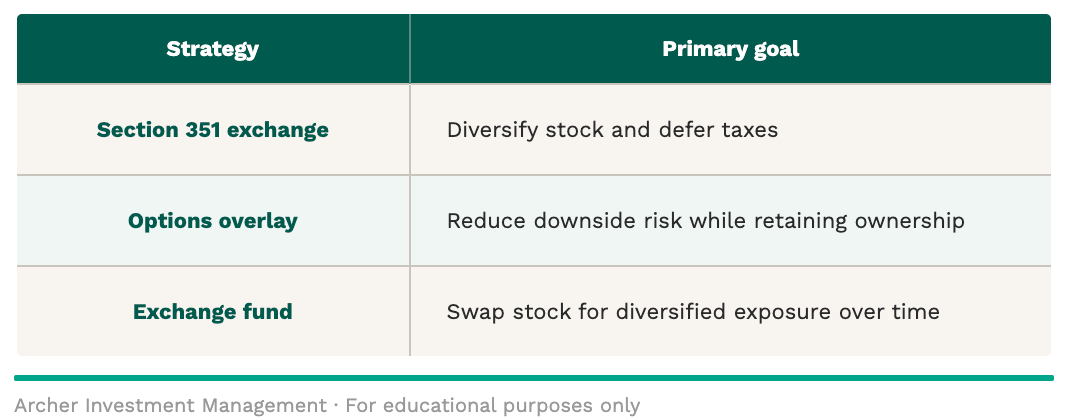
At a high level, these strategies answer different questions:None is universally “better.” Each fits different priorities around taxes, control, liquidity, and complexity, especially important considerations before an IPO.

SpaceX employee diversification strategiesNone is universally “better.” Each fits different priorities around taxes, control, liquidity, and complexity, especially important considerations before an IPO.

Talk to your financial advisor to understand how this applies to your personal situation.

Section 351 Exchanges: Structural Diversification with Tax Deferral

A Section 351 exchange allows you to contribute SpaceX shares into a newly created entity in exchange for ownership in a diversified investment vehicle—without triggering immediate capital gains taxes.

Best for pre‑IPO SpaceX employees who:

  • Have extremely low cost basis
  • Are comfortable with long lockups
  • Want immediate diversification
  • Prioritize tax deferral over flexibility

Key advantages

  • No capital gains tax at the time of exchange
  • Immediate reduction in single‑stock exposure
  • Professionally managed diversification

Trade‑offs

  • Loss of control over assets and tax timing
  • Multi‑year illiquidity
  • Meaningful fees and complexity
  • Deferred taxes still come due later

A Section 351 plan is often the most aggressive diversification tool, but also the least flexible.

Options Overlays: Risk Management Without Selling Stock

Options overlay strategies (such as collars or covered calls) use derivatives to define downside risk and/or generate income, while allowing you to continue owning your SpaceX shares.

For pre‑IPO employees, these are sometimes used when liquidity events are expected, but timing remains uncertain.

Best for pre‑IPO SpaceX employees who:

  • Want to retain ownership and control
  • Are comfortable with complexity
  • Expect future liquidity (IPO or tender)
  • Prefer incremental risk reduction

Key advantages

  • No sale of shares
  • Retains upside (to a point)
  • Can reduce volatility or generate income

Trade‑offs

  • No true diversification
  • Requires ongoing management
  • Costs can erode returns
  • May cap upside during major positive events

Options overlays manage risk, not concentration. Your net worth is still tied to SpaceX.

👉 Learn more about our financial planning work with high-earning tech executives, or read our broader guide to SpaceX IPO financial planning.

Exchange Funds: A Middle Ground—With Constraints

Exchange funds pool stock from multiple investors and allow participants to exchange their concentrated shares for interests in a broadly diversified fund.

Unlike Section 351 exchanges, many exchange funds are long‑standing vehicles with predefined structures.

Best for pre‑IPO SpaceX employees who:

  • Want diversification without selling
  • Can tolerate long lockups
  • Are comfortable with limited transparency
  • Don’t need near‑term liquidity

Key advantages

  • Diversification without immediate taxes
  • Exposure to a portfolio of other stocks
  • Familiar structure for many high‑net‑worth investors

Trade‑offs

  • Very limited liquidity (often 7+ years)
  • Less control over holdings
  • Fees and structural constraints
  • Concentration can still re‑emerge at exit

Exchange funds can feel intuitive, but they are not liquid solutions, and exits often arrive later and differently than investors expect.

How Pre‑IPO SpaceX Employees Typically Combine These Strategies

In practice, most SpaceX employees don’t choose just one. Instead, diversification tends to happen in stages, as liquidity options evolve:

  • Early career: tolerate concentration, build cash reserves
  • Pre‑IPO maturation: evaluate options overlays or partial transfers
  • Liquidity events: layer in direct sales and tax planning
  • Post‑IPO: reassess full portfolio diversification

Section 351 plans may play a role, but often alongside more flexible tools that preserve future optionality.

There’s No “Best” Strategy; Only the Right Trade‑Off For You

The most common mistake we see is evaluating these strategies in isolation. The real question isn’t: “Which strategy is best?” It’s: “Which set of trade‑offs am I most comfortable living with?”

For pre‑IPO SpaceX employees, trade‑offs around liquidity, control, taxes, and risk tolerance matter more than theoretical returns.

Our team of CERTIFIED FINANCIAL PLANNER® professionals (serving clients nationwide, virtually) works with SpaceX employees to help them understand their equity, explore their options, and build personalized financial plans around what matters most to them.

If a large portion of your net worth is tied to SpaceX stock, a thoughtful plan can help you think more clearly about taxes, liquidity, concentration risk, and what this wealth is meant to do for your life. 

Book a call to build a thoughtful plan for your SpaceX equity, so you can worry less about money and focus more on the life you are building.

This article is for general educational purposes only and is not individualized tax, legal, or investment advice. Tax rules are complex and can change, and outcomes depend on your specific situation. You should consult your CPA and/or attorney regarding your circumstances. Archer Investment Management is an SEC-registered investment adviser; registration does not imply a certain level of skill or training. Investing involves risk, including the possible loss of principal.