
Texas Inheritance Tax: What You Need to Understand
Key Takeaways:
- Texas has no inheritance tax or estate tax. Federal estate tax or other states’ rules may still apply to large estates or out-of-state property.
- Inherited assets may face federal tax later. Income, retirement account withdrawals, and sales can all trigger federal tax.
- Keep good records of what you inherit. Date-of-death values and appraisals help you report the step-up in basis correctly.
Receiving an inheritance often comes at one of the hardest times in your life. While you’re grieving someone you love, you may also be facing new financial decisions. One of the first questions many heirs ask is whether there’s a Texas inheritance tax.
Considering the stress families experience after a loss, this part should be simple. Unfortunately, that’s not always the case. Depending on what you inherit and what you do with it, you may still face taxes.
Do you owe tax because you received an inherited account? What about an inherited business or piece of property?
In the state of Texas, estate and inheritance tax laws are, thankfully, pretty straightforward.
But that doesn’t mean you’re free and clear from the tax impact of owning, managing, or selling inherited assets.
Federal tax rules, out-of-state connections, the type of account or asset you inherit, and when you sell can still affect what you need to report or plan for. Some of those choices can matter for decades to come.
Does Texas Have an Inheritance Tax?
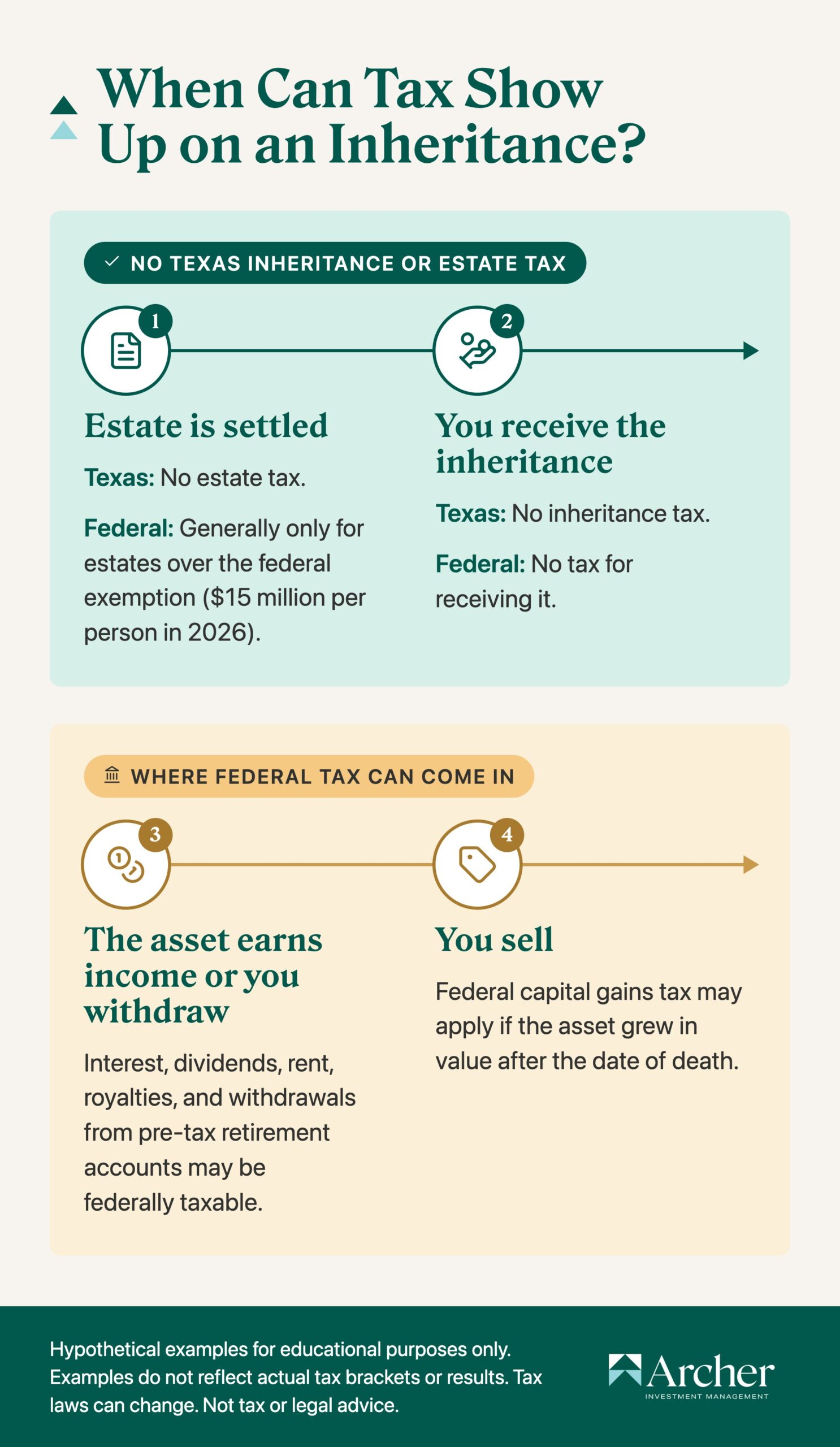
Since 2015, there has been no inheritance tax in Texas. There’s no Texas estate tax under current Texas law either, meaning neither beneficiaries nor the original estate is taxed during the wealth transfer process. At least, not at the state level. The federal estate tax may still apply to larger estates.
Texas is also one of a handful of states without personal income tax. If inherited assets generate income after the wealth transfer process is complete, the earnings won’t be subject to state-level income tax later on.
Overall, Texas is a fairly tax-friendly state. But Texas families may still face federal estate, income, and other taxes.
For example, some inherited retirement accounts will generate taxable income at the federal level, as well as other assets including rental properties, brokerage accounts, and business interests. Asset sales can also create federal tax.
If your family’s estate spans multiple states, other states’ inheritance rules could impact the tax treatment of an inheritance as well.
How Texans Should Separate the Main Tax Issues
Different taxes can apply at different moments: before, during, and after you receive an inheritance.
Rather than treat an inheritance as one singular tax issue, it’s more effective to separate the potential tax events and triggers into individual buckets.
Receiving an Inheritance
Generally, a beneficiary does not recognize federal income tax merely because they receive inherited cash, property, or investments. However, estate taxes, another state’s inheritance tax, or special tax rules applicable to certain assets may affect an inheritance
Inheritance Tax vs. Estate Tax
Inheritance tax and estate tax sound alike. Both can apply when assets pass to loved ones after a death. The key difference is who pays the tax and when.
Inheritance tax, in states where it’s applicable, applies to the person receiving assets (the beneficiary) after the inheritance has been distributed. Estate tax applies to the deceased person’s estate before heirs receive anything.
Let’s assume you are about to inherit a savings account worth $100,000 from your late father’s estate. His entire estate at the time of death is worth $600,000.
If inheritance tax applied, you would owe tax on the $100,000 you personally inherited from the estate. Other heirs would owe tax on the portion of the estate they each inherited as well.
If estate tax applied, your father’s estate would owe tax on the full $600,000. The estate would pay this tax before his heirs receive the rest. As an inheritor, you would not owe tax on the portion you inherited (unless both estate and inheritance tax applied).
These numbers are for illustration only. Estate taxes generally apply only to estates worth more than an exemption amount, so an estate this size would not owe federal estate tax.
Remember, there is no Texas inheritance tax or estate tax. However, estates exceeding the federal exemption limit may be subject to the federal estate tax. In 2026, the federal estate tax exemption limit is $15 million per person.
Married couples may be able to protect up to $30 million combined with the right planning. These limits can change. Currently, inheritance tax does not exist at the federal level.
Income, Sales, and Administrative Costs
Receiving an asset isn’t taxed, but what you do with it later can be.
If an inherited asset earns interest, dividends, rent, royalties, or business income, that income is generally taxable at the federal level.
Withdrawals from inherited pre-tax retirement accounts are too. And if you sell an inherited asset for more than its value on the date of death, you may owe federal capital gains tax.
Though inherited property in Texas is not subject to state-level inheritance or estate tax, administrative costs and other fees associated with the inheritance process may impact what heirs eventually receive.
Administrative costs will vary. The larger or more complex an estate, the more fees and associated expenses to expect. Depending on the will or any trusts, you may be able to pay these fees from the estate. You may also be able to pay yourself back for costs you covered out of pocket.
Common costs include:
- Legal work and lawyer fees
- Appraisals
- Title updates
- Court costs
- Executor expenses
- Property maintenance
These costs can reduce what heirs receive, but they aren’t Texas inheritance taxes. Many come up during probate, the court process for settling an estate under Texas probate law.
An estate planning attorney can explain which costs may apply to your family’s situation.
Federal Tax Rules for Texans With Inherited Assets
Once assets have been successfully transferred to inheritors, more taxes could apply even if inheritance or estate tax doesn’t.
When an inherited asset produces earnings or is sold for a profit, inheritors may owe federal income tax or capital gains tax (depending on the asset type).
Cash and Bank Accounts
Generally, cash in a traditional savings or checking account is one of the simplest assets to inherit. As with money in your own savings accounts, you’ll need to report any interest on your federal tax return each year.
Taxable Brokerage Accounts
Taxable brokerage accounts can hold a mix of investments, including stocks, bonds, mutual funds, and exchange-traded funds (ETFs). Simply inheriting these investments is not a taxable event for heirs.
However, the investments themselves will likely continue generating taxable income after the original owner dies. Several dividends, interest payments, or other payouts could come in between the date of death and the date the beneficiary officially takes ownership.
Who is responsible for reporting that income generally depends on when it was earned or received and who owned the account at the time.
Income received before the account owner’s death goes on their final income tax return. If the estate or a trust holds the investments when income comes in, the estate or trust may report it instead.
Once the account has been transferred to an heir, any new dividends, interest, and capital gains payouts from funds become the beneficiary’s responsibility to report.
Inherited Retirement Accounts
Inheriting a retirement account in Texas won’t create an immediate income tax bill, but taking money out of the account could. It all depends on the type of account.
Traditional Retirement Accounts
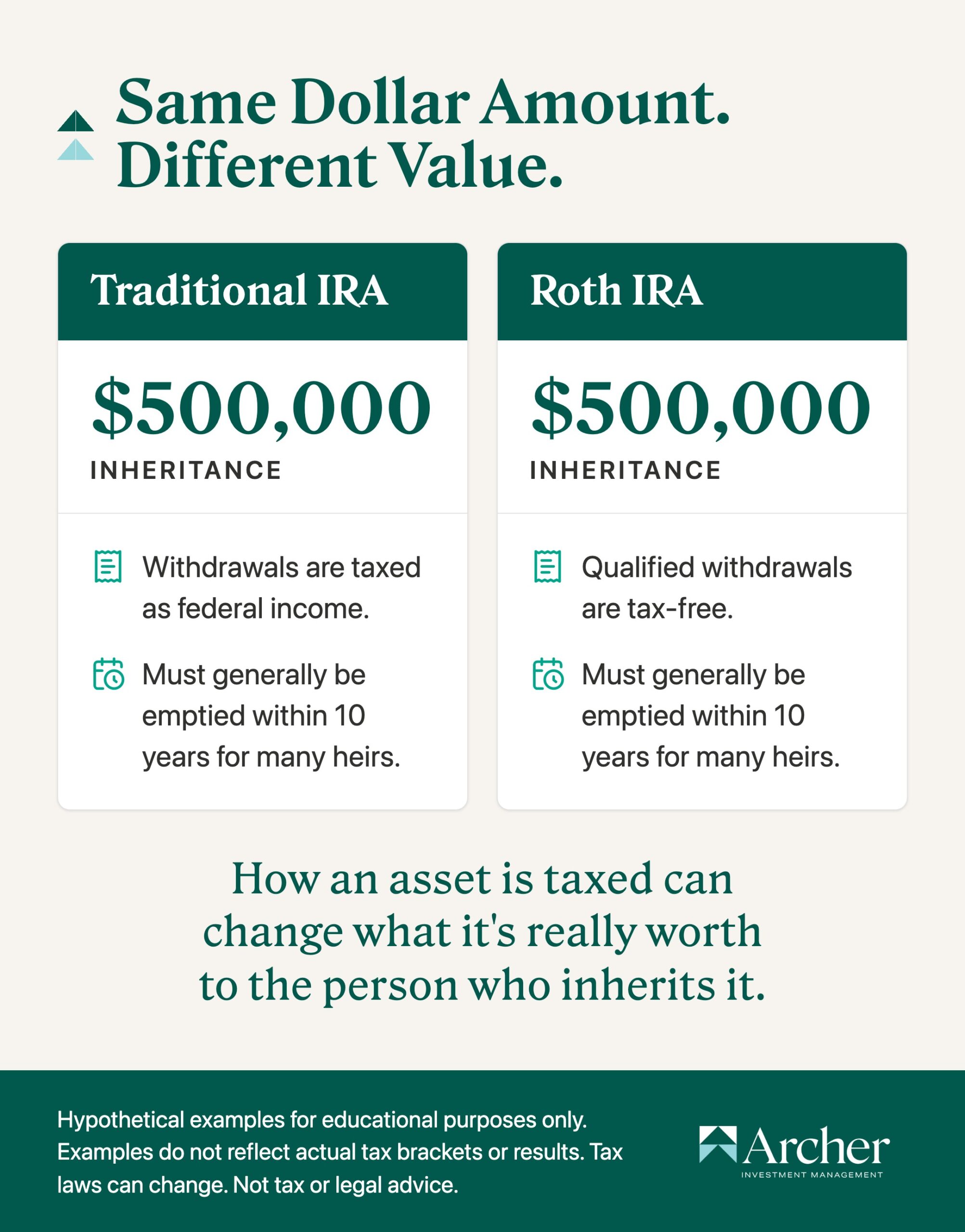
Traditional IRAs, 401(k)s, and similar accounts are “pre-tax” accounts. Because contributions and earnings in traditional retirement accounts are generally pre-tax, distributions are generally subject to federal income tax. Different treatment may apply if the account includes after-tax contributions or other basis.
Let’s say you inherit a traditional IRA worth $500,000 from a parent. Receiving the $500,000 account itself does not mean you’ve added $500,000 to your taxable income for the year.
If you later withdrew $20,000 from a fully pre-tax inherited IRA, that $20,000 would generally be included in your taxable income.
Roth Accounts
Inherited Roth accounts work differently. Because Roth contributions are made with after-tax dollars, withdrawals from an inherited Roth IRA or Roth 401(k) are tax-free, as long as they meet IRS rules.
To qualify for tax-free treatment, at least five years must have passed since the original owner first contributed to a Roth. If that hasn’t happened by the owner’s death, heirs can wait until the five years are up to take tax-free withdrawals of earnings. The basis (deposit amounts) are always available tax-free.
The exception is employer contributions, which have traditionally been made pre-tax and held in a separate part of the plan, so withdrawals from that portion may be taxable.
The 10-Year Rule
Under current federal rulings, many inheritors will need to empty an inherited retirement account within 10 years of the original owner’s death. Some beneficiaries will also have annual RMDs during years 1 through 9.
Exact requirements depend on the beneficiary’s relationship to the original owner, when the owner died, and whether the original owner had already started taking required yearly withdrawals.
The IRS explains the details in Publication 590-B.
Some inheritors who may be exempt from this rule include:
- Surviving spouses
- Minor children of the original account owner (until they turn 21)
- People with qualifying disabilities or chronic illness
- Inheritors who are less than 10 years younger than the original owner
Both traditional and Roth accounts are subject to the 10-year rule, though the tax impact is distinctly different.
Since withdrawals from traditional, pre-tax accounts are taxable, the 10-year rule can place a significant tax burden on inheritors.
That burden can be heavier if you’re already in a high tax bracket, like many tech professionals earning salary and RSU income.
Roth accounts that qualify for tax-free withdrawals still need to be emptied within 10 years by heirs subject to the rule. But since those withdrawals aren’t taxed, the tax impact is typically lower.
Rental Income, Royalties, and Business Distributions
Some inherited assets come with the potential to generate ongoing income. Even if you aren’t taxed when inheriting an asset or share, income produced after ownership is generally taxable.
Let’s assume you inherited a rental property from your grandparents. Taking ownership of the property does not cause its full value to become taxable income. If you keep collecting rent from tenants, you report that rental income on your federal tax return.
You can also deduct the costs of owning the property. Writing off the building’s wear and tear over time, called depreciation, is a whole separate tax topic we won’t get into here.
The same general concept applies to other income-producing assets. Inherited mineral rights could generate taxable royalty income, while ownership in a partnership, LLC, or closely held business can produce distributions or other income you need to report on your tax return.
Inherited business interests can be tricky. The money you receive and the income you report aren’t always the same.
Depending on how the business is set up, you may owe tax on your share of its income, even if that money stays in the business. Ownership may also come with new tax forms, more tax obligations, or other reporting requirements.
Why “Equal” Inheritances Aren’t Always Equal
How an asset is taxed impacts its total value for inheritors, which can make equal distribution of an estate more complicated to determine than many people realize.
For example, an income-producing property worth $500,000 carries more future earning potential than a savings account also worth $500,000.
Similarly, a retirement account allowing for tax-free withdrawals (like a Roth IRA) is more valuable than an account that produces taxable withdrawals (even if both accounts contain the same amount).
If you’re splitting an estate with siblings, or thinking about what you’ll leave your own kids, this is worth talking through before assets are divided.
Capital Gains When Texans Sell Inherited Assets
Selling an inherited asset is a separate tax event from receiving it. If the asset has grown in value since inheriting the asset, a sale will likely create a taxable capital gain.
Because Texas does not impose an individual state income tax, it does not separately tax an individual’s capital gains at the state level. Federal capital gains taxes can still apply and potentially reduce the amount an inheritor earns from a sale.
Two rules work in heirs’ favor here. Inherited assets are generally treated as long-term for federal tax purposes, no matter how long you own them before selling.
That usually means a lower tax rate than short-term gains. Selling costs, like commissions or real estate closing costs, can also generally reduce the gain you report.
Before assuming a sale is tax-free, compare the date-of-death value to the sale price and make sure your records back it up.
Date-of-Death Value and Basis
You may owe capital gains tax when you sell something for more than you paid for it. What you paid is called the cost basis. When assets or property are inherited, the cost basis resets to the asset’s fair market value on the original owner’s date of death.
This is known as the date-of-death value, and the act of adjusting the cost basis is called a step-up in basis. The step-up in basis can reduce the taxable gain when it comes time to sell.
Although many assets are eligible for a step-up in basis, certain investment, such as non-qualified annuities, may not be eligible for a step-up.
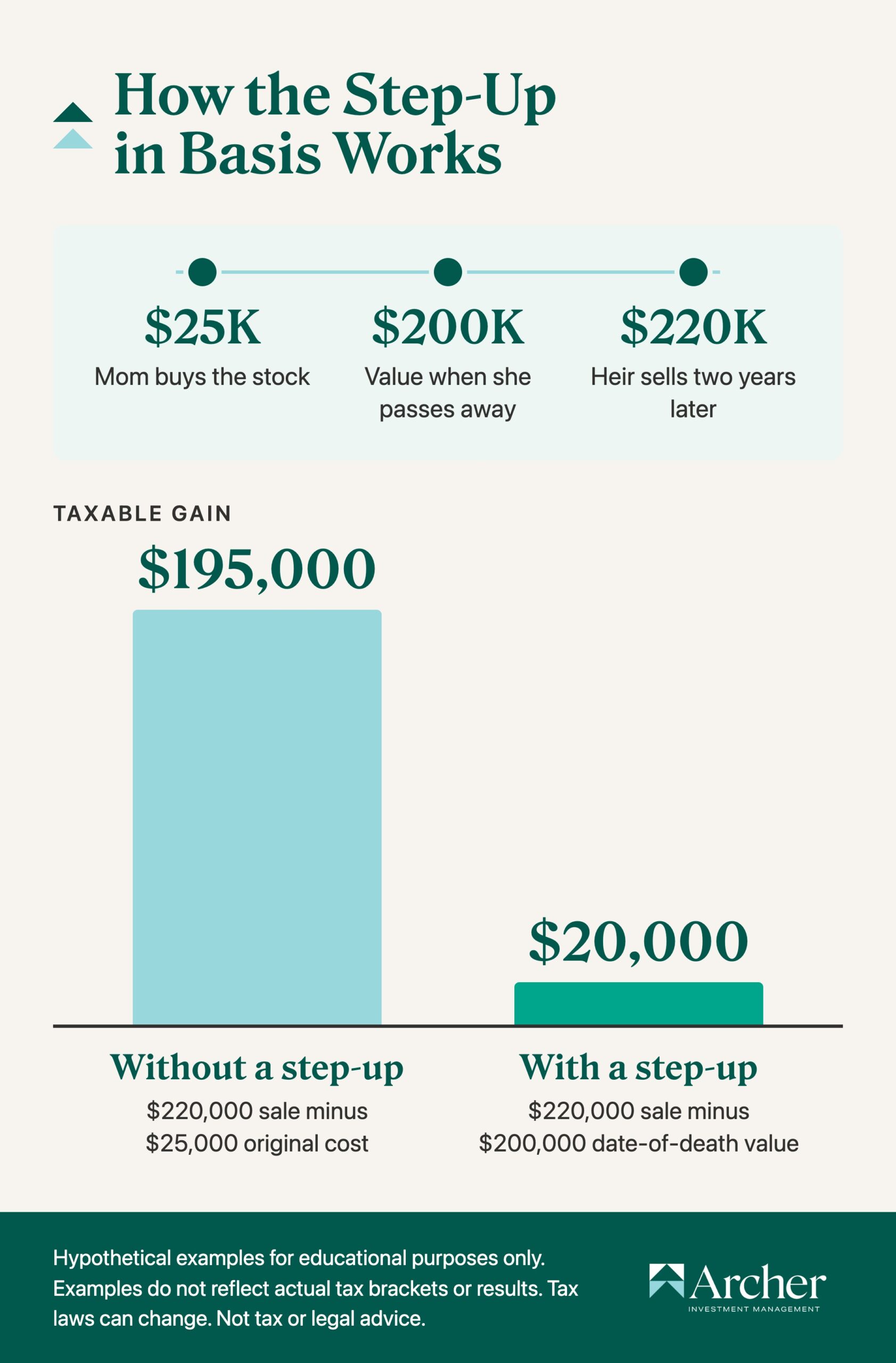
Let’s say your mother purchased stock decades ago for $25,000. By the time she passes away, it’s worth $200,000. You inherit the stock and decide to sell it right away.
Remember, the original cost basis was $25,000. If there were no step-up in cost basis, you would owe tax on the $175,000 in capital gains. Because the stock is inherited, the cost basis “steps up” to the date-of-death value, which is $200,000.
Now, barring any slight price fluctuations from the date of death to when the stock is sold, you would owe little to no capital gains tax on the sale.
But let’s say you decide to hold onto the stock for another two years before selling. Now when you’re ready to sell, the stock is worth $220,000. You’ll owe capital gains tax, but the step-up in basis still lowers the amount of gain you’re taxed on.
Rather than owe the full $195,000 in capital gains, you’re only responsible for paying tax on the $20,000 in profit generated since the stock was inherited.
A Texas Advantage for Surviving Spouses
Texas is a community property state, and that matters for married couples.
When one spouse dies, community property (generally, assets acquired during the marriage) may get a step-up in basis on both halves, not just the half that belonged to the spouse who died.
That can lower capital gains tax if the surviving spouse later sells the home, stocks, or other shared assets. How assets are titled and documented affects whether this applies, so review it with your tax professional and estate planning attorney.
Inherited Real Estate
Whether you inherit a family home, ranch, land, or rental property, you’ll have some details to sort out before deciding what to do with it.
First, you’ll need to establish the property’s value around the original owner’s death date. Unlike stocks, there’s no market price you can look up online. Instead, a qualified appraisal may be needed to document the property’s value.
Establishing this at the time a property is inherited will be important when calculating the capital gain or loss from an eventual sale.
In addition to obtaining an appraisal, take some time to research what exactly you’re inheriting.
Consider:
- Reviewing the property title for ownership issues or claims against the property
- Confirming current property taxes
- Finding out whether a mortgage or other debt remains attached to the property
- Gathering records related to the eventual sale
Depending on the property, there could be insurance, maintenance, repairs, or other ongoing expenses to consider as well.
Texas doesn’t have a state income tax, but property taxes can be a real ongoing cost.
Exemptions tied to your loved one, like a homestead exemption, may not carry over to you automatically. If you plan to keep the property, check with the county appraisal district to see what applies.
When you sell matters. If you sell soon after inheriting, the sale price is often close to the date-of-death value, so there may be little gain to tax. If you hold the property for years, any rise in value after the date of death may be taxable when you sell.
For a rental, the wear-and-tear write-offs you take while you own it can also affect the tax on a future sale.
Whether the plan is to sell immediately, keep the property in the family, or turn it into an income-producing asset, documenting its value and financial condition at the time of inheritance can make future tax decisions easier.
Inherited Investments
Investment accounts often contain dozens, even hundreds, of individual holdings. Each investment has its own step-up in basis, plus any activity after the death that needs tracking while the account is settled.
If your loved one held any private investments, these can be harder to value and keep records for.
Before selling off any part of an inherited portfolio, confirm through brokerage statements and tax documents that the step-up in basis information has been properly updated and recorded.
Assets With Debt, Depreciation, or Business Use
Inherited assets tied to a business, rental activity, or outstanding debt will come with more tax considerations. Unlike inherited cash or stocks, which are fairly straightforward, these assets’ eventual tax impact depends on how the asset was previously used, financed, and structured.
For example, an inherited rental or business property may have years of wear-and-tear write-offs that affect future tax reporting. With business interests, the ownership structure and terms of a future sale could add further complexity.
To figure out how to report the sale on your federal tax return, you’ll need to review the asset’s depreciation history, any debts, how ownership is set up, and the terms of the sale.
When Another State or a Larger Estate May Change Things
If a Texan lived in a different state or otherwise owned property outside of Texas at the time of death, Texas estate rules don’t necessarily exempt them from other state-level taxes.
In addition, large estates coming in at $15 million+ per person will require a federal estate tax review.
None of these are Texas inheritance or estate taxes. But where your loved one lived, where their property is located, how much the estate is worth, and what kinds of assets it holds can all change what needs to be reviewed.
Inheritances From Non-Texas Residents
Living in Texas doesn’t mean an inheritance will fall solely under Texas tax rules. If the person who passed away lived in another state or owned property elsewhere, that state’s estate or inheritance tax laws may apply.
Some states impose a state estate tax, a state inheritance tax, or both. Estate tax rates and inheritance tax rates vary from state to state. The rules can depend on where the deceased person lived, where certain assets are located, and what the beneficiary’s relationship to the deceased was.
Out-of-State Real Estate
Real estate generally falls under the rules of the state where it’s located.
That means a Texas heir who inherits a vacation home in another state may need to follow that state’s rules, and in some cases go through a separate probate process there, even if their loved one lived in Texas.
If your inheritance involves property held across state lines, review the other state’s rules and filing requirements before the estate is settled. Local title requirements, local taxes like property taxes, and state-specific estate or inheritance rules can all affect the transfer or sale process of inherited assets.
Larger Estates
An heir won’t owe federal estate tax personally, since the tax applies to estates, and generally only to estates over the $15 million exemption limit after accounting for large lifetime gifts.
However, any estate tax paid to the federal government reduces how much passes to heirs. The process of determining and paying estate tax can also delay the final distribution of assets to heirs.
Determining the full value of a large estate, and its estate tax exposure, can be difficult and time-consuming. Bank and retirement accounts are fairly easy to value.
Real estate, business interests, private investments, and insurance payouts may need to be valued by a professional. Charitable gifts and transfers to a surviving spouse may also affect the taxable estate.
Lifetime gifts matter here too. Under federal estate tax rules, large gifts made during your loved one’s life can count against the same lifetime exemption, which is why gift tax and estate tax are often reviewed together.
During this process, an estate might have substantial value tied up in assets that aren’t easily converted to cash. If taxes or other bills come due, executors may need to find cash without disrupting their loved one’s estate plan.
Records Texans Should Review Before Making Tax Decisions
When you receive an inheritance, it might be tempting to start making decisions right away.
Maybe you’re looking to sell investments immediately, transfer property, consolidate accounts, or take distributions from an inherited retirement account.
Before making any big moves, take time to gather and review the records associated with the inheritance first. Missing records can lead to cost basis errors, surprise taxes, and delayed sales.
They can also leave heirs unsure how to handle an asset.
Asset Values and Account Details
Solid recordkeeping now can make it easier to determine cost basis, report income, calculate capital gains, and otherwise understand the tax implications of a future withdrawal or sale.
Depending on what you inherit, obtain records including:
- Date-of-death valuations and appraisals
- Brokerage statements
- Retirement account documents
- Property records
- Business agreements
- Previous year tax returns
- Outstanding debts or liabilities
- Forms naming who inherits each account
- Purchase and sale documents
Without reliable documentation of an asset’s value at the time of death, determining the correct gain or loss years later can become much more difficult.
The same goes for inherited retirement accounts. Details including beneficiary information, the original owner’s age and distribution history, and details about the account itself can all help determine which distribution rules apply and when money must be withdrawn.
Income and Distribution Forms
Inherited assets will likely keep earning income while the estate is settled. Keep records of when income came in and who was entitled to it.
Relevant documents include:
- Forms reporting interest and dividends
- Retirement account distributions
- Estate or trust income
- Partnership income
- Rental income
- Record of royalties
- Business distributions
Depending on the type of asset and income produced, you may also encounter tax forms including 1099s or K-1s.
These records should help you determine whether income gets reported on the original owner’s final return, an estate return, or your own. Staying organized should also make it easier to identify any income generated during the transition.
Timing Before Major Decisions
Gathering documents first gives you, your executor, and your advisors a stronger starting point.
Some decisions are hard to undo. Before making any of these moves, look at the tax impact first:
- Selling inherited real estate
- Selling inherited investments
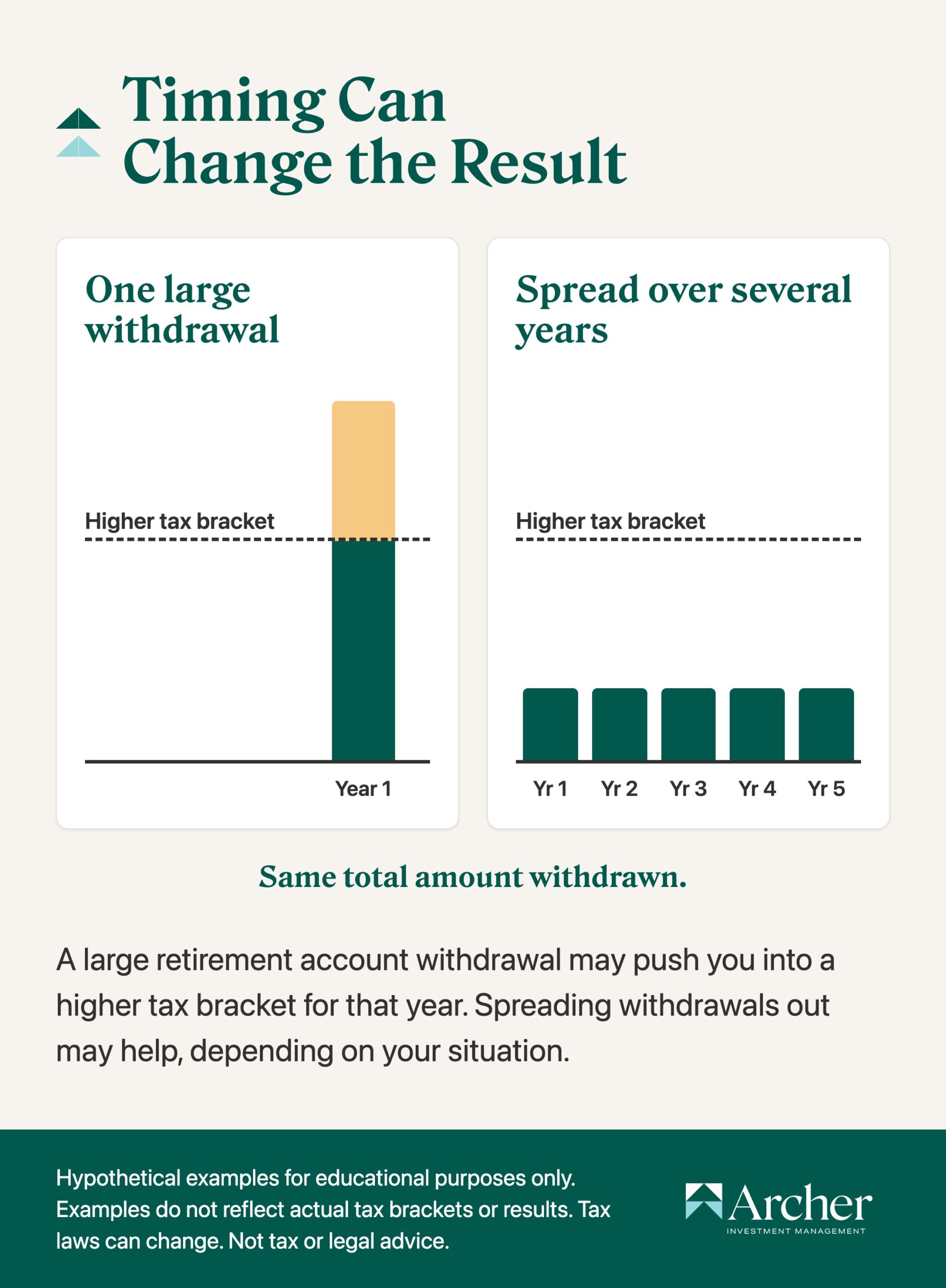
- Taking a large lump-sum withdrawal from an inherited retirement account
- Dividing complex assets, like a family business or shared land, among heirs
Timing can change the result. A large retirement account withdrawal may push you into a higher tax bracket for that year.
A big sale may mean you need to make estimated tax payments. And the cash you free up can change how your investments and overall financial plan should look.
Talking it through with your financial advisor and tax professional first gives you room to spread out income, plan for tax bills, and choose what fits your goals.
Texas Inheritance Taxes FAQs
Does Texas have an inheritance tax?
No. Texas repealed its inheritance tax in 2015, and it does not have an estate tax.
How much can you inherit in Texas without paying taxes?
There’s no state limit, since Texas doesn’t tax inheritances. At the federal level, estate tax generally applies only to estates worth more than $15 million per person in 2026, including certain lifetime gifts, and the estate typically pays it, not the heir.
Income from inherited assets and withdrawals from inherited pre-tax retirement accounts can still be taxed federally.
Do beneficiaries pay taxes on inherited money in Texas?
Not at the state level. Texas does not tax beneficiaries for receiving inherited money. They may, however, owe ordinary income tax on future earnings (including interest and dividends) from inherited assets or accounts.
What is the difference between inheritance tax and estate tax?
Inheritance tax is paid by an inheritor on the specific assets they receive as part of an inheritance. Estate tax applies to the deceased’s estate and is paid by the estate before assets are distributed to heirs.
Can another state’s tax laws affect a Texas inheritance?
Yes. If the person who died lived in another state or owned property there, that state’s estate, inheritance, property, or other tax rules may apply. Whether tax is due depends on that state’s law, the type and location of the property, and the beneficiary’s relationship to the deceased.
Do heirs owe federal capital gains tax when they sell inherited property?
Heirs will generally owe federal capital gains tax when selling inherited property if the property has increased in value since the original owner’s date of death.
Gains are generally measured from the property’s value on the date of death, not the date it was transferred to the heir.
Are inherited IRAs or 401(k)s taxable to Texas beneficiaries?
Not at the state level. Texas does not tax inherited IRAs and 401(k)s. However, withdrawals from inherited pre-tax retirement accounts are subject to federal income tax.
What records should heirs keep after receiving an inheritance?
Heirs should keep records of what they inherited, its value at the time of inheritance, and income or activity that occurred afterward.
Documents could include date-of-death valuations and appraisals, brokerage and retirement account statements, property records, business documents, tax forms, estate or trust distributions, and records of any debts tied to the inherited assets.
Build a Clearer Tax Plan After a Texas Inheritance
Texas doesn’t tax you for receiving an inheritance. But federal rules on income, retirement account withdrawals, and capital gains can still shape what that inheritance is worth to you.
Beyond tax considerations, an inheritance can make a huge, lasting impact on your life. It can potentially change your investment portfolio or even reshape your goals around retirement.
Before you make any big moves, look at how each decision fits into your broader financial life. An inheritance can also be a good moment to think about your own legacy.
Starting your own Texas estate planning now gives you a say in what you pass on to future generations and how.
A little financial planning upfront gives you time to think through decisions, which may lower the chance of rushed choices or unexpected tax bills.
It can also give you a clearer view of which assets make sense to keep, which may be better to sell, and how your inheritance fits into the plans you already have in place.
If you’ve recently inherited money or property, or expect to, you don’t have to sort it out alone.
We can help you organize what you received, look at the tax impact of selling, holding, or withdrawing, and coordinate with your CPA and estate planning attorney so everyone is working from the same plan.
Schedule a complimentary consultation to talk through your inheritance and what your next steps might look like.
Disclosure: This material is provided for general educational and informational purposes only and should not be construed as individualized investment, tax, or legal advice. Tax laws and regulations are complex and subject to change, and their application depends on individual circumstances. Archer Investment Management does not provide legal or tax advice. Examples are hypothetical and are provided for illustrative purposes only. Consult a qualified tax professional and estate planning attorney regarding your specific circumstances.